
Juicing celery on holiday
You mainly want to juice celery and are looking for a machine that fits your preparation routine, rather than basing your choice on general claims about healthier juice.


If celery is your main ingredient, start by comparing slow juicers and check each model’s instructions for feeding in the stalks and cleaning the parts. A centrifugal juicer may suit you if you mainly want to juice a variety of firm fruit and vegetables quickly, but according to the Consumers’ Association it is less suitable for some leafy greens and is often noisier.
You mainly want to juice celery and are looking for a machine that fits your preparation routine, rather than basing your choice on general claims about healthier juice.
You’re taking the juicer with you, so you’re considering its size and weight, as well as the space its separate parts take up and need for drying.
You also make juice with other ingredients and weigh up the preparation time per glass against noise and cleaning.
The Consumers’ Association says slow juicers are suitable for a wider range of ingredients, including leafy greens. For celery, also check the instructions for the exact model and what facilities are available at your holiday cottage.
| What to consider | What should you check? | Who is this important for? |
|---|---|---|
| Processing celery | Check the instructions for the exact model to find out how to prepare and feed in celery stalks. | I want to juice celery without relying on general claims about yield; around 33% of consumers prioritise processing celery. |
| Transport and space | Compare the dimensions and weight, and allow for the collection containers and separate parts too. Hurom lists the H310A as measuring 16 × 17,2 × 39,5 cm and weighing 3,4 kg. | If I’m taking the machine with me and have little cupboard space, I want to know how much room everything takes up together; around 27% of consumers make transport and space their top priority. |
| Cleaning | Check which parts can be removed and are dishwasher-safe, and whether there’s a dishwasher at the cottage. | I want to do as little washing up by hand as possible after juicing; around 27% of consumers prioritise cleaning. |
| Speed and versatility | Compare the ingredients each type of juicer is designed for, and consider noise and how easy the sieve is to clean. A manufacturer’s speed claims don’t tell you how quickly it will make your recipe. | If I also want to make juice quickly from other ingredients during my stay, I weigh up that preference against noise and suitability for leafy greens; around 13% of consumers prioritise speed and versatility. |
The Consumers’ Association warns that general claims about more vitamins or minerals don’t automatically prove that juice from a slow juicer is healthier. Juicing also leaves some of the fibre behind in the pulp.
Choose a type of juicer based on the ingredients you want to process, the preparation involved and the cleaning. The Nutrition Centre recommends eating vegetables and fruit rather than drinking them.
A wide opening can reduce the amount of chopping you need to do, but it doesn’t tell you how many parts you’ll need to take apart and clean after use.
Check which parts need cleaning after one glass of juice and which, according to the product description, can go in the dishwasher.
Also allow for the time it takes to dismantle, clean and dry the machine after use.
A Joybuy listing named Unold 48880 describes the product as a slow juicer, while Unold lists model 48880 as an ice cream maker. The product title alone is therefore not a reliable way to identify the product.
Before buying, compare the full model name and product specifications with the manufacturer’s information. Don’t treat conflicting details as confirmation that it’s a juicer.
The H310A is worth considering if you’re looking for a compact slow juicer to take with you.
The HR1889/70 is a slow juicer to include in your comparison if you’re also looking at removable parts.
The J 500 BK is a centrifugal juicer to compare if you mainly want to juice a variety of fruit and vegetables quickly.
The Slow Juicer Sam, article number 78275, is a compact slow juicer you can compare by its specifications.
This Joybuy selection includes slow juicers for fruit and vegetable juice, with celery specifically mentioned in one product description. Compare the model instructions and the space needed for the machine and its separate parts.
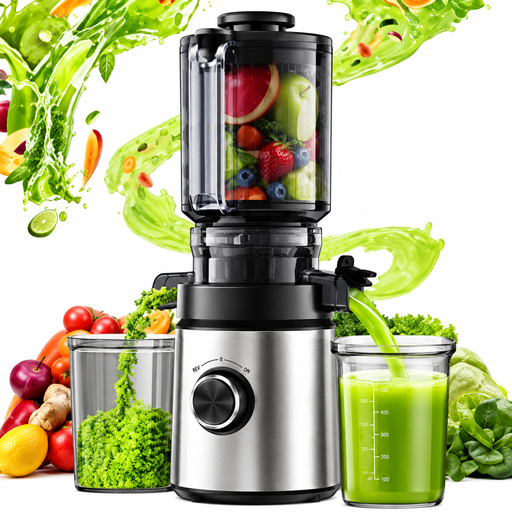 No image available
The product name describes this model as a slow juicer for fruit and vegetables.
The product name specifies a 130 mm XL feed chute and a 2 l capacity.
 No image available
The product description mentions celery and recommends cutting fibrous vegetables into 3–4 cm pieces; follow the instructions for this specific model.
Listed dimensions: 189 × 170 × 395 mm; weight: 2,3 kg; juice jug: 600 ml.
The product name lists an 836 ml pulp container. The description states a maximum of 10 minutes’ continuous use, followed by a 20-minute rest.
Yes, if a smoothie suits you better than clear juice: blending keeps more of the vegetables, including the fibre, in your drink. The Nutrition Centre recommends eating vegetables and fruit rather than drinking them.
Wash the celery under running water and use clean kitchen utensils, as recommended by the Nutrition Centre. Cut the stalks according to your juicer’s feeding instructions and follow the manual for assembly, operation and cleaning.
For a consumer purchase in the Netherlands, the seller must offer a solution, according to ACM ConsuWijzer, if the product doesn’t do what you can reasonably expect of it during normal use. A manufacturer’s or extended warranty doesn’t replace this legal right.
According to ACM ConsuWijzer, when you buy a product online, you generally have a statutory cooling-off period of up to 14 days after delivery. The cooling-off period is a separate right from your warranty rights if a product is faulty.