
Vandaag of morgen in huis

Kwaliteit gegarandeerd

Welkomstaanbiedingen ontgrendelen: GRATIS bezorging | Tot 80% korting | Gratis 30 dagen JoyPlus-proefperiode
Download de app
A juicer can be handy for fresh fruit juice, vegetable juice or a citrus drink with breakfast. However, appliances vary considerably in how they work, their capacity and how easy they are to clean. A compact citrus press, for example, is suitable for oranges and grapefruits, while a centrifugal juicer can also process harder vegetables and pieces of fruit.
Choosing the wrong appliance can leave you with something that takes up too much space, is difficult to clean or isn’t suited to the quantities you want to prepare each day. So don’t focus only on the wattage or an appealing product name. Pay particular attention to the design, capacity and accessories.
A higher wattage doesn’t automatically mean a juicer is more pleasant to use. The power rating should suit the type of appliance and the ingredients. A 25-watt electric citrus press is designed for citrus fruit and works differently from a fruit and vegetable juicer with a stainless steel sieve.
So check:
With a food processor that includes a juicer, the motor, drive mechanism and supplied accessories also play a part.
A large jug may seem appealing, but a high-capacity juicer takes up more space and can be harder to clean. Around 0.7 litres may be enough for one person. Families may prefer a 2-litre collection container or a food processor with a mixing bowl that holds several litres.
Look out for the difference between:
You’re less likely to use a juicer if it has lots of small parts to deal with after every use. Check whether the sieve, jug, pressing cone and other removable parts come apart easily. Parts listed as dishwasher-safe in the product description can make cleaning easier. The motor base must not be immersed in water.
If you’re looking for an easy-to-clean juicer, don’t rely on the term “easy clean” alone. Check which parts are actually dishwasher-safe and whether the stainless steel sieve is easy to reach.
A centrifugal juicer grates ingredients against a sieve and separates the juice from the pulp. This type is handy if you regularly want to process different kinds of fruit and vegetables. A citrus press uses a pressing cone and is mainly suited to oranges, lemons and grapefruits.
A slow juicer generally uses a different extraction method and a lower rotational speed. If you’re looking for an alternative to a slow juicer, you could consider a centrifugal juicer if speed and ease of use matter more to you than a particular preparation method. Always check which ingredients are suitable according to the product information.
A stainless steel filter or sieve is practical for frequent use and can feel sturdy. Also check the quality of the plastic parts, how the jug is secured and how stable the base is. For a citrus press, the pressing cone, non-slip base and measuring marks on the jug are also worth considering.
Measure the available worktop space before you order. An appliance that’s around 40 cm tall won’t fit under every kitchen cupboard. A cord wrap or cord storage can be useful if you keep your juicer in a cupboard.
Also consider the noise level. Not all retailers list a decibel rating. If they don’t, you can’t compare this feature objectively, so it’s best not to assume that quiet operation is a guaranteed benefit.
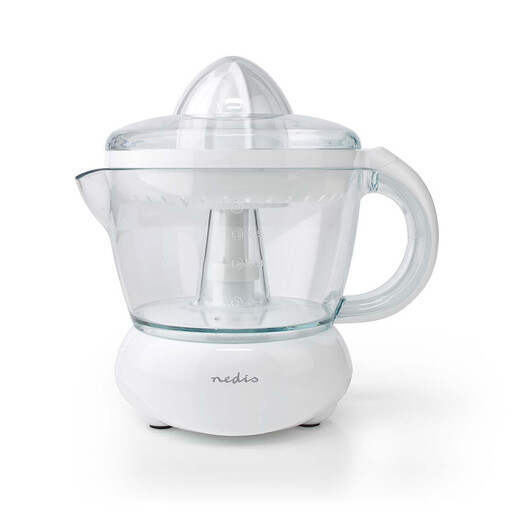
Why it suits these needs: This compact model is designed for citrus fruit and everyday use with smaller quantities. The jug holds around 0.7 litres and, at 19 cm tall, takes up relatively little space.
Its purpose is clear: this is an electric citrus press, not a fruit and vegetable juicer. That means you won’t buy an appliance with features you don’t need.
25 watts, automatic rotation to the left and right, a removable jug and measuring marks.
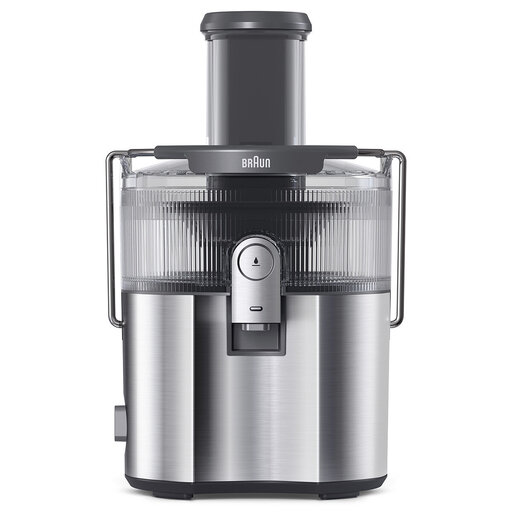
Why it suits these needs: This centrifugal juicer is designed for people who want to make a variety of fruit and vegetable juices. The product information lists a 2-litre collection capacity and two speeds.
The specifications give you more information than just the power rating: it has two speeds, a stainless steel sieve and parts listed as dishwasher-safe in the product description.
Listed power rating of 1,000 watts, 2-litre capacity, cord storage and a stainless steel filter.

Why it suits these needs: This food processor is suited to households that want to prepare dough, smoothies, chopped vegetables and mince as well as juice. The stainless steel mixing bowl has a capacity of 3.9 litres.
You won’t need to buy a separate juice extractor if you need several kitchen functions. Before buying, check the accessories supplied and the exact motor power rating: the product information provided lists both 900 watts and 450 watts.
3.9-litre mixing bowl, blender, citrus press, meat grinder and vegetable slicer, according to the product description.
We’ve put together a complete, up-to-date list of products that meet these strict selection criteria and current European safety requirements.
Usually not. A citrus press is designed for citrus fruit such as oranges, lemons and grapefruits. For carrots, apples, cucumber or leafy greens, you’ll generally need a centrifugal juicer or another type of fruit and vegetable juicer. Always check the ingredients list and instructions for the model you choose.
Its lifespan depends on how often you use it, how well you clean it and how hard you push it. Don’t overload the motor, follow the maximum operating time and clean the sieve straight after use. The product information for the appliances mentioned states that they come with a legal guarantee of at least two years under the applicable EU consumer rules. This is a guarantee period, not a fixed lifespan.
Energy use depends on the power rating and how long you use the appliance for. A 25-watt citrus press uses little energy during brief use. A more powerful model has a higher power rating, but is usually only switched on for a few minutes. You can estimate consumption using this calculation: power in watts divided by 1,000, multiplied by the number of hours of use. Also follow the advice to switch the appliance off and unplug it after use.
