
Vandaag of morgen in huis

Kwaliteit gegarandeerd

Welkomstaanbiedingen ontgrendelen: GRATIS bezorging | Tot 80% korting | Gratis 30 dagen JoyPlus-proefperiode
Download de app
A juicer can be useful if you regularly want to make juice from apples, carrots, cucumber or leafy greens. However, a high wattage rating alone is not automatically a good reason to buy a particular model. The real difference often lies in the feed chute, collection capacity, ease of cleaning and how the appliance handles hard or soft ingredients.
If you are looking to buy a juicer, it is worth avoiding these three common pitfalls:
An electric juicer with around 1000 watts is worth considering for households that regularly process hard ingredients such as carrots, apples and beetroot. However, power should be considered alongside the number of settings. With two speeds, you can adjust the appliance more effectively for softer fruit and firmer vegetables.
Also check the recommended operating time in the manual. A powerful motor is not designed to run continuously without a break. Allow the appliance to cool down whenever the manufacturer instructs you to do so.
A juicer with a wide feed chute reduces the amount of chopping required. According to the product specifications, the Bosch MES4000 has an 84 mm opening. The Philips HR1919/70 has an 8 cm feed tube. This is practical for larger pieces of fruit, but ingredients still need to be washed, checked and prepared appropriately.
You should also consider two different capacities:
A large collection container is particularly useful for families. For one glass a day, a more compact design may be more convenient on the worktop.
The sieve partly determines how much pulp ends up in the juice and how much cleaning is required. A stainless-steel sieve is a common choice. According to the product information, the Bosch MES4000 uses a ceramic blade and an electro-polished stainless-steel sieve. The manufacturer says this is designed to make removing residue easier; treat this as a product claim and check the care instructions for your own use.
An easy-to-clean juicer should ideally have:
Always check whether only the removable parts may be placed in the dishwasher. The motor base must not be immersed in water. Sharp blades and sieves should also be switched off, unplugged and handled carefully.
The recommendations below are based on verifiable product specifications such as power, feed chute, capacity, speed settings and maintenance. Brand claims about juice yield, noise levels or texture are presented as claims made by the manufacturer.
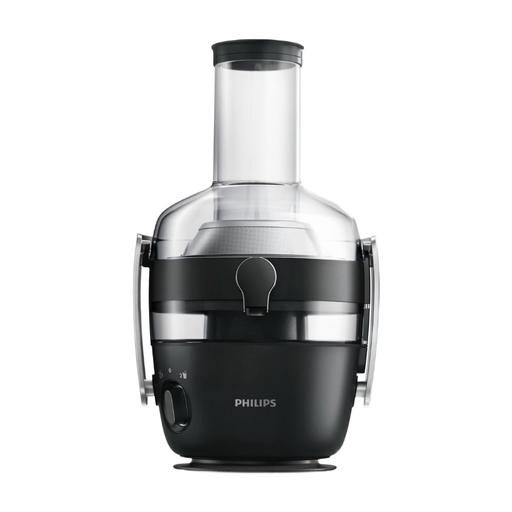
Why it suits this profile: The 1000W motor, 8 cm feed tube and built-in pre-cleaning function are practical for anyone who wants to get started with fruit and vegetable juice without complicated settings.
The wide feed chute reduces preparation and chopping. According to Philips, the round shape, QuickClean function and dishwasher-safe removable parts are designed to make maintenance easier.
1000 watts, 8 cm feed tube, drip stop and adjustable fibre texture according to the product information.
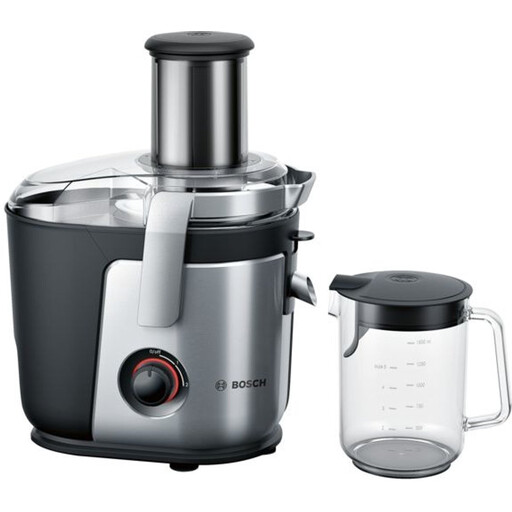
Why it suits this profile: This model is designed for households that process larger quantities. The 1.5-litre juice jug and 3-litre pulp container provide plenty of room for several portions.
The 84 mm opening reduces the need to chop ingredients into small pieces. Automatic shut-off if the appliance is opened incorrectly helps ensure safe use, but it is still essential to assemble it according to the manual.
1000 watts, two speeds, ceramic blade, 1.5-litre juice jug and dishwasher-safe removable parts according to the product information.
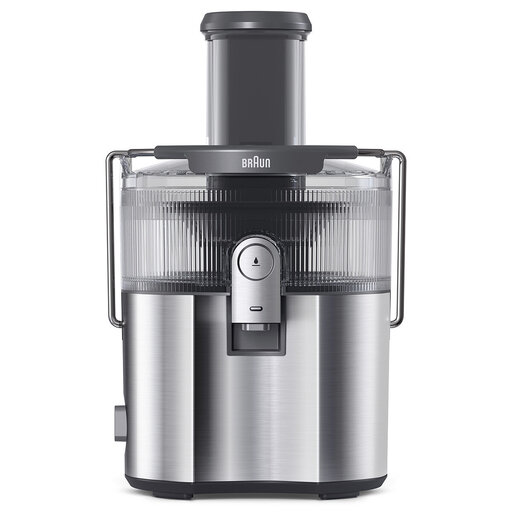
Why it suits this profile: For regular use, the two speeds, stainless-steel sieve, cable storage and 2-litre capacity are useful practical features.
According to the product information, most parts are dishwasher-safe. This can reduce the effort involved in cleaning after intensive use, although the motor base must be cleaned by hand.
1000 watts, two speeds, 2-litre capacity, stainless-steel sieve and cable storage according to the stated specifications.
We have put together a complete, up-to-date list of products that fully meet these strict selection criteria and the applicable European safety regulations.
Yes. Power and a suitable speed setting are important for this. According to the stated specifications, a 1000-watt model with two settings, such as the Bosch MES4000 or Braun MultiJuice 7, can be used for hard ingredients. Cut very large or hard pieces into smaller pieces if necessary and follow the manual.
Its lifespan depends on how often it is used, cleaning, storage and correct assembly. Overloading, a damaged sieve or ignoring the recommended operating time can accelerate wear. Check the sieves and locking mechanisms regularly, and do not use the appliance if any parts or the power cord are damaged.
You can calculate the electricity consumption using: power in kilowatts × operating time in hours × your electricity tariff. A 1000-watt appliance running for ten minutes theoretically uses around 0.167 kWh. The actual cost depends on the operating time, the tariff and how often you use the appliance. You also need to factor in the cost of fruit and vegetables and, potentially, water for cleaning.
