
Vandaag of morgen in huis

Kwaliteit gegarandeerd

Welkomstaanbiedingen ontgrendelen: GRATIS bezorging | Tot 80% korting | Gratis 30 dagen JoyPlus-proefperiode
Download de app
A juicer can make fruit and vegetable juice in next to no time, but not every appliance suits the same kitchen or frequency of use. For example, a high motor power rating does not automatically mean you will get more juice. A wide feed chute can also be less practical if the parts are difficult to clean.
Pay particular attention to the design, capacity and everyday operation. Below, you can read about the common pitfalls that are often overlooked and which models suit different types of users.
A 1,000-watt motor sounds powerful, but the result also depends on the filter, blade, speed settings and how the appliance processes soft and hard ingredients. An electric juicer with several settings may be better suited to different types of fruit and vegetables than a model with a high wattage rating alone.
So check:
A juicer with a wide feed chute can reduce preparation time. You will not need to cut ingredients into such small pieces. However, citrus fruit will usually still need to be peeled and hard stones removed. Long, fibrous vegetables are also best cut into pieces.
Do not just look at the diameter of the feed chute. Also consider the shape of the inlet, the pusher and the available space beneath kitchen cupboards.
An appliance with lots of loose parts after every glass of juice and a filter that is difficult to clean may soon be used less often. Look for dishwasher-safe parts, a smooth filter and functions that help remove residue.
An easy-to-clean juicer should ideally have:
A classic juicer uses a rapidly rotating filter and is particularly practical when you want to make a glass of juice quickly. Models with a powerful motor and a wide inlet are suitable for families or larger quantities.
A slow juicer generally presses ingredients at a lower speed. Preparation may therefore take longer, and ingredients often need to be cut into smaller pieces. This type may appeal to users who deliberately choose slow pressing and have time for preparation and cleaning.
Bear in mind that terms such as cold-pressed juice do not automatically guarantee a particular nutritional value or flavour. Always check which technology the brand actually describes and compare the product specifications.
A citrus juicer is designed for oranges, lemons and grapefruits. This type is less suitable for carrots, leafy vegetables or apples, but can be particularly useful if you mainly process citrus fruit. An adjustable pulp level is useful when members of the household have different preferences.
A suitable motor is important for hard ingredients such as carrots or apples. Philips and Bosch describe their models as having a 1,000-watt motor. The Bosch MES4000 also has two speeds, while the Philips HR1919/70 lists a constant speed control and FiberBoost function.
You should not judge a quiet juicer solely by its wattage. According to the product description, the Philips motor is designed to produce less noise and vibration. The WOOX MX0289 is listed with a noise level of less than 72 dB. This is a stated product specification; the audible experience may vary depending on the kitchen, surface and ingredients.
A feed chute of around 8 cm may be suitable for larger pieces of fruit. The Philips has an 8 cm opening, while the Bosch has an opening of 84 mm. The Bear citrus juicer lists an extra-wide 110 mm inlet, designed for whole citrus fruits.
For larger households, the containers are important. According to the specifications, the Bosch has a 1.5-litre juice jug and a 3-litre pulp container. The WOOX has a juice cup with a maximum scale of 600 ml and an 836 ml pulp container. This clearly shows the difference between making one glass and preparing several portions.
If you like to adjust the texture of your juice, look for pulp settings or fibre control. Philips mentions FiberBoost, which lets you choose between clear juice and a thicker texture. Bear lists five pulp settings.
Also check whether the materials that come into contact with food are described as BPA-free. This is a product specification, not a general guarantee of a particular taste or performance. Sharp filters and blades should always be handled according to the instructions.

Why it suits this profile: This compact electric juicer is designed for oranges, lemons and grapefruits. One-button operation and no installation make it easy to get started.
The product specifications list five pulp settings and removable parts. This means you do not have to settle for one fixed juice texture or a permanently assembled system.
110 mm inlet, five pulp settings, BPA-free materials according to the product information and non-slip feet.
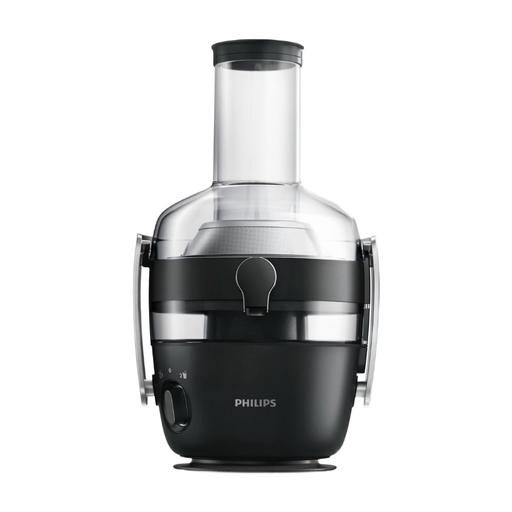
Why it suits this profile: This model combines 1,000 watts with an 8 cm inlet and a function for adjusting the juice texture. It is well suited to households that regularly make different types of fruit and vegetable juice.
According to Philips, the QuickClean and pre-cleaning functions are designed to make it easier to remove residue. The product information also states that the separate parts are dishwasher-safe.
1,000 watts, 8 cm feed chute, adjustable juice texture and integrated drip stop.
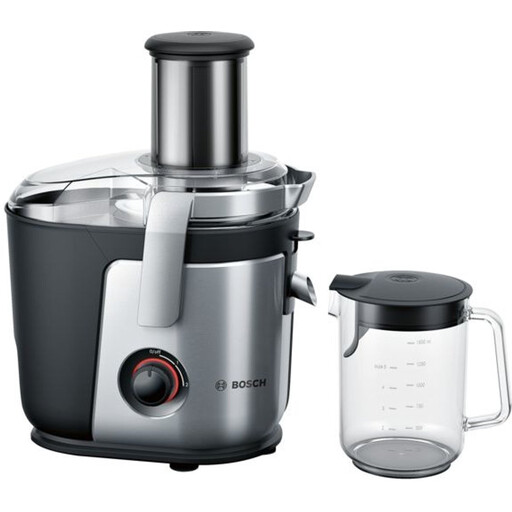
Why it suits this profile: The combination of a 1.5-litre juice jug, 3-litre pulp container and two speeds is well suited to larger quantities and regular family use.
The wide opening reduces preparation work, while the automatic pulp ejection means you do not need to stop frequently to empty the pulp container. According to the product information, the separate parts are dishwasher-safe.
1,000 watts, 84 mm feed chute, 1.5-litre juice jug, 3-litre pulp container and two speeds.
We have put together a complete, up-to-date list of products that fully meet these strict selection criteria and the applicable European safety regulations.
No. Hard vegetables and many types of fruit are often suitable, but fibrous ingredients, stones and certain soft produce can block the filter or inlet. Check the instructions for your model and cut long fibres into smaller pieces.
Its lifespan depends on how often it is used, how well it is cleaned and whether the maximum operating time is observed. Allow the motor to cool down when instructed to do so in the manual, and do not use an appliance with damaged parts.
As well as the purchase price, your main costs are ingredients and electricity. A higher wattage may increase consumption per minute, but the total operating time varies from one appliance to another. Compare power, preparation time and portion size rather than looking at wattage alone.
