
Vandaag of morgen in huis

Kwaliteit gegarandeerd

Welkomstaanbiedingen ontgrendelen: GRATIS bezorging | Tot 80% korting | Gratis 30 dagen JoyPlus-proefperiode
Download de app
Buying a juicer sounds simple, until you discover how many different appliances fall under that name. A centrifugal juicer, slow juicer, citrus press and smoothie blender all work in different ways. The right choice depends on what you want to make, how much space you have and how much time you want to spend on preparation and cleaning.
Pay particular attention to these three common pitfalls:
Start by choosing the type of appliance that suits how you usually use it.
A citrus press is practical if you mainly want to make fruit and vegetable juice from citrus fruit. An electric citrus press with a wide opening can reduce preparation time. Pay attention to the pulp setting if people in your household have different preferences.
According to the product specifications, the Bear CZJ-A04B1 has a 110 mm feed chute, five pulp settings and a system for separating juice from pulp. The manufacturer states that the appliance is suitable for oranges, lemons and grapefruits, among other things. This makes this type of juicer interesting for everyday orange juice, but less suitable if you regularly want to process leafy greens or hard vegetables.
A slow juicer presses ingredients using a slowly rotating system. This can be appealing if you want to experiment with different types of fruit and vegetables. With this type of appliance, look not only at the speed, but also at the maximum operating time, the collection containers and the instructions for fibrous ingredients.
The WOOX MX0289 has a power rating of 150 watts, a juice cup with a maximum scale of 600 ml and an 836 ml pulp container. The product specifications state that it has a noise level of less than 72 dB, overheating protection and a maximum continuous operating time of 10 minutes. According to the operating instructions, ingredients such as celery and parsley should be cut into pieces measuring 3 to 4 cm.
A blender keeps the pulp and fibre in the mixture. This means you do not get clear juice like you would from a citrus press or slow juicer, but you do get a thicker smoothie. A compact smoothie maker is suitable for individual portions, while a food processor offers more accessories and greater capacity.
The Nutribullet Original Blender has a power rating of 600 watts, a 700 ml cup and six automatic programmes, according to the product information. The appliance is designed for smoothies, sauces and cocktails, among other things. The operating instructions state that hot liquids must not be processed and that continuous use should be limited.
A juicer with a large feed chute can save time, but check exactly what the manufacturer means by “large ingredients”. An opening measuring 110 or 130 mm is relevant for whole citrus fruits or certain pieces of fruit, but hard stones, skins and fibrous stalks may still need to be removed.
Also check whether the feed chute has a pusher or safety lock. Never put your fingers or kitchen utensils into an appliance while it is running.
For one person, a 600 to 700 ml cup may be sufficient. Families will benefit more from a generously sized juice and pulp container. Also pay attention to the maximum operating time. A motor that needs to cool down after a few minutes is less suitable if you want to make several portions one after another.
A large capacity does not automatically prevent interruptions: a filter can become full and the pulp may need to be removed during use. So check the manual, rather than looking only at the capacity of the collection container.
A BPA-free juicer means that the relevant food-contact materials are BPA-free according to the product specifications. Always check which parts this refers to. The motor base must not be immersed in water on any of these appliances.
For everyday use, an easy-to-clean juicer is often more practical than an appliance with lots of separate parts. Look for:
A quiet juicer is pleasant to use in an open-plan kitchen, but only compare noise claims when they have been measured under similar conditions. The stated dB value is a product specification, not a guarantee of the same experience in every kitchen.
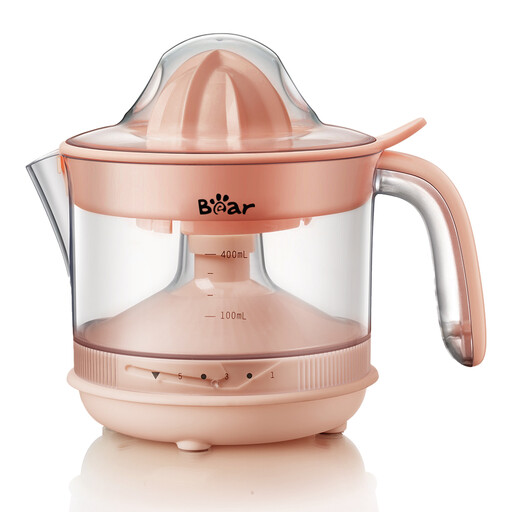
Why it suits this profile: This compact model is designed for citrus fruit and offers simple one-button operation. The wide feed chute reduces the amount of cutting needed for oranges.
The five pulp settings make it clear what texture you can select. The product specifications also state that the parts can be removed for cleaning.
110 mm feed chute, five pulp settings, BPA-free food-contact materials according to the product information and non-slip feet.

Why it suits this profile: The spacious chamber and separate collection containers are ideal for households that regularly prepare different types of juice.
The instructions specify both the maximum operating time and the preparation required for fibrous ingredients. This helps prevent overloading caused by incorrect use.
150 watts, 600 ml juice cup, 836 ml pulp container, overheating protection and reverse function according to the product specifications.

Why it suits this profile: This food processor comes with several accessories, including a blender and citrus press. It is a good fit for home cooks looking for one appliance to handle a wide range of preparations.
You are not just buying a juicing function, but you do need to allow for a larger appliance, more accessories and additional cleaning.
3.9-litre stainless steel bowl and functions for kneading, slicing, blending and pressing citrus fruit, among other things.
We have put together a complete, up-to-date list of products that fully meet these strict selection criteria and the applicable European safety regulations.
This depends mainly on the ingredients, portion size and how often you use it. A slow juicer can be suitable for a wide range of fruit and vegetables, but it often requires more preparation and cleaning. So do not compare electricity consumption alone; also consider the time involved and the quantity of ingredients you process each time.
Its lifespan depends on how it is used, how well it is maintained and whether the maximum operating time is followed. Allow the motor to cool down when instructed in the manual, remove the pulp after use and check the filters and seals regularly. Stop using the appliance immediately if you notice an unusual smell, vibration or noise, and contact customer services.
A blender usually produces a thicker mixture in which the pulp and fibre remain. For smoother juice, you can strain the mixture if you wish, but the result will differ from that of a centrifugal juicer or citrus press. Choose a blender primarily if you want to prepare smoothies, sauces and mixed drinks.
