If you’re making the same banana smoothie for several participants, a jug blender is the obvious choice; compare its usable capacity with your serving size. A personal blender is better suited to individual recipes, but for a group it means more preparation and cleaning rounds. If you’re using frozen banana, check the instructions for the exact model: wattage or an ice function doesn’t guarantee a particular texture.
Which type of blender is right for you?
Workshop host preparing group servings
You make the same banana recipe for several participants and want to know how much usable capacity is available and how many cleaning rounds you’ll need. The Consumers’ Association lists capacity and intended use as factors to consider when choosing a blender.
Host guiding individual recipes
You let participants create their own smoothies, so you compare personal cups, changeover time and cleaning between preparations. The Consumers’ Association describes a personal blender as a blender with a small jug.
Smoothie maker using frozen fruit
You use frozen banana or other cold ingredients and check whether the exact model is suitable. The Consumers’ Association treats a smoothie with frozen banana as a separate test category.
What should you look for when choosing?
First decide whether you want to use one jug for group servings or make each smoothie separately. Then compare capacity, cleaning requirements and guidance on ingredients.
| What to consider |
What to look for when buying |
Who is this most relevant to? |
| Servings per blend |
Compare the usable capacity with the amount per glass; don’t treat the jug’s total volume as its usable capacity. |
If I’m making the same recipe for a group, I want to know in advance how many servings I’ll get from the usable capacity. Around 36% of consumers would prioritise getting enough servings per blend. |
| Cleaning between recipes |
Check whether each component is removable and dishwasher-safe; this doesn’t automatically apply to the blade unit. |
When using different ingredients, I want to be able to clean the cup and blades thoroughly before starting the next preparation. For around 29% of consumers, cleaning between recipes would be their main concern. |
| Frozen banana |
Check the instructions for the exact model and, if possible, look for a test using a similar recipe. |
When I use frozen banana, I want to know whether the model is suitable and what that means for my recipe. Around 21% of consumers would consider frozen ingredients first. |
| Individual cup |
Check the capacity and number of cups supplied, and whether extra cups are compatible with the exact model. |
If participants are creating their own smoothies, I want to be able to use a suitable cup for each preparation. Around 14% of consumers would give individual cups the most weight. |
Blender pitfalls to avoid for workshops
-
Confusing the jug’s total capacity with its usable capacity
Philips lists a maximum capacity of 1.9 l and an effective capacity of 1 l for the HR2041/00. Tefal lists a total capacity of 1.75 l and a usable capacity of 1.25 l for the BL435831. This difference affects how many batches you’ll need to plan for your workshop.
Plan using the usable capacity of the exact model and your own serving size.
-
Assuming wattage or an ice function guarantees a particular texture
The Consumers’ Association treats smoothies with frozen banana and crushing ice as separate test categories. Power or a function alone doesn’t tell you how your specific recipe will turn out.
Check the model instructions for frozen ingredients and, where possible, consult an independent test for the smoothie you want to make.
-
Assuming all dishwasher-safe parts can go in together
Tefal states that the BL435831 jug is dishwasher-safe without the blades. For the NB904CP, nutribullet says the cup can go on the top rack and the blade assembly should be rinsed with water and washing-up liquid.
Before buying, check the cleaning instructions for every part that will come into contact with food during the workshop.
Brands to consider
Philips
The HR2041/00 is a jug blender to consider if you’re making the same smoothie for group servings.
- Philips specifies 450 W, a maximum capacity of 1.9 l and an effective capacity of 1 l. The model has one speed and a pulse function.
- Use the effective capacity to plan your servings; the stated capacity isn’t a measure of how many batches you can make during a workshop.
Tefal
The Blendforce II BL435831 is a jug blender with a glass jug and removable blades.
- Tefal specifies a usable capacity of 1.25 l, two speeds and a pulse function.
- According to Tefal, the jug, lid and measuring cap are dishwasher-safe, but the jug must be washed without the blades.
Bosch
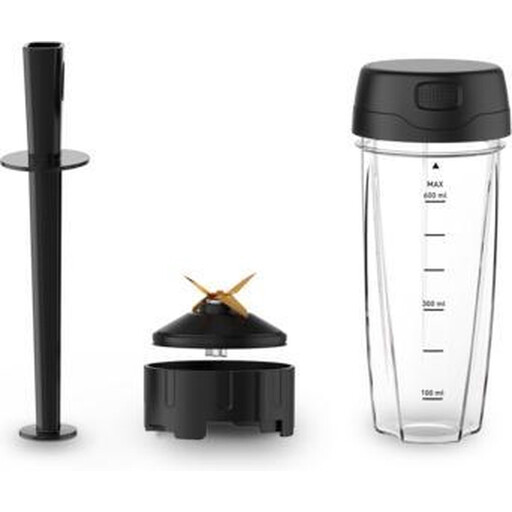
The VitaPower Serie 2 MMB2111S is a personal blender for making an individual smoothie in a To Go Bottle.
- Bosch specifies a 0.6 l cup, a safety lock and dishwasher-safe parts.
- For several identical group servings, a personal cup may require more preparation rounds than a jug blender.
nutribullet
The Pro NB904CP is a personal blender for individual preparations; check the exact version and cup bundle when buying.
- The manufacturer lists a 900 W motor and a 700 ml cup included.
- According to the cleaning instructions, the cup can go on the top dishwasher rack; the blade assembly should be rinsed with water and washing-up liquid. Power alone doesn’t guarantee a good result with frozen banana.
Joybuy jug blenders for group servings
These Joybuy products are jug blenders for making smoothies in group servings. Compare the stated capacity and model specification with the number of participants and the instructions relevant to your recipe.
 No image available
Cecotec Power Black Titanium 1300Max jug blender, 1.5 l
A jug blender for making smoothies in group servings.
1300 W; 1.5 l jug; four titanium blades; two speeds and an ice-crushing function.
Joybuy
 No image available
Tefal PerfectMix+ BL871A High Speed Blender, 1.5 l
A jug blender to compare when making several smoothie servings in one go.
1200 W; 1.5 l capacity; Dune finish.
Joybuy
 No image available
Tefal BL91HD High Speed Blender, 1.75 l Tritan
A jug blender to consider when making smoothies for group servings.
1600 W; 35,000 RPM; 1.75 l capacity; Tritan.
Joybuy
 No image available
Ninja Detect Blender Pro & Smoothie Maker TB301EU
A jug blender for making smoothies for several participants.
Check the instructions for the exact model if you want to use frozen banana.
Joybuy
 No image available
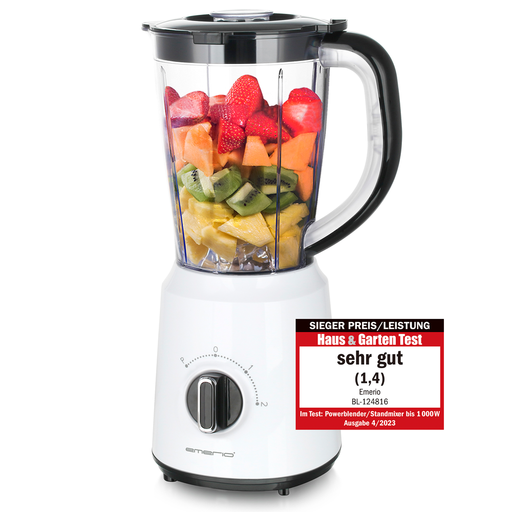
Emerio BL-124816.7 blender, 1.5 l, white
A jug blender for making smoothies in group servings; bear the stated operating limits in mind if using it repeatedly.
1.5 l jug; two speeds.
According to the product information, the appliance can run for a maximum of one minute at a time and should rest for two minutes after heavy blending cycles.
Joybuy
Frequently asked questions
How many smoothies can you make at once?
Divide the jug’s usable capacity by the planned amount per glass and round down. This is a planning calculation, not a measured capacity for every recipe: Philips lists an effective capacity of 1 l for the HR2041/00, while Tefal lists a usable capacity of 1.25 l for the BL435831.
Can the jug and blades go in the dishwasher together?
Not necessarily; follow the instructions for the exact model. Tefal states that the BL435831 jug is dishwasher-safe without the blades. For the NB904CP, nutribullet says the cup can go in the top of the dishwasher and the blade assembly should be cleaned with water and washing-up liquid.
What warranty and cooling-off period apply when buying online as a consumer?
In the Netherlands, you have a statutory guarantee in addition to any manufacturer’s warranty: the product must meet what you could reasonably expect. There is no general fixed two-year period. For an online consumer purchase, you usually have a cooling-off period of up to 14 days after delivery, subject to legal exceptions. ACM ConsuWijzer explains these consumer rights; if you’re buying on behalf of a business, check separately which rules apply.
Does a commercial cooking workshop need an HACCP plan and allergen information?
If you prepare, process or sell food as a food business, the NVWA requires an HACCP food safety plan or an applicable approved hygiene code. Businesses offering non-prepacked smoothies must give consumers information about any allergens present. Whether these rules apply to a particular workshop depends on how it is run in practice.


