If you’re making several smoothies in each round, a jug blender is an obvious choice, provided its usable capacity suits your recipe. For individual drinks, a personal blender may be more practical. Also compare how easy the parts are to clean and whether the model is suitable for your ingredients. Wattage alone doesn’t prove that spinach will blend smoothly; the Consumentenbond assesses smoothie-making and puréeing vegetables as separate test categories.
Who is this choice relevant to?
Workshop leader running group sessions
You want to serve several spinach smoothies in each blending round, so you’re mainly comparing the jug’s usable capacity and how easy the parts are to clean. The Consumentenbond lists jug capacity and material as factors to consider.
Leader of individual recipe sessions
You let each participant make their own smoothie, so you’re more likely to consider individual cups and the sequence of blending and washing up than one large jug. A personal blender may suit smoothies that participants drink straight from their own cup.
Organiser with quick changeovers
You make recipes one after another and want to know which parts can be taken apart and cleaned between preparations. The Voedingscentrum recommends using clean equipment and keeping raw and prepared food separate.
What should you look for in a blender for a cooking workshop?
Start with how much you want to make in each round, then consider how the appliance suits your recipe and cleaning routine.
| What to consider |
What to look for when buying |
Especially suitable for |
| Capacity for each group session |
Compare the usable filling capacity with the quantity in your own recipe, not just the jug’s total capacity. |
If I want to serve several participants in one round, the usable capacity needs to suit my recipe. Around 33% of consumers prioritise enough capacity for group portions. |
| Spinach and other ingredients |
Check whether the model is designed for making smoothies and puréeing vegetables; the stated motor power alone doesn’t tell you how well it will handle your recipe. |
I want to know in advance whether the blender suits the ingredients I use, without relying on wattage alone. Around 27% of consumers prioritise puréeing vegetables and achieving their desired texture. |
| Cleaning between preparations |
Check which parts can be taken apart and are dishwasher-safe, and follow the cleaning instructions for the exact model. |
When I’m making different recipes, I want to be able to clean the parts thoroughly between rounds. Around 27% of consumers focus mainly on cleaning between preparations. |
| Individual smoothies and workspace |
Compare the cups supplied, the space required and the time needed for separate blending sessions. |
If participants are making their own drinks, I may find individual cups more convenient than pouring from a jug. Around 13% of consumers prioritise making individual smoothies. |
Buying pitfalls to avoid
-
Confusing total jug capacity with usable capacity
According to Tefal, the Tefal PerfectMix+ BL871D has a 2-litre jug with a usable capacity of 1.5 litres. So don’t automatically calculate portions using the jug’s total capacity.
Compare the stated usable capacity of the exact model with the quantity in your own recipe.
If the usable filling capacity is lower than expected, you may need to blend more batches.
-
Assuming high wattage guarantees a smooth result
Wattage is a model specification, not a test result for a spinach smoothie. The Consumentenbond assesses smoothie-making and puréeing vegetables separately.
Where available, check the results for the exact model and see whether your full recipe is suitable according to the instructions for use.
-
Assuming one cleaning option applies to every part
How easy a blender is to clean varies by part. A dishwasher-safe jug doesn’t automatically mean that the blades, lid and other parts can go in the dishwasher too.
Check the manual for each part and allow time to clean the equipment you’ve used between recipes. The Voedingscentrum recommends using clean equipment and keeping raw and prepared food separate.
Taking the blender apart and cleaning it between rounds takes extra time.
Brands to compare
Bosch
The VitaPower Serie 4 MMB6141B is a jug blender worth comparing for group preparations.
- Bosch lists this model as 1200 W.
- For eligible kitchen appliances, Bosch offers a 10-year motor guarantee after registration.
- The motor guarantee doesn’t cover the entire appliance and, by itself, says nothing about the texture of spinach smoothies.
Tefal
The PerfectMix+ BL871D is a jug blender to consider if usable capacity and easy-to-clean parts matter to you.
- Tefal lists a usable capacity of 1.5 litres for its 2-litre jug, which is made of dishwasher-safe glass, and removable blades.
- The stated power is 1200 W.
- Power is a specification, not an independent comparison of how well it makes spinach smoothies.
nutribullet
The Original NB603DG is a useful comparison point for individual smoothies.
- The manufacturer lists a 600 W power base and a 700 ml cup supplied with the blender.
- You may need to blend separate batches to make portions for a group at the same time.
Fritel
The BL 3890 is a jug blender worth comparing if you’re looking for removable parts and a glass jug.
- Fritel lists 1800 W, a smoothie programme, removable blades and dishwasher-safe parts.
- Fritel gives both 1.8 litres and 1.5 litres as the capacity. Check the usable filling capacity in the manual before planning portions.
Braun
The PowerBlend 1 Jug is a jug blender to include when comparing working capacity.
- Braun lists a power rating of 600 W and a working capacity of 1.25 litres for this product range.
- The claim about its smaller footprint is Braun’s comparison with the JB9040, not a comparison with all blenders.
Blenders for smoothies and workshop recipes
This selection of Joybuy products includes jug blenders for several portions and a hand blender set for smaller preparations.
 No image available
Cecotec Power Black Titanium 1300Max, jug blender
The 1.5-litre jug capacity is worth considering if you’re comparing blenders for several portions per round.
The product information lists two speeds, a pulse function and four blades.
View at Joybuy
 No image available
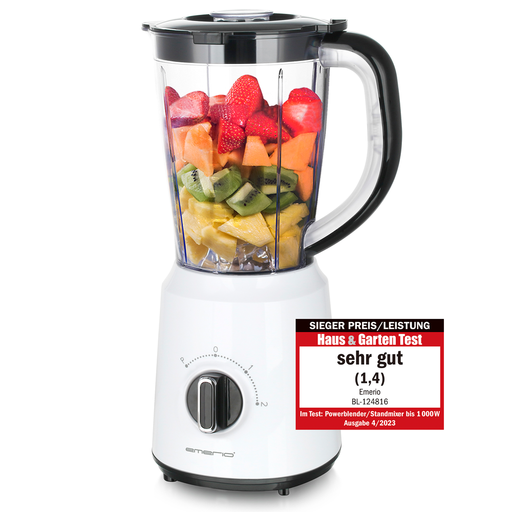
Emerio BL-124816.7, jug blender
The 1.5-litre jug capacity is worth considering if you want to make smoothies for a group.
The product information lists two speeds, a pulse function and four stainless steel blades. The jug, lid and blades are described as dishwasher-safe.
View at Joybuy
 No image available
Emerio HB-130492, hand blender set
A hand blender may suit smaller smoothie portions that you prepare individually.
The product information lists a detachable stainless steel blending foot, two blades and a 700 ml measuring beaker.
View at Joybuy
 No image available
3-in-1 multifunction blender, 800 W
The combination of a mixing jug and a travel bottle is worth considering if you’re looking at both group preparations and individual smoothies.
The product title lists a 1500 ml mixing jug and a 600 ml travel bottle. The product information lists two speeds, a pulse function and dishwasher-safe parts.
View at Joybuy
 No image available
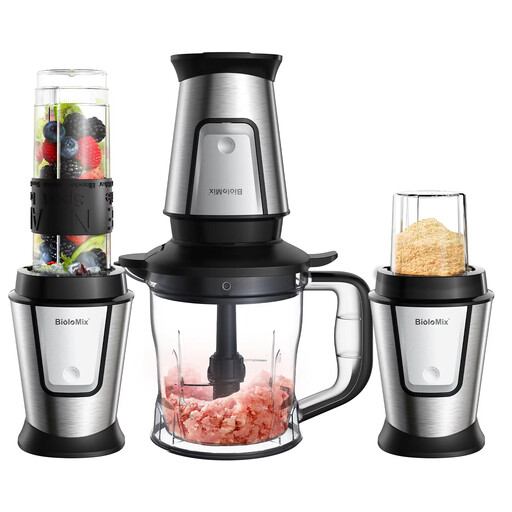
BioloMix TB23M, multifunction blender
The product information lists smoothies and puréeing among its uses, so you can compare this option with your recipe and preferred way of working.
The product title lists a 700 W motor and 24,000 rpm; the product information mentions a bowl and a wavy-blade system.
View at Joybuy
Frequently asked questions
Does a blender need a certain wattage to make a spinach smoothie?
A particular wattage alone doesn’t guarantee the result you want from a spinach smoothie. Check whether the model suits your ingredients and, where available, look at results for the exact model. The Consumentenbond assesses smoothie-making and puréeing vegetables separately.
How should you prepare raw spinach safely?
Wash raw spinach under running water before using it. The Voedingscentrum notes that raw vegetables can carry pathogens. Also use clean equipment and avoid contact with utensils that have been used for raw meat or fish.
Can you use the same blender for different workshop recipes?
Yes, as long as you clean the parts you’ve used appropriately between preparations, following the manual, and take ingredients and potential allergens into account. A dishwasher-safe jug doesn’t automatically mean every part is dishwasher-safe.
Does a Dutch cooking workshop need an HACCP plan or hygiene code?
The NVWA says that businesses preparing, processing or selling food must work with an HACCP food safety plan or an applicable hygiene code. The term ‘cooking workshop’ alone doesn’t mean that every private gathering falls under this business requirement.
When do you need to tell participants about allergens?
According to the NVWA, businesses in hospitality, craft trades and retail must inform consumers about allergens in non-prepacked food; this also applies to institutions. If you’re running a business workshop, check which ingredients are being used and how participants can get the information before eating.


