
Vandaag of morgen in huis

Kwaliteit gegarandeerd

Welkomstaanbiedingen ontgrendelen: GRATIS bezorging | Tot 80% korting | Gratis 30 dagen JoyPlus-proefperiode
Download de app
When buying Joma football boots, people often look first at the colour, price and lightweight appearance. But it’s the playing surface, stud configuration and fit that determine whether a pair is comfortable and practical. An FG model on artificial grass may wear out more quickly, while an AG model on natural grass may not feel as suitable.
In this buying guide, the Joybuy Product Recommendation Officer helps you separate marketing claims from verifiable product information. You’ll find information about Joma FG football boots, Joma AG football boots, turf models and practical sizing tips for sizes 41, 42, 42.5, 43, 44, 44.5, 45 and 46.
The abbreviation on the boot matters more than its appearance:
An FG sole isn’t automatically suitable for every football facility in the Netherlands. So check whether you usually play on natural grass, modern artificial grass or turf.
Lightweight football boots can feel comfortable when accelerating and changing direction. But that alone says nothing about heel stability, cushioning or the durability of the upper. So pay attention to the materials and construction. Synthetic leather is generally easy to clean, while microfibre can offer a lightweight feel and a close fit. Natural leather can mould more closely to your foot, but needs appropriate care.
According to the product information, certain Joma models feature an EXO Counter heel construction or an integrated sock section. Treat these as product specifications, not a guarantee of how the boots will feel when you play.
Football boots should fit snugly without creating pressure points. The same EU size can feel different from one model to another. Ideally, measure your foot at the end of the day, wearing the socks you use for training. Then compare your foot length with the size guide on the product page.
For example, the Joma Striker 2402 FG is listed as having a regular fit, with a size guide covering sizes 41 to 46. This can help you find the right size 42 football boots, size 42.5, size 44.5 or size 45.
For football boots for natural grass, FG studs are relevant when the ground is firm. The Joma Super Copa 2402 FG and Joma Striker 2402 FG are described in their product information as suitable for firm ground with natural grass.
For football boots for artificial grass, look for AG. According to the product information, the Joma Super Copa 2402 AG and Super Copa 2401 AG are designed for artificial grass. If the pitch is wet, long-pile or very hard, always check your club’s and the manufacturer’s recommendations.
The Joma Top Flex TF has a rubber sole with plenty of grip and is listed in the product information as suitable for turf. This type is a good fit for players who regularly train on short-pile artificial pitches or similar hard surfaces.
A synthetic upper is a practical choice if your boots often get dirty and wet. Product information for the Super Copa models lists synthetic leather, a rubber sole and a cushioned insole. According to its specifications, the Joma Striker 2402 FG has a microfibre upper, a textile lining and a synthetic-fibre sole.
The Joma Aguila Cup is listed as having a natural leather upper. It may appeal to players looking for a softer touch on the ball and a fit that moulds more closely to the foot. However, you should care for the boots according to the label.
Studs provide grip, but the right configuration depends on the surface. A boot with a supportive heel construction may appeal to players who change direction frequently. A flexible turf sole, on the other hand, can be suitable for short passes and quick movements on hard pitches.
Marketing terms such as “maximum control” or “superior grip” sometimes come from brand or sales copy. A brand’s own research may suggest that these features feel different depending on the player, pitch and fit. So base your choice on the stated sole type, materials, fastening and recommended playing surface.
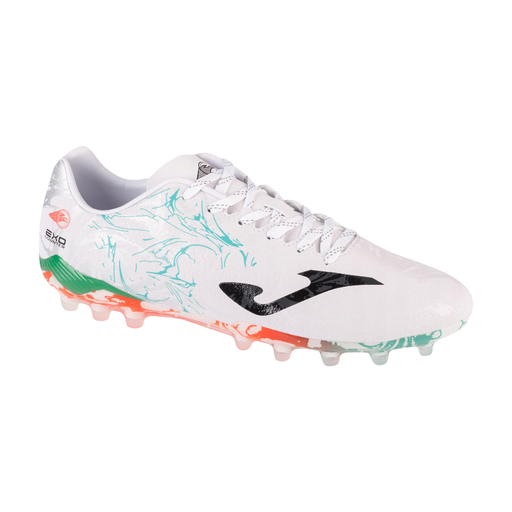
Why it suits this type of player: A straightforward FG model for recreational players who mainly play on firm natural grass and want a synthetic upper.
The product information clearly states FG and natural grass. That means your choice doesn’t depend solely on colour or promotional copy.
Synthetic upper, rubber sole, cushioned insole and available in size 42.5.

Why it suits this type of player: Designed for players who value a microfibre upper, a close-fitting sock section and extra heel support.
The specifications mention more than just a lightweight design: they also list microfibre, an integrated Sock System and EXO Counter. Do check that the fit around your ankle feels comfortable.
Microfibre upper, regular fit, lace-up fastening and size 44.5.
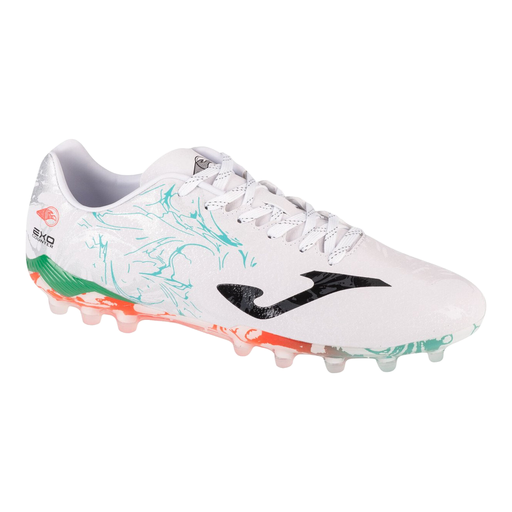
Why it suits this type of player: A sensible choice for players who train or play matches almost exclusively on artificial grass.
The product description explicitly states AG. This helps you avoid buying an FG model for a surface it isn’t specified for.
AG sole, synthetic upper, rubber sole and available in size 44.5.
We’ve put together a complete, up-to-date list of products that meet these strict selection criteria and current European safety regulations.
Usually not as your regular choice. FG stands for Firm Ground and is linked to firm natural grass in the product information. If you mainly play on artificial grass, look for Joma AG football boots. For short-pile turf pitches, a TF model is often the more suitable option.
Their lifespan depends on how often you use them, the playing surface, playing time and how well you care for them. Use FG, AG and TF boots only on their recommended surfaces. Remove grass and dirt after use, let the boots dry naturally and don’t store them while damp for long periods. These products have a minimum two-year legal guarantee in the EU; this is separate from normal wear and tear.
It varies by model. Measure your foot and compare its length with the size guide for the product you’ve chosen. The Striker 2402 FG is listed as having a regular fit. Try football boots on with football socks and check that your heel doesn’t slip out and your toes aren’t pressing against the front.
