What should you consider when choosing?
If you want to take consistent photos of a collection, first make a note of your camera position, background and lighting. Then assess whether your current camera falls short when it comes to close-up detail or ease of use.
| Consideration |
What should you check? |
Who is this important for? |
| Consistent composition |
Can you position the camera steadily and record the distance, background and lighting for future sessions? |
I want to photograph new products with the same crop each time, without having to work out the entire setup again. Around 33% of consumers prioritise consistent framing. |
| Small details |
Compare the magnification of the exact lens, and check the lens mount and focus-bracketing process. |
If engravings or small stones need to be clearly visible, I want to know what the lens can capture up close and how focus is managed across the depth of the image. Around 27% of consumers prioritise macro detail. |
| Colour and reflections |
Can you repeat the lighting, set the white balance and, if needed, shoot in RAW? |
When photographing reflective jewellery, I want to control reflections and keep colours as consistent as possible between sessions. Around 20% of consumers prioritise these considerations. |
| Complete setup |
Check whether you’re buying a body or a kit, which lens is included and what other equipment you need. |
I want to know first whether my current camera is good enough and what equipment a new setup actually requires. Around 20% of consumers prioritise the total cost of the setup. |
Cameras on Joybuy
This selection features digital cameras for photography. The zoom and resolution figures quoted don’t, on their own, confirm how well a camera captures small jewellery details up close, so check the close-up capabilities of the exact model.
 No image available
KOMERY G7 5K digital camera, 80 MP, white
For jewellery close-ups, check whether the model can focus closely enough; the stated zoom figure doesn’t, on its own, confirm macro performance.
- The product title lists 5K and 80 MP.
- The product description mentions 18× optical zoom.
- Colour: white.
View at Joybuy
 No image available
Komery W6 digital camera, 12× optical zoom, 4K, 64 MP
For jewellery photography, check whether the camera can capture the close-up you want in sharp focus; the details in the title don’t confirm that it’s suitable.
- The product title lists 12× optical zoom and 4K video.
- The product title lists 64 MP.
View at Joybuy
 No image available
Songdian Pocket Camera 4K, 44 MP, 16× zoom, pink
Take a test shot to see whether the model captures the small details of your jewellery in sharp focus; the stated zoom figure doesn’t tell you that on its own.
- The product title lists 4K and 44 MP.
- The product information mentions autofocus and 16× zoom.
- Colour: pink.
View at Joybuy
 No image available
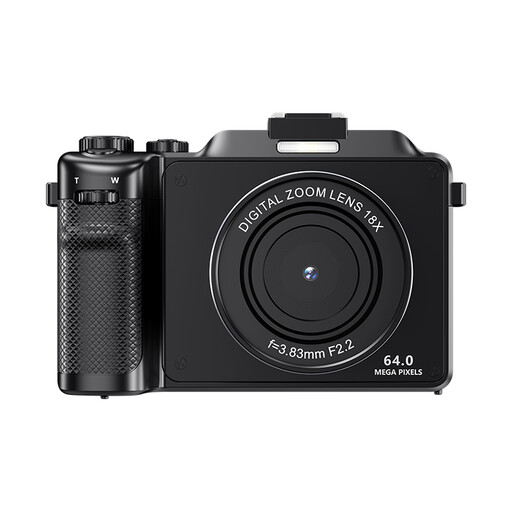
Komery X9 4K digital camera, 64 MP, black
Check that the model can focus up close before choosing it for small jewellery details; the stated digital zoom doesn’t confirm that it’s suitable for macro photography.
- The product title lists 4K and 64 MP.
- The product information mentions autofocus and 18× digital zoom; the description warns that digital zoom can reduce image quality.
- Colour: black.
View at Joybuy
Frequently asked questions
Do you need a new camera straight away for consistent jewellery photos?
Not necessarily. If your current camera already captures the details you want, first try using the same camera position, background and lighting. Take a test shot to check that the close-up is sharp enough before considering another camera.
Can a macro lens get an entire ring in focus in one shot?
Not always; the depth of field can be shallow at short focusing distances. A sequence of shots taken at different focus points can be merged, but check whether this is done in-camera or afterwards for each model, and use a stable setup.
How can you avoid colour differences between photo sessions?
Keep the lighting as consistent as possible and set the white balance deliberately. If you shoot in RAW, you can adjust the white balance during editing; also watch out for reflections as you set up.
Do the Dutch cooling-off period and statutory guarantee apply if you buy a camera for your jewellery business?
That depends on how the camera will be used. ACM ConsuWijzer states that consumer protection doesn’t apply when an agreement is used mainly or exclusively for business; it may be different if it’s used mainly for private purposes. For a distance purchase covered by consumer law, the cooling-off period is usually 14 days. The statutory guarantee covers what you could reasonably expect from the product.


