Who is this choice relevant to?

Maker focusing on fine jewellery details

If you want to show small finishes or textures clearly, check the magnification of the specific lens and take a test shot of the smallest detail. Canon, Nikon and Sony list magnification specifications for individual macro lenses.

Maker working with shiny materials

When photographing polished metal and gemstones, you’ll want to control reflections and colour across a series of shots. Nikon explains how incorrect white balance can introduce an unwanted colour cast, so your setup and lighting are important too.

Maker who wants to shoot a series quickly

If you want to photograph several pieces of jewellery consistently, a repeatable camera setup can help. Canon recommends using a tripod for consistent framing, although careful focusing is still important.

What should you look for in a camera for jewellery photography?

Compact camera with a fixed lens

When to choose it: If you mainly want to photograph complete pieces of jewellery and a few close-ups without changing lenses, first compare the smallest detail you want to capture with a test shot. OM SYSTEM lists a microscope mode for the TG-7; Panasonic describes focus stacking for the DC-TZ99.

Trade-off: The fixed lens limits your options for upgrading later, so check that its close-up mode can capture your smallest details.

Mirrorless camera with a macro lens

When to choose it: If you need to capture tiny engravings or settings so they fill the frame, compare the maximum magnification of the lens you actually intend to use.

Trade-off: A camera body or standard zoom doesn’t automatically include a macro lens. Also check that there’s enough room around the jewellery for lighting.

What to consider What should you look for? Who should prioritise this?
Small details Check the maximum magnification of the included lens or the close-up mode of the fixed lens. Try photographing your smallest desired details from the distance you plan to shoot at. If I want to show engravings or fine finishes clearly, I start by considering the crop I need. Around 33% of consumers prioritise small details when making this choice.
Reflections and colour Test soft, even lighting on your own piece of jewellery and compare the white balance and how the materials look across several photos. When I photograph shiny metal or gemstones, I want to be able to assess distracting reflections and changes in colour. Around 27% of consumers prioritise reflections and colour consistency.
A consistent series Check whether you can use the camera from the same position each time, and assess sharpness at the size you plan to display the photos. For a series of similar exhibition photos, I want to be able to repeat my framing and background. Around 20% of consumers prioritise consistency.
Complete camera kit Compare the camera body, the lens actually included, the lens mount and the accessories you need for your setup. If I want to know what I can use straight away and what I still need to buy separately, I check everything included in the offer. Around 20% of consumers prioritise a complete, ready-to-use kit.

Common buying mistakes

  • Assuming a camera body or standard kit is a macro kit

    The stated magnification applies to a specific lens, not automatically to every kit with the same camera body. For example, Sony lists a standard zoom lens with the ZV-E10 II lens kit; the macro specification applies to a separate lens.

    Before buying, check everything included in the kit, the lens mount and the specifications of the lens you’ll actually receive.

    A suitable macro lens may need to be purchased separately.

  • Trying to solve reflections by changing cameras alone

    Jewellery can reflect its surroundings. Even with a different camera, the lighting and the area around the subject will affect how reflections appear in your photos.

    Testing your own materials in soft light lets you assess reflections before choosing a different camera body.

    A stable, diffused lighting setup may require extra preparation and equipment.

  • Assuming every macro camera has focus stacking

    Focus stacking combines shots taken at different focus points; the feature and how you use it vary by model.

    Check what the exact camera model can do and try the process with a stationary piece of jewellery.

    Taking and combining multiple shots may require extra shooting and editing time.

Brands to consider

OM SYSTEM

The TG-7 is a fixed-lens camera worth considering if you’re looking for a more compact option for close-ups.

  • OM SYSTEM lists a microscope mode for the TG-7.
  • The lens is fixed, so you can’t choose a different lens later.

Panasonic

The LUMIX DC-TZ99 is a fixed-lens option; Panasonic describes a focus stacking feature for this model.

  • According to Panasonic, the feature combines shots taken at different focus distances.
  • How focus stacking works and the process involved are specific to each model.

Canon

The EOS R50 can be paired with the separate RF 35mm F1.8 MACRO IS STM lens.

  • Canon specifies a maximum magnification of 0.5× for this lens.
  • This specification applies to the lens and not automatically to every EOS R50 kit; check the lens mount and what’s included in the kit.

Nikon

A Z-series mirrorless camera such as the Z50II can be paired with the separate NIKKOR Z MC 50mm f/2.8 lens.

  • Nikon specifies 1:1 magnification for this lens.
  • The short distance between the front of the lens and the subject can affect your lighting setup; the lens isn’t necessarily included with a Z50II kit.

Sony

The ZV-E10 II is worth considering with a separate E 30mm F3.5 Macro lens (SEL30M35).

  • Sony specifies a maximum magnification of 1.0× for the SEL30M35.
  • The ZV-E10 II lens kit is listed with an E PZ 16-50mm zoom lens; the macro specification does not automatically apply to that kit.

Cameras at Joybuy

Joybuy products relevant to this topic.

KOMERY G7 5K digital camera, white

KOMERY G7 5K Digital Camera, White

Before choosing this camera for jewellery photography, take a test shot to see whether it captures your smallest details sharply enough.

The product title lists 80 MP, 18× optical zoom and 5K.

View product at Joybuy

KOMERY W6 digital camera

KOMERY W6 Digital Camera

Take a test shot to check whether this camera can capture the details of your jewellery at the size you want.

The product title lists 64 MP, 4K, 12× optical zoom and Wi-Fi.

View product at Joybuy

Songdian pocket camera, pink

Songdian Pocket Camera, Pink

Take a test photo to see whether this camera offers the framing and sharpness you need for your jewellery photos.

The product title lists 4K and 44 MP. The product description lists autofocus and 16× digital zoom.

View product at Joybuy
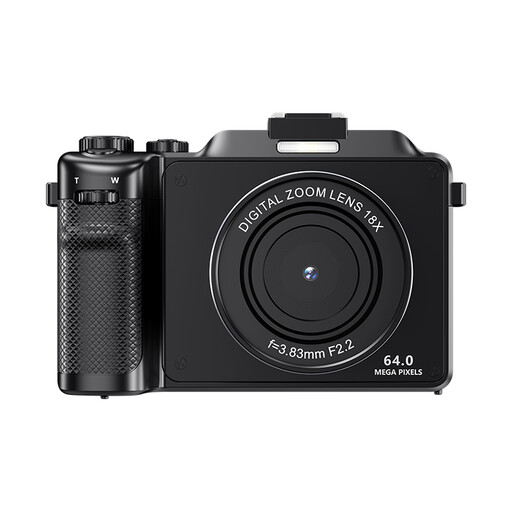
KOMERY X9 4K autofocus camera, black

KOMERY X9 4K Autofocus Camera, Black

Take a test shot to check whether this camera captures the small details of your jewellery sharply enough.

The product title lists autofocus and 18× digital zoom. According to the product description, digital zoom reduces image quality.

View product at Joybuy

Frequently asked questions

Do you need a 1:1 macro lens for every piece of jewellery?

No, not if the complete piece of jewellery already shows enough detail at the size you want in the frame. First, try cropping a test shot of the smallest part, then compare the maximum magnification of the lens you plan to use. For example, Canon lists 0.5× for the RF 35mm F1.8 MACRO IS STM; Nikon lists 1:1 for the NIKKOR Z MC 50mm f/2.8.

How can you take a consistent series of jewellery photos?

Use the same stable camera position, background and similar lighting each time. Check the white balance when the lighting changes. Canon recommends using a tripod for consistent framing, but you’ll still need to focus carefully.

What can you do if a camera bought online isn’t suitable?

For a qualifying consumer purchase in the Netherlands, the product must meet the terms of the agreement, and the seller is your point of contact if there’s a problem, according to the Dutch government. For distance purchases from a business, a 14-day cooling-off period applies in many cases, subject to legal exceptions. Check which terms apply to your purchase.

Do privacy rules apply to photos of your exhibition?

The Dutch Data Protection Authority explains that recognisable people in photos are personal data, which may be covered by the GDPR. This does not mean you need a specific camera permit to photograph only your own jewellery. If you photograph recognisable visitors or publish images, check separately which privacy rules apply.
