
Jazz player with limited space
You want to practise chords somewhere where width and storage space are important. Check whether the positions in your practice material fit on a shorter keyboard; Berklee Online discusses different piano voicings.


Choose a compact standalone keyboard if space is limited and you mainly want to practise compact voicings. If you want to play bass lines alongside chords or work on piano-focused exercises, a wider range and a different keyboard action may suit you better. Berklee Online covers chord voicings, while Berklee College of Music discusses left-hand bass lines; compare your own exercises with the range, dimensions and keyboard action of the exact model. A MIDI controller is only suitable if you also have an external sound source.
You want to practise chords somewhere where width and storage space are important. Check whether the positions in your practice material fit on a shorter keyboard; Berklee Online discusses different piano voicings.
You practise left-hand bass alongside chords or melody, so you want to compare the range of different keyboards. Berklee College of Music describes left-hand bass lines in improvisation.
Your choice is mainly about the touch you want to practise, or you already have a software sound source and are looking for a controller. These require different set-ups: Novation points out that MIDI data does not contain sound in itself.
Start by measuring the full playing area, then check whether your most challenging bass and chord positions fit within the range you have in mind. The percentages below give a general indication of the factors consumers may prioritise.
| Consideration | What to look for when buying | Who is this more important for? |
|---|---|---|
| Set-up space and storage | Measure the available width and depth, including space for a stand, sheet music and a comfortable playing position. | I want to be able to set the instrument up in a small space and put it away after practising. Around 29% of consumers prioritise set-up space and storage. |
| Range for your own voicings | Try your lowest and highest required notes on a 61-, 76- or 88-key keyboard. | If I combine bass, voicings and melody, I want enough range without choosing a keyboard that won't fit in my space. Around 23% of consumers prioritise the range they need. |
| Key action for piano technique | Compare the keyboard specifications and action of the exact model; a light keyboard does not automatically have hammer action. | I also want to work on piano technique, so I pay attention to how the keys feel, not just the dimensions. Around 18% of consumers prioritise key action. |
| Quiet practice and sustain | Check for a headphone socket and whether the pedal you want is included. | I want to practise at home with headphones and use sustain; a pedal socket alone doesn't tell you whether a pedal is included. Around 18% of consumers mainly choose according to these practice features. |
| Playing straight away or using software | Check whether the instrument produces its own sound or needs an external sound source, and how you will listen to it. | I want to use my existing software set-up and know in advance how I'll hear the sound. Around 12% of consumers prioritise connecting to an existing software sound source. |
Keyboards vary by model: Korg describes the Liano as having a light LS keyboard, Yamaha specifies a GHC keyboard for the P-145, and Casio describes the CDP-S110BK as having scaled hammer action.
First decide what kind of touch you want to practise, then compare the keyboard specifications of the exact models.
According to Novation, MIDI data does not contain sound in itself; the controller operates an external sound source.
Decide in advance which computer, software or other sound source you will use, and how you will listen to it.
A suitable external sound source and audio set-up may require extra equipment and connections.
A ready-to-play set-up may also need space for a stand, sheet music and a pedal. Korg says the Liano comes with a PS-3 pedal switch; Yamaha lists a sustain pedal socket for the PSR-EW320.
Measure the full set-up and check the connections and what is included with the exact model.
A suitable stand or pedal may involve extra cost and storage space if it is not included with the model you choose.
The Casio models in this comparison range from compact keyboards to 88-key digital pianos.
The PSR-EW320 is a standalone option with 76 keys; the P-145 offers a different option with 88 keys and a GHC keyboard.
The Liano is a slim digital piano with 88 keys and a light keyboard action.
The Launchkey 61 MK4 is a MIDI controller designed to work with an external sound source.
This selection focuses on 61-key models for anyone who wants to practise compact voicings. Check that the range and listed connections suit your exercises and set-up.
 No image available
Suitable for compact voicings if 61 keys cover the range you need for your exercises; there is less range for bass alongside chords than on 76- or 88-key models.
The product name lists a weighted keyboard, 300 tones, 300 rhythms, an LCD screen, USB-MIDI, speakers, a headphone socket and a music stand.
 No image available
A compact keyboard layout to consider if your exercises fit within 61 keys; check in advance that your wider bass and chord positions have enough room.
The product name lists a MIDI function, recording function, speakers, metronome and music stand.
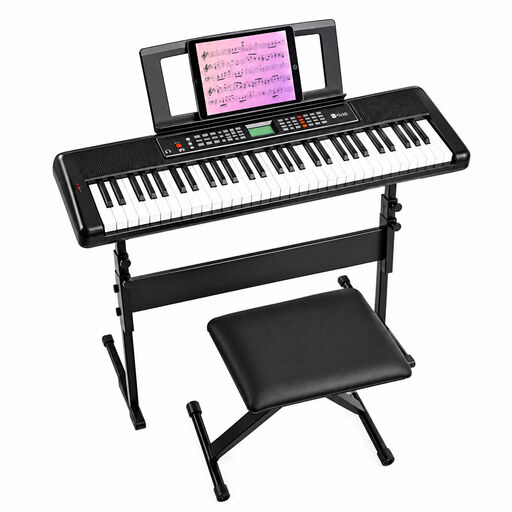 No image available
This 61-key bundle is an option for compact voicings if its stated range suits your practice material; compare the lowest and highest notes you need before choosing.
The product name lists a stand, bench, music rest, 300 tones, 300 rhythms, three learning levels, an LCD screen and USB-MIDI.
It depends on the positions and parts you practise. Compare compact chord positions with passages where you play bass, voicings and melody at the same time; Berklee covers both chord voicings and left-hand bass. Try the lowest and highest notes you need on the keyboard you are considering.
You need a suitable external sound source, such as software on a computer. Novation explains that MIDI control data does not contain sound in itself; also decide how you will listen to the sound from your chosen source.
Measure the width and depth of the space where the instrument will go, and allow room for playing, sheet music and a stand if needed. Also check the headphone and pedal sockets on the exact model, and whether the pedal you want is included.
For eligible distance purchases from a business, you generally have 14 days to change your mind; the Dutch government lists some exceptions. Your statutory rights are separate from this: according to ACM ConsuWijzer, what you can expect from a product depends on the circumstances, and there is no fixed statutory two-year guarantee period in the Netherlands.
The Dutch government states that electronic devices offered for sale in the EU must carry a CE marking. Check the product information, marking and supplied power supply for the exact model; a claim on a sales page does not, by itself, prove that a specific item meets all requirements.