If you want to practise bass notes and two-handed voicings across a wide range, start with a compact 88-key digital piano and measure the whole set-up, not just the instrument. If even the keyboard width won’t fit, a 61-key keyboard can be a deliberate choice for voicings that stay within its range; it isn’t a substitute for a full piano keyboard. Compare the touch response, headphone socket, and pedal and stand compatibility too.
Who is this guide for?
Jazz pianist with a narrow practice space
You want to practise two-handed voicings across a full keyboard, but need to fit the whole set-up into your space. Casio gives the PX-S1100BK and CDP-S110BK a cabinet depth of 232 mm; Yamaha lists the P-145 as 268 mm deep without the music rest.
Pianist who practises touch response
You prioritise control over the keys and want to compare different weighted keyboards for yourself. Roland lists a PHA-4 Standard keyboard for the FP-10; Yamaha specifies a GHC keyboard for the P-145.
Player without enough room for 88 keys
You’re considering a shorter keyboard for practising chords and sounds, and accept that its range and feel will be different. Yamaha specifies 61 touch-sensitive FSB keys for the CK61.
What should you look for when choosing?
Compact piano with 88 weighted keys
Choose this option: if you want to use both hands across a full piano keyboard and depth is your main constraint. Casio lists a cabinet depth of 232 mm for the PX-S1100BK; Yamaha lists the P-145 as 1.326 × 268 mm without the music rest.
Bear in mind: a shallow cabinet won’t solve a lack of width. Measure the whole set-up and try the touch response for yourself.
Portable 88-key piano with a focus on touch response
Choose this option: if you have room for a full keyboard and want to compare weighted keys and headphone practice. According to Roland, the FP-10 has a PHA-4 Standard keyboard.
Bear in mind: key feel is personal. Check the depth with the music rest fitted too, and find out which pedal comes with the model.
Shorter keyboard with 61 keys
Choose this option: if your available width rules out an 88-key model and your parts fit within the shorter range. Yamaha specifies touch-sensitive FSB keys and electric piano sounds for the CK61.
Bear in mind: the CK61 doesn’t have the weighted 88-key piano keyboard found on the piano models mentioned here. Try your own bass lines and voicings.
| Consideration |
What should you check? |
Who is it important to? |
| Space and range |
Measure the available width and depth, including the music rest, stand, pedal and seating space. Compare dimensions measured on the same basis. |
I want to play bass notes on the left and voicings on the right across a full keyboard, but need to fit the set-up into a small practice space. Around 33% of consumers make space and range their top priority. |
| Touch response and pedal |
Try the same voicings on the keyboards you’re considering and check which pedal is included and which pedals the model is compatible with. |
I practise dynamics and pedal technique, and want the key feel to suit my piano playing. Around 27% of consumers put touch response and pedal first. |
| Practising with headphones |
Check the type of headphone socket and whether you also need a computer or audio connection. |
I want to practise without hearing the sound through speakers, so a suitable headphone socket matters to me. Around 20% of consumers make this their top priority when choosing. |
| Shorter keyboard and sounds |
Play your usual left-hand parts and right-hand voicings within the 61-key range before choosing a keyboard with fewer keys. |
I can’t fit an 88-key model and want to know whether my parts will work on a shorter keyboard. Around 20% of consumers make range and sound variety their main consideration. |
Common buying pitfalls
-
Comparing only the depth of the piano cabinet
The stated measurement without the music rest may differ from the depth of the set-up you’ll actually use.
Measure the complete set-up and compare dimensions on the same basis, for example, both with or both without the music rest.
Remember to allow space for the stand, pedal and stool too.
-
Treating a 61-key keyboard as a smaller 88-key piano
A shorter keyboard has a narrower range and may also have a different type of touch response from a weighted piano keyboard.
Try your own bass lines and voicings on the shorter keyboard, and only make this trade-off if your parts fit within its range.
-
Assuming the stand and pedal will suit your playing style
Pedal options and compatibility vary by model. A piano that isn’t positioned correctly may also be unstable.
Before buying, check what’s included in the package, model compatibility and the instructions for stable positioning.
A compatible pedal or suitable stand may take up extra space and require additional accessories.
Brands to compare
Casio
The PX-S1100BK and CDP-S110BK are worth considering if you need a shallow 88-key set-up.
- Casio specifies a cabinet depth of 232 mm for both models.
- This measurement doesn’t tell you the depth of the complete set-up or how the touch response will feel to you. Casio’s claim that it makes the slimmest piano is its own claim, not an independent, up-to-date comparison.
Yamaha
The P-145 is an 88-key option; the CK61 is a separate 61-key alternative with a range of keyboard instrument sounds.
- Yamaha lists a GHC keyboard and a depth of 268 mm without the music rest for the P-145. The CK61 has touch-sensitive FSB keys and electric piano sounds.
- The CK61 isn’t equivalent to a weighted 88-key piano keyboard.
Roland
The FP-10 is a portable 88-key piano to compare for practising at home.
- Roland specifies a PHA-4 Standard keyboard and built-in speakers. You can also practise with headphones.
- Roland says Bluetooth availability varies by country. Check whether this feature is available on the version being offered.
Kawai
The ES120 is a portable 88-key piano to compare if you’re also looking for split functions and connections for external equipment.
- Kawai lists a width of 130,5 cm and a depth of 28 cm without the music rest, or 35 cm with it.
- Pedal options depend on which parts are included or sold separately; specifications may vary by market.
Joybuy products
These Joybuy products are 61-key keyboards for players who want to check first whether their jazz voicings fit on a shorter keyboard.
 No image available
MLS-931 keyboard, 61 keys, black
An option if your own voicings fit within 61 keys.
Weighted keyboard; 300 sounds and 300 rhythms; USB-MIDI and headphone socket.
Joybuy
 No image available
Electronic keyboard with 61 keys, black
A shorter keyboard to consider if your usual parts fit within its range.
61 keys; MIDI and recording function; headphone socket.
Joybuy
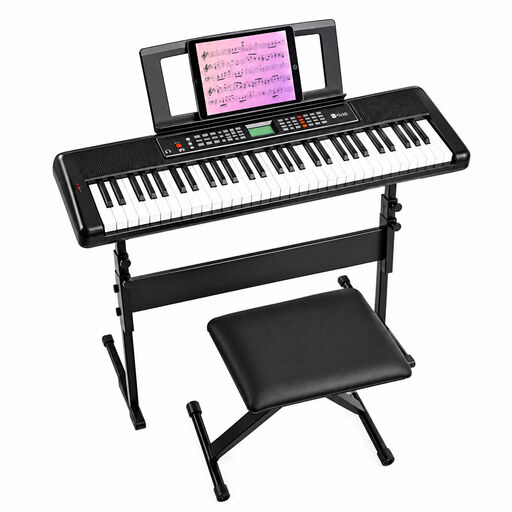 No image available
61-key keyboard set with stand and stool, black
A set to consider if you’re looking for a practice set-up with a stand and seat, and your parts fit within 61 keys.
500 tones; 300 rhythms; three-step learning mode; USB-MIDI.
Joybuy
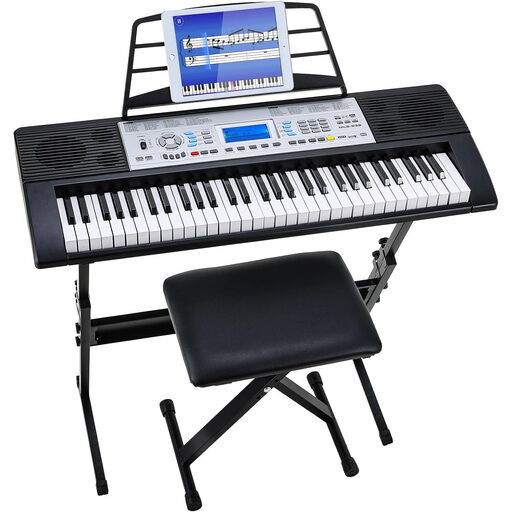 No image available
61-key keyboard set with stand and bench, black
An option if you’re looking for a practice set and your usual voicings fit on a 61-key keyboard.
300 sounds; USB-MIDI; headphone socket.
Joybuy
Frequently asked questions
Are 61 keys enough for your jazz voicings?
It depends on the bass notes and spacing you actually play. Try your own two-handed exercises within five octaves; if you need the full piano range, an 88-key model is the alternative.
What should you measure before placing a piano?
Measure both the cabinet and the complete set-up. Yamaha lists the P-145 as 268 mm deep without the music rest and 320 mm with it; Kawai lists the ES120 as 28 cm without and 35 cm with the music rest. Also leave room for a stable stand, seating and pedal.
Can you use any pedal and stand?
No. Check compatibility with the specific model and what’s included with the version on offer. Kawai offers different pedal options; Roland warns that incorrect positioning can cause instability.
What should you look for if you want to use headphones?
Check whether the model has a headphone socket and whether it’s compatible with your headphones. If you also want to use software, check which computer or audio connection suits the way you practise.
What product safety should you check when buying in the Netherlands?
Electronic devices sold on the EU market must meet the applicable safety requirements and carry the required CE marking, as explained by the Dutch government. Check the marking and product information for the item you want to buy; a general product rule doesn’t confirm that a specific item complies.


