For practising melodies and chord voicings with both hands, a portable digital piano with a piano-style keyboard is the obvious choice. If you want accompaniment without a computer, consider a keyboard with built-in styles. A MIDI controller is best suited to you if you already have a computer or another sound source. Yamaha, Roland, Casio and Korg describe piano-focused models, while Yamaha lists 61 keys for the PSR-E383 and Novation explains that MIDI data contains no sound itself. So check the available space, connections and equipment you’ll need, too.
Which option is right for you?
Aspiring jazz pianist
You want to practise melodies and chord voicings with both hands, and a piano-style feel matters more to you than a wide choice of accompaniment styles. Yamaha Music discusses jazz voicings for solo piano and accompaniment; the playing experience also depends on the keyboard you choose.
Player who needs to practise quietly
You share your practice space and want to listen through headphones instead of using the built-in speakers. Roland and Korg list headphone sockets on specific models; check the connections on the version you choose.
Player using accompaniment software
You want to practise a standard with rhythms or accompaniment, either on a keyboard or using software you already have. Yamaha describes the built-in accompaniment styles on the PSR-E383; Novation explains that a MIDI controller needs a separate sound source.
Which buying priorities make a difference?
Portable digital piano
Choose this option if: you want to practise parts for both hands with a piano-style feel and a suitable range of keys.
Trade-off: an 88-key model takes up more width than the 61-key keyboard considered here; Yamaha lists 88 keys for the P-145 and 61 for the PSR-E383.
Keyboard with built-in accompaniment
Choose this option if: you want to use rhythms or accompaniment styles without a computer; Yamaha lists built-in styles for the PSR-E383.
Trade-off: the PSR-E383 has 61 organ-style keys, not a weighted piano keyboard; check that its range suits the parts you play.
MIDI controller with an external sound source
Choose this option if: you already use a suitable computer with music software or an external sound source.
Trade-off: Novation explains that MIDI data contains no sound, so a controller on its own isn’t enough to hear what you play.
Compare the highest and lowest notes in your arrangement with these four buying priorities and the facilities available in your music room.
| What to consider |
What to check before buying |
Who should give this more weight? |
| Piano feel and range |
Compare the highest and lowest notes in your arrangement with the keyboard, and try the exact model if possible. Yamaha lists 88 keys for the P-145 and 61 for the PSR-E383. |
If I’m practising melodies and chord voicings with both hands, I want to prioritise playing feel and range; around 36% of consumers care most about piano-style playing. |
| Practising in a shared space |
Check the type of headphone socket and what happens to the speakers when you plug in. Headphones don’t necessarily block the mechanical sound of the keys. |
When I share a music room, I want to practise with suitable headphones instead of using the speakers; around 29% of consumers prioritise using headphones in a shared space. |
| Accompaniment without a computer |
Check which styles the model offers and how the accompaniment is controlled; Yamaha lists built-in accompaniment styles for the PSR-E383. |
I want to play through a jazz standard with a rhythm without using a computer, so built-in accompaniment matters more to me; around 21% of consumers prioritise this way of playing. |
| MIDI with existing equipment |
Check that you have suitable software or an external sound source, as well as audio output. Novation stresses that MIDI data contains no sound itself. |
If I already have suitable software or hardware in my music room, I want to use it to control MIDI notes; around 14% of consumers prioritise using MIDI with equipment they already own. |
What to watch out for when buying
-
Confusing touch sensitivity with a weighted piano keyboard
Yamaha describes the PSR-E383 as a keyboard with touch-sensitive organ-style keys, and the P-145 as having a GHC keyboard. Touch sensitivity doesn’t automatically mean that two models feel the same to play.
Choose a keyboard that suits the way you want to play, and try the exact version before deciding if you can.
-
Assuming a MIDI controller produces piano sounds on its own
According to Novation, MIDI data is control data and contains no sound itself. Without suitable software or another sound source and audio output, you won’t automatically hear a piano sound.
Before buying, check which computer, software, external equipment and connections you can use in your music room.
-
Assuming an optional pedal unit or stand is included
Korg distinguishes between the B2 and the B2SP setup. An item included with one version won’t necessarily come with another bundle.
Compare the full model code and the contents listed for the specific offer, not just the product family or image.
-
Choosing a 61-key model without checking your parts
The Yamaha PSR-E383 considered here has 61 keys, while the P-145 has 88. An arrangement may include notes outside the range of the model you choose.
Check the highest and lowest notes in the parts you want to play before choosing a more compact model.
Brands and models to consider
Yamaha
The P-145 and PSR-E383 considered here represent different ways to play; these features apply to those models, not every Yamaha instrument.
- Yamaha specifies 88 keys and a GHC keyboard for the P-145; according to Yamaha, the PSR-E383 has 61 touch-sensitive keys and accompaniment styles.
- The PSR-E383 has a smaller range and a different type of keyboard from the 88-key models considered here. Choose according to your arrangement and how you want to play.
Roland
The FP-10 is an 88-key, piano-focused option considered here, with headphone use.
- Roland lists a PHA-4 Standard keyboard and a metronome for the FP-10.
- Roland warns that Bluetooth may not be available in every country. Check that the feature is included in the version sold in the Netherlands before relying on it.
Casio
The CDP-S110 is a compact, portable digital piano with 88 keys.
- For the version described, Casio Europe lists a cabinet depth of 232 mm, battery or mains power, and an SP-3 damper pedal included in the box.
- Check the power supply and pedal contents of the actual offer in the Netherlands; what’s in the bundle may determine what else you need.
Korg
The B2 is a digital piano; the B2N and B2SP are different versions or setups and shouldn’t be treated as the same bundle.
- Korg lists an 88-key NH keyboard, a headphone/line-out socket and a damper pedal included with the B2.
- According to Korg, half-pedalling requires the separately available PU-2. The B2SP is a different setup, with a stand and pedal unit.
Novation
Launchkey is a controller option for anyone who already has software or an external sound source in their practice setup.
- Novation explains how Launchkey can send MIDI control data to operate software or compatible external equipment.
- MIDI contains no sound itself, so check that you have a sound source, software and audio output available too.
Joybuy product picks
These Joybuy picks are keyboards for practice. For each model, compare the key range, connections and listed accessories with your arrangement and practice space.
 Image unavailable
MLS-931 digital piano, 61 keys
An option to compare if rhythms and private practice are important to you; check that 61 keys cover the range of your arrangement.
The product name lists weighted keys, 300 rhythms, USB-MIDI and a headphone socket.
Joybuy
 Image unavailable
Electronic keyboard, 61 keys, with recording function
An option if you’re looking for a keyboard with a recording function and music stand; first check that the parts you play fit within 61 keys.
The product name lists speakers, a metronome and a music stand.
Joybuy
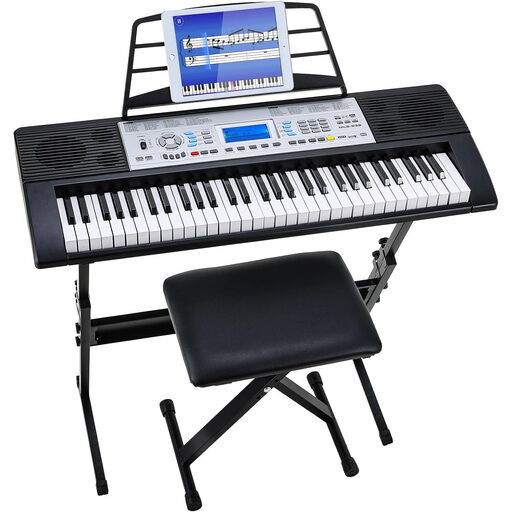 Image unavailable
61-key keyboard set with stand and stool
A set to consider for a permanent practice space with room for a stand and stool; compare the key range with your arrangement.
The product name lists 500 sounds, a three-level lesson mode, an LCD screen and dual speakers.
Joybuy
Frequently asked questions
Do you need 88 keys for every jazz arrangement?
Not necessarily. Compare the lowest and highest notes in the parts you actually play with the instrument’s range. The Yamaha PSR-E383 considered here has 61 keys; the P-145 and Casio CDP-S110 have 88.
What should you check before using an instrument in a shared music room?
Check the power supply, that you have a stable place to play, and the headphone and pedal connections on the model you’ve chosen. A MIDI controller also needs a suitable sound source and audio output; don’t assume that software or equipment is already available in the room.
Does a MIDI controller produce piano sounds on its own?
No. MIDI control data contains no sound itself. Novation explains that a controller such as Launchkey can operate software or compatible external equipment, so check in advance which sound source and audio output you can use.
How can you practise with headphones while keeping the listening volume under control?
The World Health Organization advises keeping the volume low, for example no higher than 60% of the maximum, and taking the duration and frequency of listening into account too. That percentage isn’t a measured safe volume setting for every instrument and headphone combination.
Can you return an instrument bought online in the Netherlands?
For online consumer purchases, ACM ConsuWijzer says you generally have up to 14 days to change your mind after the product has been delivered, subject to exceptions. Check whether an exception applies to your purchase and follow the returns instructions; cancellation rights are separate from your rights if a product is faulty.


