
Jazz piano student
Practises the spacing and dynamics of voicings across a full piano keyboard and wants to judge for themselves whether the action suits their playing.


For jazz voicings with a piano-like feel and a wide range, an 88-key digital piano is a good starting point. If you regularly switch between piano, electric piano and organ sounds during rehearsals, consider an instrument designed for the stage. A compact keyboard with fewer keys is mainly an option if your parts fit within its range. Check how the instrument connects to the studio set-up, too, and try the exact keyboard action for yourself: specifications can’t tell you how it will feel to play.
Practises the spacing and dynamics of voicings across a full piano keyboard and wants to judge for themselves whether the action suits their playing.
Wants to be heard in the rehearsal room and switch between piano and other keyboard sounds; connections and sound controls are also important.
Takes their instrument along and sets it up each time. Size and weight matter, as does having enough keys for the parts they need to play.
Best for: practising piano-style voicings across the full piano range.
Consider: check that the instrument will fit in the studio and try the keyboard action for yourself.
Best for: rehearsals where you use or combine piano, organ and other sound sections.
Consider: the number of keys and keyboard type vary by model; also check whether your preferred model is available.
Best for: limited set-up space or travel, if your voicings fit within the keyboard’s range.
Consider: try your lowest left-hand note and highest right-hand note on the exact model.
| What to consider | What to look for | Who should pay particular attention? |
|---|---|---|
| Keyboard action and range | Play your own lowest and highest voicings; try both gentle and firm keystrokes on the exact model. | When I practise piano-style voicings with both hands, I want enough range and an action that suits my playing. Around 33% of consumers put action and range first. |
| Volume and connections | Compare the instrument’s output with the studio inputs and check which cable you’ll need. | If I want to play through the studio set-up during rehearsals, the instrument needs to connect to it. Around 27% of consumers give studio audio and connections top priority. |
| Choice of sounds | Check which sounds you can select on the exact model and whether you can split or combine sections. | When I switch between piano, electric piano and organ parts in an arrangement, the choice of sounds is crucial. Around 20% of consumers put this first. |
| Transport and set-up | Measure the available space and allow for a stand, pedal, power supply and cables; check the model’s weight. | If I have to carry and set up the instrument each time, size and ease of handling matter a lot. Around 20% of consumers prioritise transport and set-up. |
The number of keys and the keyboard type vary by model. A description alone won’t tell you how the instrument feels or whether your voicings will fit within its range.
Check the full model name, number of keys and keyboard construction. Try your own parts on the exact model.
Practising on your own and playing through the studio set-up may require different connections.
Compare the instrument’s outputs with the studio inputs and check whether you can also practise with headphones.
The Dutch government states that the Netherlands has no fixed statutory warranty period. If a product is faulty, the retailer is your point of contact; a manufacturer’s warranty is in addition to your statutory rights.
Read what any additional warranty covers and keep your purchase and product information.
The P-225 is a portable digital piano worth comparing if you’re looking for a full-size piano keyboard.
The FP-30X is worth comparing if you’re looking for a full-size piano keyboard and options for different listening set-ups.
The ES120 is a portable digital piano worth comparing for practising on your own and connecting to external audio.
The Privia PX-S1100BK is worth considering if you want to set up a full-size piano keyboard in a shallow space.
The Electro 6 models are stage-focused alternatives if you want to use multiple sound sections.
These Joybuy products are compact 61-key keyboards. They’re only suitable for jazz voicings that fit within this range; also check which keyboard and connection features matter for your practice set-up.
 Image unavailable
Suitable for practising voicings within a 61-key range; try your own parts on the exact model.
The product name lists a MIDI controller, recording function, speakers, metronome and music stand.
 Image unavailable
Consider this model if your voicings fit within 61 keys; check the keyboard type and try the action for yourself.
The product name lists a weighted keyboard, 300 sounds, 300 rhythms, an LCD screen, USB-MIDI, speakers, a headphone socket and a music stand.
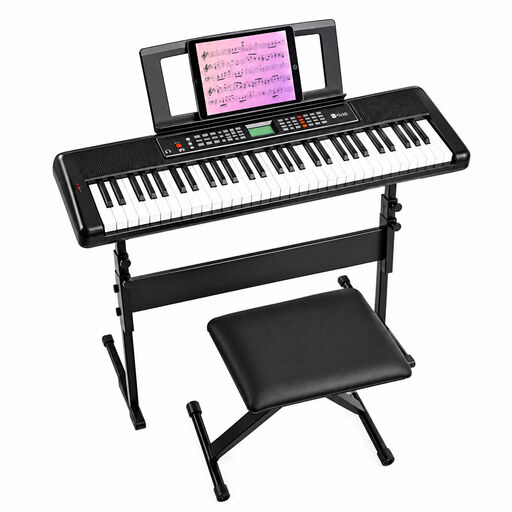 Image unavailable
The 61 keys suit parts that stay within this range; try your own voicings on the exact model.
The product name lists a stand, stool and music stand, 300 sounds, 300 rhythms, a three-step learning mode, an LCD screen and USB-MIDI.
Play your lowest note with your left hand and your highest note with your right hand on the exact model. Nord lists 61 keys for the Electro 6D 61 and 73 for the Electro 6D 73; that difference in range could make all the difference for your parts.
That depends on the instrument and the studio inputs. Roland lists built-in speakers and outputs for external powered speakers for the FP-30X; Kawai lists built-in speakers and Line Out for the ES120. Compare the connections before choosing your cables.
Check that the stand, pedal, power supply and cables are suitable for the model you’ve chosen and the space available in the studio. Roland lists specific optional stands and pedals for the FP-30X; follow your own instrument’s manual for maintenance and electrical safety.
No. According to the Dutch government, the Netherlands has no fixed statutory warranty period. You’re entitled to a product that works properly; factors including its type, price and expected lifespan are taken into account. If a product is faulty, the retailer is your point of contact. A manufacturer’s warranty is in addition to your statutory rights.
According to the Dutch government, distance purchases often come with a 14-day cooling-off period, although there are exceptions. It also states that electronic products on the EU market must carry a CE mark. Check the information about the model on offer and the seller, especially if the seller is based outside the EU.