Who is this buying guide for?

Pianists refining their voicings

You want to practise chord voicings with both hands, so you’re comparing key range, touch and pedal use on standalone pianos. Yamaha and Roland describe models with 88 keys, while Korg specifies a hammer-action keyboard for the B2.

Players with a small practice space

You need to set up your instrument in a spare room or put it away regularly, so you’re comparing dimensions, weight and headphone practice options. Roland, Casio and Korg list connections or portability features for specific models.

Keyboard players recording sounds

You want to switch between piano sounds while playing voicings or work with a DAW, and need to choose between built-in sounds and software that requires an audio output. Novation describes the Launchkey as a MIDI controller; MIDI data does not contain sound on its own.

What should you consider when choosing?

Digital piano with weighted keys

Choose this if: you want to practise two-handed voicings and piano-style dynamics on a standalone instrument. According to their manufacturers, the Yamaha P-225 and Roland FP-30X both have 88 keys.

The trade-off: an 88-key instrument needs more space than a shorter keyboard. Try the action on the exact model you’re considering.

61-key keyboard

Choose this if: you’d prefer a shorter keyboard with easy access to other sounds or built-in accompaniment. Yamaha describes the CK61 as having piano, electric piano and organ sounds, and the PSR-E383 as offering accompaniment styles.

The trade-off: check that the range is sufficient for both your left-hand voicings and right-hand part. This isn’t an 88-key hammer-action keyboard.

Lightweight 88-key digital piano

Choose this if: you want to keep the full range and move the instrument regularly. Korg lists the Liano as having 88 touch-sensitive keys and a stated weight of 6,0 kg.

The trade-off: according to Korg, the Liano has an LS keyboard. Try the action if you also want to practise piano technique.

MIDI controller with a computer

Choose this if: you want to record or listen to voicings in a DAW using software instruments. Novation specifies that the Launchkey 88 MK4 has 88 semi-weighted keys and DAW controls.

The trade-off: the controller doesn’t produce sound on its own; you’ll need working software and an audio output.

What to consider What should you check? Who is this important for?
Key range and touch Play your own left-hand voicing and right-hand part on the exact model. Compare the range and feel; the number of keys alone doesn’t tell you what the keyboard feels like. I want to practise voicings with both hands and need a range and touch that suit my parts; around 31% of consumers prioritise piano-style touch and range.
Practising with headphones Check the headphone socket on the exact version and whether you’ll also need it for external audio. Headphones don’t change the physical feel of the keys. I want to practise in the spare room without sound from the speakers; around 25% of consumers say headphone practice is their top priority.
Sounds and accompaniment Try the sounds and controls you want. Built-in accompaniment is different from playing both parts yourself. I want to switch between sounds or use accompaniment, rather than play piano sounds alone; around 19% of consumers prioritise a variety of sounds or built-in accompaniment.
Space and storage Measure the space, including the stand and room for a seat. Also check that the weight and keyboard suit how often you plan to move the instrument. I need to fit the instrument into the spare room and store it easily; around 13% of consumers prioritise a suitable size and easy storage.
DAW and audio output Before buying, check that your software instrument, MIDI setup and audio output work for the way you want to practise. I mainly want to record or listen to voicings using software; around 12% of consumers say working with a DAW is their main requirement.

Common buying pitfalls

  • Mistaking a 61-key keyboard for an 88-key piano keyboard

    Yamaha specifies 61 touch-sensitive keys for the PSR-E383 and an 88-key GHC keyboard for the P-225. They’re designed for different practice setups.

    Before choosing, play your own voicings and right-hand part on the exact keyboard.

  • Buying a MIDI controller as a ready-to-play piano

    Novation states that Launchkey MIDI data does not contain sound on its own.

    Choose this option if you want to use a software-based workflow and can set up the software instruments and audio output.

  • Comparing only the cabinet size or number of keys

    Your playing space, stand and pedal are also part of the complete setup. Roland and Kawai list optional stands or pedals for specific models, while Korg says the Liano comes with a pedal switch.

    For the model you choose, check the power supply, headphone socket, stand and the sustain pedal you want.

    An optional stand or pedal upgrade means making a separate choice when putting together your practice setup.

Brands to consider

Yamaha

The product lines described range from an 88-key digital piano to 61-key keyboards.

  • Yamaha describes the P-225 as having an 88-key GHC keyboard; the CK61 offers electric piano and organ sounds.
  • The CK61 and PSR-E383 have a shorter range than an 88-key keyboard, and their keyboards aren’t directly interchangeable with the P-225’s.

Roland

The FP-30X is a portable, 88-key digital piano for practising on its own.

  • Roland specifies a PHA-4 Standard keyboard and two headphone outputs for this model.
  • Roland lists stand and pedal options separately, so check which accessories are included with the version you’re considering.

Casio

The CDP-S110 is a digital piano for anyone looking for a standalone instrument with a pedal and headphone socket.

  • Casio lists a scaled hammer-action keyboard and an included SP-3 pedal for this model.
  • The PHONES/OUTPUT socket may also be needed for external audio, so check that it suits your setup.

Korg

The Liano is described as a lightweight 88-key digital piano, while the B2 has a specified hammer-action keyboard.

  • According to Korg, the Liano weighs 6,0 kg and uses an LS keyboard; the B2 has an NH hammer-action keyboard.
  • The Liano and B2 have different keyboard types, so try the action if it matters for your practice.

Kawai

According to Kawai, the ES120 combines a Responsive Hammer Compact keyboard with built-in electric piano sounds.

  • The manufacturer describes it as a portable digital piano.
  • The stand and triple pedal unit are listed as optional; descriptions of key cushioning aren’t an independent sound measurement in a spare room.

Novation

The Launchkey 88 MK4 is a MIDI controller for anyone working with a DAW and software instruments.

  • Novation specifies 88 semi-weighted keys and DAW controls.
  • MIDI data doesn’t contain sound on its own; you’ll need software and an audio output to hear the notes you play.

Joybuy products for this practice setup

This Joybuy selection consists of 61-key keyboards. They’re worth considering if your parts fit within that range; check the connections you need and the included accessories for each version.

MLS-931 digital keyboard with 61 keys, black

MLS-931 digital keyboard, 61 keys, black

An option to consider if your voicings fit within the range of 61 keys.

The product title lists a weighted keyboard, 300 sounds, 300 rhythms, USB-MIDI, speakers, a headphone socket and a music stand.

View at Joybuy

Digital keyboard with 61 keys, black

Digital keyboard, 61 keys, black

This model may suit you if a 61-key range is enough for your voicings.

The product title lists a recording function, speakers, a metronome and a music stand.

View at Joybuy

Digital keyboard with 61 keys, stand, bench and music stand

Digital keyboard, 61 keys, with stand and bench

A set to consider if a 61-key range suits your parts and you also need a seat and support.

The product title lists 300 sounds, 300 rhythms, USB-MIDI, a stand, bench and music stand.

View at Joybuy
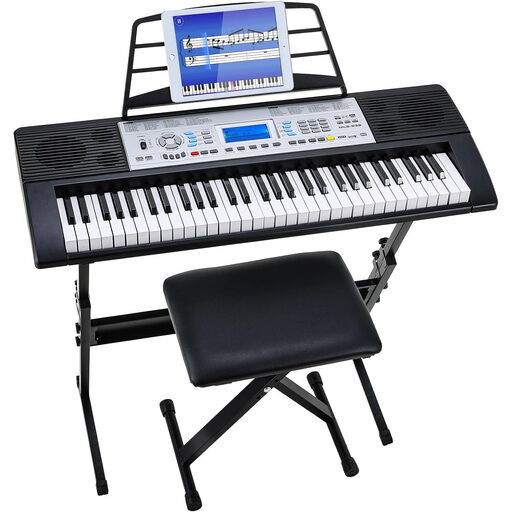
Digital keyboard with 61 keys, stand and stool

Digital keyboard, 61 keys, with stand and stool

This keyboard is worth considering if your parts fit within 61 keys and you need a stand and a seat.

The product title lists 500 sounds, a three-level learning mode, two speakers and an LCD screen.

View at Joybuy

Frequently asked questions

Do I need 88 keys for jazz voicings?

Not for every chord voicing. Before buying, play your own left-hand voicing alongside the right-hand part on the keyboard you’re considering. The Yamaha CK61 and PSR-E383 have 61 keys, while the digital pianos mentioned include 88-key models. The range you need depends on the parts you play.

Can I play a MIDI controller through headphones straight away?

Not as a standalone sound-producing instrument. Novation explains that a Launchkey sends MIDI data but doesn’t produce sound itself; first, set up a software instrument and your preferred audio output.

What should I set up in the spare room?

Check that you have a suitable space, power supply, stand and sustain pedal. Korg lists an adapter, music stand and pedal switch as included with the Liano; Kawai lists a stand and triple pedal unit as optional for the ES120. Follow the manual for your chosen model when using and cleaning it.

Who can help if an instrument bought in the Netherlands develops a fault too soon?

For a consumer purchase, the seller is responsible if the product doesn’t perform as you could reasonably expect under normal use. ACM ConsuWijzer explains that statutory consumer rights apply alongside any manufacturer’s or seller’s guarantee; the right solution depends on the circumstances.

Is a CE logo the same as an independent safety certificate?

No. According to the European Commission, where applicable harmonised EU rules require it, CE marking is the manufacturer’s declaration that the product meets the relevant requirements. Check the information for the specific instrument; the marking isn’t a certification issued independently.
