What should you consider when choosing?
Standard steam iron
Choose this if: you usually iron for short periods, want to work precisely around small edges and have limited storage space.
Bear in mind: it has a smaller tank than a steam generator, so you may need to refill it more often when ironing a large load.
Steam generator
Choose this if: you often iron for long periods at a time and have room for a separate water tank.
Bear in mind: it takes up more space. Even with automatic settings, the care label should always guide you.
When ironing a mixed load, start by checking the care instructions for each item. Then compare the appliance features that suit the way you use it: precision around small edges, changing settings, refilling and storage.
| What to consider |
What to look for when buying |
Who is this important for? |
| Handkerchiefs and edges |
Look at the shape and reach of the tip, and check whether the steam can be adjusted. Assess the steam boost separately from the continuous steam output. |
If I mainly iron small handkerchiefs and edges, I want to be able to guide the tip precisely. Around 36% of consumers prioritise this level of finish. |
| Switching between fabrics |
Check the ironing symbols and see whether the model offers manual settings or an automatic setting for ironable fabrics. |
When I have a basket of laundry with different labels, I want to be able to choose the right approach for each item. Around 28% of consumers prioritise being able to handle different fabrics. |
| Long ironing sessions |
Compare tank capacity and refilling, the space needed for the base and the continuous steam output. Don’t confuse the latter with a short steam boost. |
If I iron a lot in one go, I want to stop less often to refill the water. Around 18% of consumers prioritise longer sessions. |
| Storage and maintenance |
Check the dimensions and maintenance instructions for the exact model. Also check whether the anti-scale system requires cleaning or replacement parts. |
With limited cupboard space, I want to know where the appliance and any separate tank will fit, and what maintenance is required. Around 18% of consumers prioritise space and maintenance. |
Irons at Joybuy
This selection includes standard steam irons and steam generators for short, mixed and longer ironing sessions. Before buying any mains-powered model, check the applicable electrical safety requirements and CE marking for the exact model.
 Image unavailable
Philips 3000 Series Steam Generator Iron PSG3000/20
If you’re considering a steam generator for longer sessions, compare its tank and space requirements with your weekly ironing pile.
2400 W; steam boost 350 g; water tank 1,4 l.
View at Joybuy
 Image unavailable
Philips 3000 Series Steam Iron DST3031/20
A standard steam iron to compare if you usually iron for short periods and want to match the settings to the care labels when switching between fabrics.
Continuous steam 40 g/min; steam boost 180 g; water tank 300 ml.
View at Joybuy
 Image unavailable
Xiaomi Handheld Steam Iron BHR9034EU
A compact handheld steamer to compare if you’re short on space. Check that its controls and method of use suit ironing on a flat surface.
The product name specifies dual voltage.
View at Joybuy
 Image unavailable
Philips 1000 Series Steam Iron DST1030/20
A standard steam iron to compare against your ironing time and need for manual settings.
2000 W. According to the product instructions, steam isn’t available on the synthetic setting.
View at Joybuy
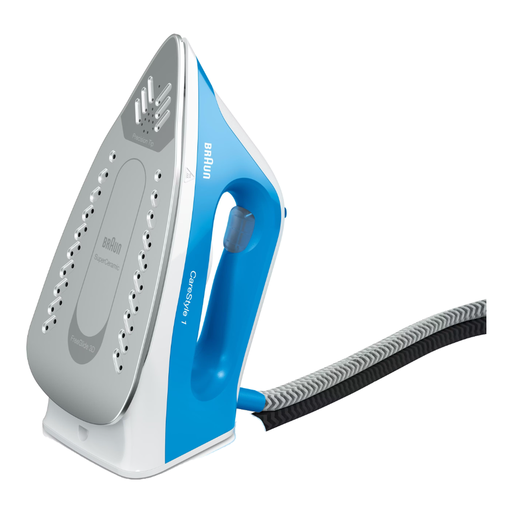 Image unavailable
Braun CareStyle 1 IS1012 Ironing System
A steam ironing system to compare if you often have longer sessions. Check the tank, settings and storage space needed for this model.
View at Joybuy
Frequently asked questions
Can you automatically select the highest setting for cotton handkerchiefs?
No. First check the ironing symbol on the handkerchief and follow any limitations on the label. GINETEX states that the maximum temperature is determined by the care label, not just the type of fibre. Check the other items in the wash in the same way.
What water should you use, and how do you maintain the iron?
Follow the manual for your exact model for guidance on water, any additives and maintenance. According to the Consumers’ Association of the Netherlands, steam irons and steam generators are designed for tap water, but descaling is still necessary.
Are you only entitled to a two-year warranty in the Netherlands?
No. In addition to any manufacturer’s warranty, statutory guarantees apply without a fixed time limit in the Netherlands. ACM ConsuWijzer explains that if a product breaks sooner under normal use than you could reasonably expect, you can contact the seller for an appropriate solution.
Can you return an iron bought online within 14 days?
For a standard online consumer purchase, you generally have a statutory cooling-off period of up to 14 days after delivery, although there are exceptions. ACM ConsuWijzer explains the cooling-off period; also check the terms that apply to your purchase.
What electrical safety requirements apply to products sold in the Netherlands?
The applicable electrical safety requirements and CE marking apply to new mains-powered household appliances within the scope of the Low Voltage Directive. The Netherlands Food and Consumer Product Safety Authority and the European Low Voltage Directive explain these requirements. Check the specific model, as a statement on a product page alone doesn’t confirm compliance.


