A steam generator is a better fit if you need to iron several uniform items in a row or tackle stubborn creases. For just a few sleeves and limited storage space, a standard steam iron is more practical. The Dutch Consumers' Association highlights the larger water tank and lighter hand unit as factors to consider, but you should also check that you have a suitable ironing board. A sleeve board can make it easier to position narrow sleeves; always follow the care label.
Who is this relevant for?
Weekly uniform ironing
You iron several uniform items in a row and want to tackle creases without having to refill the tank often. A steam generator could suit you if you have room for the complete set and a suitable ironing board. The Dutch Consumers' Association says a steam generator is particularly relevant for people who do a lot of ironing.
Precise sleeve ironing
You want to position narrow sleeves and awkward corners neatly; extra steam may not be your main priority. A sleeve board can help, provided you can set it up securely. Brabantia describes its sleeve board as an aid for ironing sleeves and shirts.
Occasional quick ironing
You iron just a few sleeves before the working week and want to get your appliance out and put it away quickly. A standard steam iron may be more practical if limited space and a short ironing session matter more to you than a larger water tank.
What should you consider when choosing?
Steam generator
A good fit for: regularly ironing several uniform items in a row or tackling stubborn creases.
Trade-off: the complete set takes up more space and needs a suitable, stable ironing board.
Standard steam iron
A good fit for: ironing a few sleeves, working with limited storage space or getting started quickly.
Trade-off: with a smaller water tank, you may need to refill it more often when ironing several items.
| What to consider |
What to check before buying |
Who should pay particular attention? |
| Positioning sleeves |
Measure the available working space and check that a sleeve board will fit securely. Brabantia lists an ironing surface of 60 × 10 cm for its specific sleeve board. |
If I mainly want to lay out narrow sleeves and cuffs neatly, I’d look for a suitable ironing surface rather than extra steam. Around 36% of consumers put precise sleeve ironing first. |
| Ironing several items |
Compare continuous steam output figures like for like, rather than comparing them with a steam boost. Check the tank capacity and whether your board can support the generator; the Dutch Consumers' Association says the larger tank is useful for longer sessions. |
If you want to iron several uniform items in a row, focus on refilling and tackling stubborn creases. Around 29% of consumers prioritise a longer ironing session. |
| Fabric and steam |
Read the care label on each item and check whether you can adjust the steam. Don’t use steam if the label says not to; an automatic setting doesn’t override that instruction. |
If I’m ironing different uniform fabrics, I want to follow the instructions for each item and adjust the steam accordingly. Around 21% of consumers prioritise fabric care and using the right amount of steam. |
| Storage and maintenance |
Measure your storage space and check the warm-up time and descaling instructions for the exact model. Philips provides maintenance procedures for each series. |
If I’m ironing just a few sleeves, I want an appliance that’s easy to get out, put away and maintain. Around 14% of consumers prioritise compactness and easy maintenance. |
Common buying mistakes
-
Confusing a powerful steam boost with continuous steam
A steam boost and the regular steam output are different specifications. Too much steam can also leave your clothes and ironing board damp.
For longer ironing sessions, compare the continuous output in g/min separately from the steam boost, and check the available settings.
-
Buying a large generator for just a few sleeves
A complete generator takes up more space and usually takes longer to heat up than a standard steam iron. A standard ironing board may not be suitable for the complete set.
Compare it with a standard steam iron too, and consider whether a sleeve board would solve the positioning problem more effectively.
-
Assuming an automatic setting replaces the care label
The care instructions on the garment always take priority; a setting doesn’t override a warning not to iron or steam.
Read the label before choosing a temperature or steam setting, and don’t use steam if the label says not to.
-
Confusing a manufacturer’s guarantee with your statutory rights
According to the Dutch Government, there is no fixed time limit for the statutory guarantee in the Netherlands. The seller remains your point of contact if a product doesn’t meet what you could reasonably expect from it.
Before paying for an additional guarantee, compare it with the statutory rights you already have.
A paid-for additional guarantee may be unnecessary if it doesn’t give you any extra rights.
Brands worth comparing
Tefal
The Express Power range is worth comparing for longer ironing sessions and a removable scale collector; the details below apply to the SV8111E0.
- Tefal lists continuous steam output of 120 g/min, pump pressure of 6,2 bar and a removable 1,8-litre tank for the SV8111E0.
- These are manufacturer specifications, not independently measured ironing results. A larger generator is less suitable if storage space is your main concern.
Braun
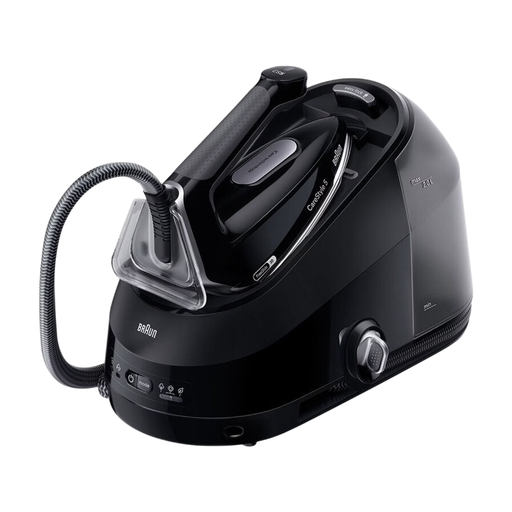
The CareStyle 5 IS5249BK is worth considering if you want to compare different settings and a hand unit for longer ironing sessions.
- Braun lists a maximum steam output of 150 g/min and Eco, iCare and Turbo settings for the IS5249BK.
- These specifications apply to this model. Check that the complete set and your ironing board fit in your available space.
Philips
The PerfectCare 7000 PSG7300/70 is worth comparing if you’re weighing up automatic steam and a setting for ironable fabrics.
- Philips lists a motion sensor, a maximum steam output of 170 g/min and a 1,5-litre tank for the PSG7300/70.
- These are manufacturer specifications for this particular model. Follow the care label and the descaling instructions for the exact model.
Steam generators at Joybuy
These Joybuy steam generators are worth comparing for ironing uniform sleeves and other ironable garments.
 No image available
Philips 3000 Series PSG3000/20
A steam generator worth comparing if you iron several ironable garments in a row.
Power: 2400 W.
Steam boost: 350 g.
Water tank: 1,4 L.
Vertical steaming function.
Joybuy
 No image available
Philips PerfectCare Compact Essential GC6842/30
A steam generator worth comparing if you iron several ironable garments in a row.
Joybuy
 No image available
Tefal Express Power SV8026
A steam generator worth comparing for ironing several garments in one session.
Joybuy
 No image available
Braun CareStyle 5 IS5249BK, black
A steam generator worth comparing if you iron several ironable garments in a row.
Joybuy
 No image available
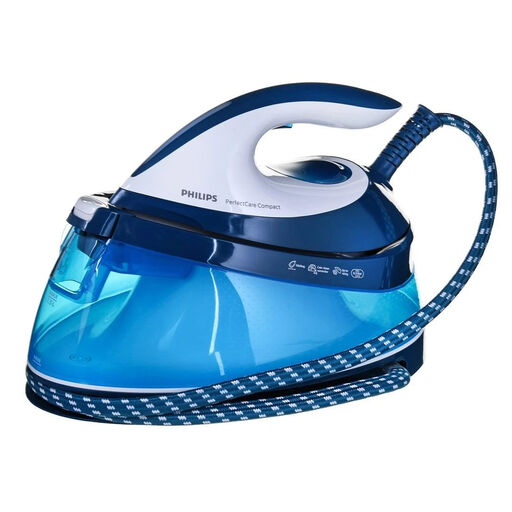
Philips PerfectCare GC7840/20
A steam generator worth comparing for longer sessions with ironable garments.
Power: 2400 W.
Steam boost: 400 g.
Water tank: 1,5 L.
Vertical steaming function.
Joybuy
Frequently asked questions
Can I steam-iron any uniform sleeve?
No. Check the care label on each garment. An iron symbol crossed out means you shouldn’t iron it; if the label says not to use steam, iron without steam. An automatic setting doesn’t change these instructions.
How can I stop sleeves and the ironing board from staying damp?
Use steam sparingly and follow the Dutch Consumers' Association’s advice: iron with steam first, then without steam until the fabric is dry. Too much steam can condense on your clothes and ironing board.
How often should I descale a steam generator?
Follow the manual for the exact model. Philips recommends regular descaling and gives different procedures for each series; harder water can lead to limescale building up more quickly. Don’t assume a Philips procedure is suitable for another brand.
What product safety should I check when buying a steam generator?
Electrical equipment that falls within the scope of the EU Low Voltage Directive and is sold in the Netherlands must meet the applicable EU safety requirements, including CE marking and clear instructions and safety information. Check this for the exact model supplied; a brand name alone doesn’t confirm compliance.
Do I automatically get only two years of statutory guarantee in the Netherlands?
No. According to the Dutch Government, there is no fixed time limit for the statutory guarantee in the Netherlands: the product must do what you could reasonably expect from it. Contact the seller if there’s a problem; a manufacturer’s or additional guarantee doesn’t replace your statutory rights.


