
Pressing uniform sleeves precisely
You want to press cuffs and sleeve creases neatly, and can clear a small, stable area for ironing. Check the care label to see whether the fabric can be ironed and what temperature to use.


For a sharp crease in uniform sleeves, a standard steam iron is usually a good choice, as long as you have a stable, heat-resistant surface. Check the care label first and make sure the whole set-up will fit in your small laundry area. If you only need to freshen up your uniform and there’s no room for an ironing board, a handheld steamer or hybrid appliance may be more practical. However, according to the Consumentenbond, an iron removes creases more effectively than a garment steamer. A steam generator is worth considering mainly for longer ironing sessions, provided you also have a safe space for its separate base and an ironing board.
You want to press cuffs and sleeve creases neatly, and can clear a small, stable area for ironing. Check the care label to see whether the fabric can be ironed and what temperature to use.
You have little room for both the appliance and an ironing board. Decide whether a compact ironing set-up will fit, or whether simply freshening up your uniform without a sharp crease will do.
You regularly get through a larger pile of clothes and are weighing up refilling and longer sessions against the extra space needed for a steam generator and its base.
Best for: you want a sharp crease and have a safe, stable place for a small ironing board.
Trade-off: you’ll need more space to set it up and store it than you would for vertical steaming.
Best for: you mainly want to freshen up uniforms and can’t set aside a permanent ironing area.
Trade-off: according to the Consumentenbond, an iron removes creases more effectively than a garment steamer. If you’re considering a hybrid model, check which settings require an ironing surface.
Best for: you have longer ironing sessions and enough room for both the base and an ironing board.
Trade-off: the separate base takes up worktop and storage space, so measure the area available beforehand.
First decide whether you need a sharp crease or mainly want to freshen up your uniform. Then measure the space for the whole appliance and the surface it needs, not just the handle.
| What to consider | What to look for | Who should give this more thought? |
|---|---|---|
| Precise pressing | Check the shape of the iron’s tip and whether a stable, heat-resistant surface will fit. | I want to press sleeves and cuffs flat and create a visible crease. Around 40% of consumers say precise pressing is their top priority. |
| Work and storage space | Measure the appliance, any separate base, and the space needed to set it down safely and store it. | I have limited space and want to know whether the ironing area I need will fit in my laundry area too. Around 30% of consumers say space is their main buying concern. |
| Freshening up one uniform item | Check what set-up the setting you choose requires, and whether freshening up will be enough instead of pressing. | I usually treat one uniform item at a time and don’t want to set up a large ironing station every time. Around 20% of consumers say quickly treating a single item is most important to them. |
| Longer ironing sessions | Check the model’s water tank and care instructions, and allow space for a steam generator’s base. | I iron several uniforms in one go and want to weigh up the extra space needed for the base against the convenience of longer sessions. Around 10% of consumers say longer ironing sessions are their top priority. |
Freshening up is not the same as pressing. According to the Consumentenbond, an iron removes creases more effectively than a garment steamer.
Before you buy, decide whether you really need a visible crease.
You also need space for an ironing surface and, if you choose a steam generator, its separate base.
Measure the whole set-up and allow for a safe place to set the appliance down and let it cool.
A stated steam output is not an independent test of the fabric or sleeve construction of your uniform.
Compare like-for-like specifications and follow the care label. Don’t choose based only on the steam shot figure.
The TexStyle 3 range includes steam irons such as the SI 3030 PU. Check the features and dimensions of the specific model before setting aside space for it.
The 3000 Series includes standard steam irons, while Philips describes the OneTurn GC213/10 as a hybrid iron and steamer.
The Express Steam FV2838 is a steam iron, while the Express Easy SV6131 is a steam generator with a separate base.
This selection includes steam irons for pressing against fabric, as well as handheld and 2-in-1 models. Choose according to the crease you want, the care instructions and the space available for the appliance and ironing surface.
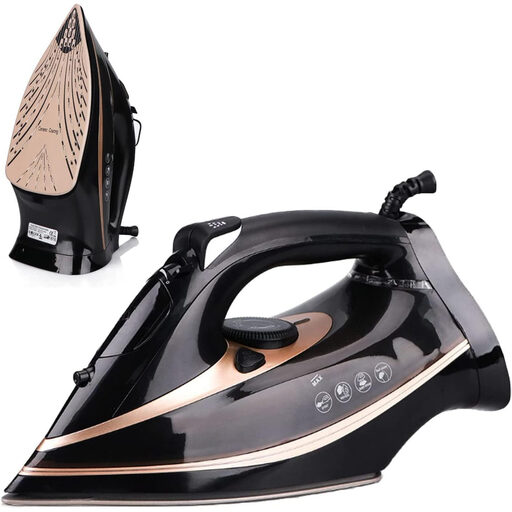 No image available
A steam iron for pressing against fabric; set aside a stable, heat-resistant surface.
Ceramic soleplate; steam output 70 g/min; steam shot 120 g; 300 ml water tank; self-cleaning.
 No image available
A 2-in-1 model to consider if you’re looking for a handheld design; check which settings require an ironing surface.
 No image available
A handheld steam iron to consider if space is limited; check whether you can work horizontally on a stable surface to get the crease you want.
Dual voltage.
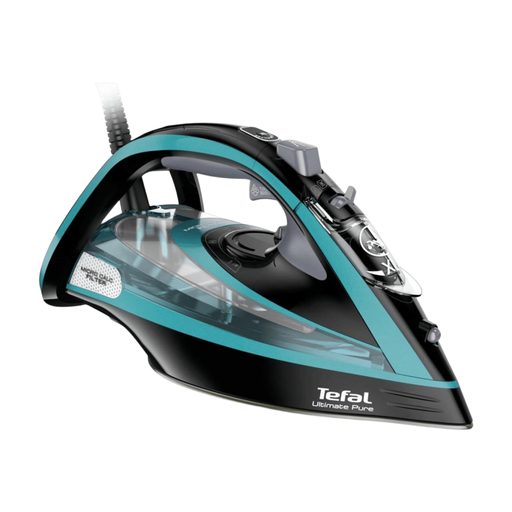 No image available
A steam iron for pressing against fabric; make sure you have a suitable, heat-resistant surface.
 No image available
A steam iron for pressing against fabric; check that the ironing surface you need will fit in your laundry area.
Colour: blue and white; power: 2000 W.
No. Check the care label on each item. Follow the stated temperature and the symbols for ironing and steam; don’t use heat or steam if the label says not to.
Philips, for example, describes using a rolled-up towel inside the sleeve. You still need a stable, heat-resistant work surface for ironing with an electric appliance; a towel is not a substitute for one.
Follow the descaling instructions for your exact model. Tefal warns that using vinegar or descaler when rinsing a steam tank may cause damage; don’t assume this guidance applies to every appliance.
For online purchases, you generally have a 14-day cooling-off period. In the Netherlands, you’re also entitled to a product that is fit for purpose, but there is no fixed statutory warranty period; a manufacturer’s warranty is in addition to this. The exact rules depend on the purchase.
Electrical appliances must meet the applicable European safety requirements. According to Ondernemersplein, the Dutch government’s business information portal, the manufacturer applies a CE marking after assessing the relevant requirements and draws up an EU declaration of conformity. A product listing alone does not confirm that this assessment has been demonstrated for every individual item offered for sale.