
Careful sleeve ironer
You want to finish seams, cuffs and buttons neatly, without leaving an unwanted crease. A manageable iron tip and a suitable ironing surface may therefore matter more than a high steam output alone.


For a few uniform sleeves and limited storage space, a compact steam iron with a suitable ironing surface is the most practical choice. A sleeve board can help support the sleeve without folding it in half. A handheld steamer is better suited to freshening up clothes while they hang, while a steam generator is worth considering if you regularly iron large loads and have space for its separate water tank. Always check the care label and the CE marking on the exact appliance being offered before you choose.
You want to finish seams, cuffs and buttons neatly, without leaving an unwanted crease. A manageable iron tip and a suitable ironing surface may therefore matter more than a high steam output alone.
You usually iron just a few garments at a time and want to be able to put the appliance and ironing surface away easily after use.
You want to adjust the temperature and steam to suit the care instructions, while using a hot appliance safely in shared accommodation.
The Consumentenbond cites small ironing loads and limited storage space as reasons to consider a steam iron. The percentages below each refer to consumers choosing an iron for uniform sleeves; the main concern behind each purchase is shown in each row.
Choose this if: you iron a few uniform items and have limited space.
Trade-off: the water tank is built into the iron, so you may need to refill it sooner during longer ironing sessions. A sleeve board is a separate option and requires extra storage space.
Choose this if: you mainly want to freshen clothes while they are hanging and would rather not use an ironing board.
Trade-off: this method does not automatically provide a firm pressing surface for shaping a sleeve.
Choose this if: you regularly iron large loads of crease-prone garments.
Trade-off: the separate water tank needs more storage space, and the extra steam must still be suitable for the fabric.
| What to consider | What to look for | Who it matters to |
|---|---|---|
| Precise finishing | Check the shape of the iron tip and whether the sleeve fits on the ironing surface. A sleeve board is a separate work surface; also check that it is stable and suitable for steam. | If I want to finish seams, cuffs and buttons neatly without creating an extra crease, I look at both the iron tip and the ironing surface. Around 36% of these consumers prioritise precision. |
| Storage space | Compare the iron’s dimensions and weight with the available heat-resistant work surface and storage space. | If I only iron a few sleeves and have little room for an appliance or board, compact storage is a major consideration. Around 29% of these consumers list storage space as their main concern when buying. |
| Fabric and steam | Read the care label and check that the temperature and steam settings are suitable. Do not compare continuous steam output with a steam shot. | If I want to care for uniform fabrics according to their individual instructions, I first check which settings are suitable. Around 21% of these consumers put fabric care first when choosing a product. |
| Safe use and maintenance | Check whether the exact model switches off automatically and how to descale it. Follow the instructions and inspect the cord and socket. | In shared accommodation, I want a stable place to use the iron and clear maintenance instructions. I would not rely on automatic shut-off instead of paying attention. Around 14% of these consumers prioritise safe use and maintenance. |
A handheld steamer can freshen clothes while they hang, but it does not automatically provide the firm pressing surface you need to shape a sleeve precisely.
First decide whether you mainly want to freshen your clothes or actually press a sleeve.
If you later decide you want to press a sleeve, you may need an iron and a suitable ironing surface as well as the handheld steamer.
Manufacturers list continuous steam output and a steam shot as separate figures. So a high steam-shot figure is not the same as the amount of steam delivered continuously. Too much steam can also make the fabric and ironing surface wet.
Compare continuous output with continuous output, and check that both features are suitable for the care label.
For the Tefal FV2838E0, the product description on Joybuy states that automatic shut-off is not included. Temperature control and shut-off are separate features.
Check whether the exact model has automatic shut-off, and never leave a hot iron unattended.
These brands are included because of features found on the models mentioned; this information is not an assessment of every product from each brand.
The 3000 Series DST3010/30 is an example of a steam iron with a precision tip, anti-drip function and descaling feature.
The Express Steam FV2838E0 is an example of a traditional steam iron where you select the temperature setting yourself.
The TexStyle 3 SI 3055 Black is an example to consider if a precision tip and automatic shut-off are important to you.
These product selections are steam irons for short ironing sessions and finishing uniform sleeves. Before buying any specific item, check its product information and CE marking. The Dutch government states that electrical appliances offered in the EU must meet the applicable requirements and carry the required CE marking.
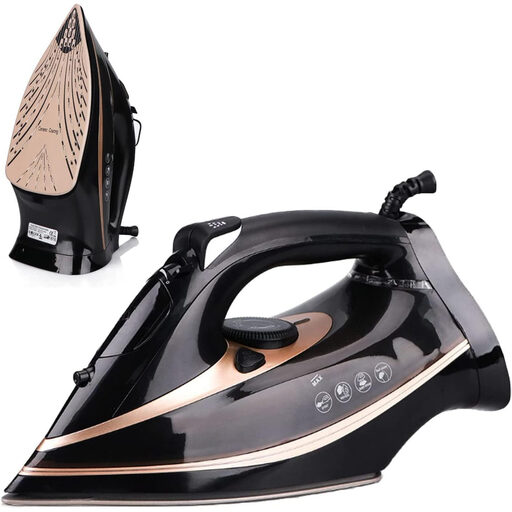 No image available
An option if you are looking for a steam iron with a ceramic soleplate for uniform sleeves.
The product name lists 2600 W, a 120 g steam shot, a 300 ml tank and a self-cleaning function.
 No image available
An option if you are looking for a manageable iron for short sessions with uniform clothing.
The product name lists 2400 W, a non-stick soleplate, an automatic cleaning function and an anti-drip system.
 No image available
An option if you want to compare a Philips 3000 Series model with stated steam specifications.
The product name lists a 180 g steam shot, continuous steam output of 40 g/min and a 300 ml tank.
 No image available
A model to include in your comparison if you are looking for a Tefal steam iron for garments that can be ironed.
 No image available
An option if you are looking for a compact handheld steam iron for a short ironing session.
The product name lists a compact, lightweight design and Dual Voltage. Check that the voltage rating is suitable for where you plan to use the appliance.
For a few sleeves and limited storage space, a compact steam iron with a suitable ironing surface is a sensible choice. The Consumentenbond cites small ironing loads and limited storage space as reasons to consider a steam iron; a handheld steamer is better suited to freshening clothes than to precise pressing.
No. Follow the care label on the specific garment. GINETEX describes, among other things, an ironing setting of no more than 110 °C without steam, so do not base your choice only on the fabric you think the garment is made from.
Not for every sleeve. If you want to support the sleeve without folding it in half, a narrow sleeve board may be an option. Check that it is stable and suitable for use with steam; the information about how it works is based on the manufacturer’s details.
Compare continuous steam output with continuous steam output, and keep steam-shot figures separate. The Consumentenbond describes these as separate specifications; also check that the temperature and steam settings are suitable for the care label.
Check the product information and CE marking for the exact appliance being offered. The Dutch government states that electrical appliances offered in the EU must meet the applicable product safety requirements; a brand or model name alone does not confirm that the item being offered carries the marking.