Who is this choice relevant to?

Collar and cuff specialist

You mainly iron a few shirts and want to work carefully around collar edges and buttons without having to store a large appliance. Philips recommends laying a shirt collar flat and ironing the underside first, followed by the outside.

Mixed-fabric ironer

You take shirts in different materials out of the wardrobe and want to adjust the temperature and steam to suit their care labels. The Dutch Consumers' Association advises following care instructions and sorting laundry by ironing temperature.

Large-pile ironer

You iron a lot of shirts in one go when changing your wardrobe and want to refill the water less often, even if the appliance takes up more space. The Dutch Consumers' Association suggests a steam generator as a possible choice for anyone who does a lot of ironing and has enough storage space.

What should you look for when choosing?

Standard steam iron

Choose this if: you iron a few shirts, have limited storage space or mainly want to tidy up collar details.

Bear in mind: the built-in water tank may mean you need to refill more often during a long ironing session.

Steam generator

Choose this if: you iron a lot of shirts in one go and want a larger, separate water tank.

Bear in mind: the complete setup takes up more space and is less straightforward to store.

Dry iron

Choose this if: you only occasionally touch up a collar and the care label allows ironing without steam.

Bear in mind: you’ll need to add moisture separately if needed, and still set the correct temperature.

What to consider What to look for when buying Who should pay particular attention?
Ironing precisely around collar edges and buttons Compare the shape of the soleplate tip and how the exact model feels in your hand; a precision tip does not guarantee better ironing results. If I mainly iron collar edges and buttons, I want to be able to guide the tip accurately. Around 40% of consumers prioritise precision around collars.
Protecting different shirt fabrics Check whether you can adjust the temperature and steam appropriately, and follow the care label; maximum steam is not suitable for every fabric. When ironing shirts in different materials, I want to be able to choose the right setting for each item. Around 30% of consumers prioritise fabric protection.
Ironing a lot of shirts in one go Compare the tank and the dimensions of the complete setup with your laundry load, storage space and ironing board. If I iron a large pile in one session, I want to refill the water less often. Around 20% of consumers prioritise capacity for a full session.
Maintaining the steam function between seasons Check how the model is descaled and follow the instructions for water, emptying and maintenance. After a period without ironing, I want to know how to deal with limescale and maintain the steam function. Around 10% of consumers prioritise ease of maintenance.

Common pitfalls

  • Assuming a high steam output will solve every collar problem

    A steam generator is best suited to a lot of ironing; for a few shirts, a standard steam iron may be more practical. Steam output alone does not tell you whether the tip can reach collar edges easily.

    Start by considering how much laundry you have and how easily you can reach collar details. Then compare steam outputs between models of the same type.

  • Following general fabric advice instead of the care label

    The permitted temperature and use of steam vary from one garment to another. The wrong setting can damage the fabric or leave shiny marks.

    Read the care label before setting the temperature and steam.

  • Assuming an anti-scale function makes maintenance unnecessary

    Descaling methods vary by appliance, and limescale can affect the steam function.

    Check the instructions for the exact model and follow the guidance on descaling and emptying the tank.

Brands to consider

Philips

The 1000 Series includes standard steam irons; the DST1030/20 and refurbished DST1030/20R1 are different versions.

  • Philips lists a non-stick soleplate, temperature control and Calc-Clean for the refurbished DST1030/20R1.
  • These manufacturer specifications do not prove that the refurbished version is identical to the standard DST1030/20.

Tefal

The FV6670E0 and SV8110E0 are examples of different setups: a cordless steam iron and a steam generator.

  • Tefal lists a precision tip and manual settings for the FV6670E0; for the SV8110E0, it specifies a separate generator unit and a limescale collector.
  • Published steam output figures are manufacturer specifications, not independently measured results.

Braun

The TexStyle 3 SI 3030 is an example to consider when comparing the soleplate tip and maintenance of a standard steam iron.

  • Braun lists a precision tip and Self Clean for this model.
  • Descriptions of how smoothly it glides and its ironing performance are manufacturer claims, not confirmed advantages over other brands.

Rowenta

The Autosteam DW4020D1 is an example of a model with automatic steam and temperature settings.

  • Rowenta lists a precision tip for this model.
  • Check the specifications of the version you choose; features of the DW4020D1 do not automatically apply to other Rowenta models.

HEMA

Item 80080009 is an example of a basic steam iron with an adjustable thermostat.

  • HEMA lists a ceramic soleplate, anti-drip system, self-cleaning function and 1.9 m cord for this item.
  • These are product specifications and retailer claims, not the results of an independent ironing test.

Joybuy products for ironing shirts

This selection includes standard steam irons and larger setups for longer ironing sessions. Compare the tank, dimensions and listed settings with your ironing routine and available storage space.

Philips 3000 Series PSG3000/20 steam generator

Philips 3000 Series PSG3000/20

The removable 1.4-litre water tank is suited to longer ironing sessions when you want to refill less often.

The product name lists 2400 W and a 350 g steam boost; these figures are product specifications, not comparative test results.

The generator setup takes up more space than a standard steam iron.

View at Joybuy

Xiaomi BHR9034EU handheld steam iron

Xiaomi BHR9034EU handheld steam iron

Manual temperature and steam controls suit anyone who wants to care for different fabrics according to their care labels.

The product information lists a weight of 0.77 kg, a 0.15-litre tank, vertical steaming and dual voltage.

View at Joybuy
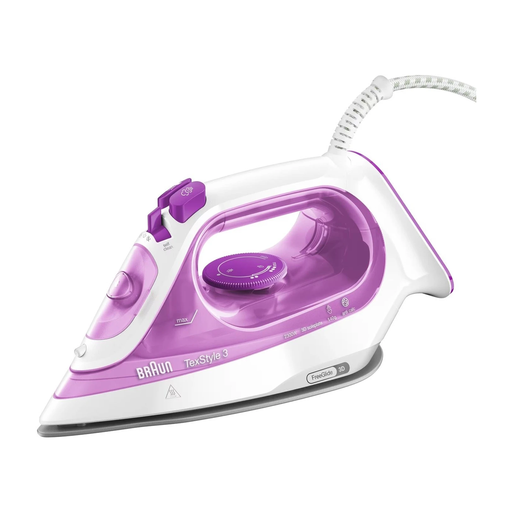
Braun TexStyle 3 SI3030 steam iron, purple

Braun TexStyle 3 SI3030, purple

The product information highlights a precision tip for collar edges and seams.

According to the product information, this model has a 270 ml tank and a self-cleaning system.

View at Joybuy
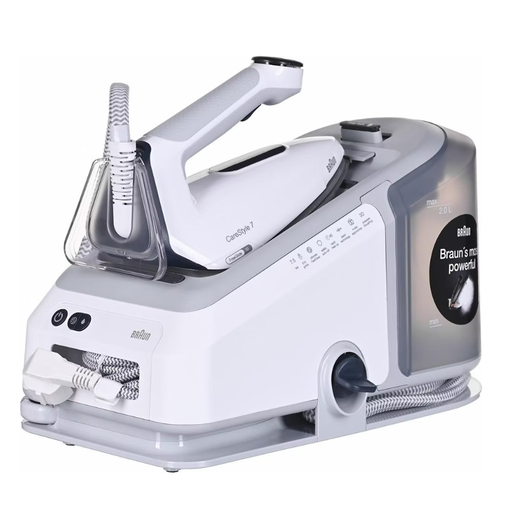
Braun CareStyle 7 IS7262GY ironing system

Braun CareStyle 7 IS7262GY

The 2-litre tank is useful if you want to iron for longer with fewer interruptions.

The product information lists a FastClean descaling system and a FreeGlide 3D soleplate.

View at Joybuy

Braun FreeStyle 5 SI5037 steam iron, violet

Braun FreeStyle 5 SI5037, violet

The listed precision tip is useful if you want to work around collar details and other hard-to-reach areas.

The product information lists a 300 ml tank, self-cleaning and automatic shut-off.

View at Joybuy

Frequently asked questions

How do you iron a shirt collar without creating new creases?

Check the care label first and lay the collar flat. Philips recommends ironing the underside first, followed by the outside; guide the tip around buttons rather than ironing over them.

Do you always need to use steam?

No. The care label may advise against steam, and dry ironing may be suitable. For stubborn creases in fabric that can be steamed, the Dutch Consumers' Association suggests using a steam boost or spray function, followed by dry ironing.

What should you do with a steam iron after changing your wardrobe?

Follow the instructions for your exact model for descaling and maintenance. The Dutch Consumers' Association recommends emptying the tank after ironing; heated water can leave limescale behind.

Does a two-year manufacturer’s warranty mean you have no rights in the Netherlands after that?

No. According to the Dutch Government, the Netherlands has no fixed statutory warranty period: a product must meet what you can reasonably expect of it. If a product is faulty, the seller is your point of contact; a manufacturer’s warranty is an additional benefit.

Which product safety rules apply to an electric iron sold in the Netherlands?

Under the European Low Voltage Directive, electrical equipment within the applicable range of 50–1000 V AC or 75–1500 V DC must carry a CE marking when placed on the EU market and meet the applicable safety requirements. The marking is not an independent assessment of ironing performance and, on its own, does not prove that every individual product complies.
