
For ironing cuffs with limited cupboard space
You mainly press small areas of shirts and want to store both the appliance and a suitable ironing surface neatly. Prym describes its Mini as a small iron for precise ironing.


If you want sharply pressed cuffs, a mini iron or an iron with a precision tip is a sensible choice, provided you can also store a suitable ironing surface. A handheld garment steamer takes up less space than a permanent ironing set-up, but Philips says it won’t deliver the same results as an iron, particularly on thicker cotton or linen shirts.
You mainly press small areas of shirts and want to store both the appliance and a suitable ironing surface neatly. Prym describes its Mini as a small iron for precise ironing.
You also iron whole shirts and need to work around collars, cuffs and seams. A standard steam iron takes up more room than a mini version, but it’s also designed for larger areas of clothing.
You want to tackle small creases without setting up an ironing board each time, and accept that steaming doesn’t always produce the same results as pressing with an iron.
First decide whether you want to press cuffs sharply or mainly remove creases. Then consider how much space the appliance and the ironing surface together will take up.
| What to consider | What should you check? | Who is this important for? |
|---|---|---|
| Pressing cuffs precisely | Check the soleplate shape, how easily you can work around buttons, and whether you can lay the cuff flat and safely. | If you mainly want to press small areas sharply, look for good control around seams and buttons; around 40% of consumers prioritise pressing cuffs precisely. |
| Storing the appliance and ironing surface | Check the space needed for the appliance and any mat or case, as well as the requirement for a heat-resistant surface. | If you have limited cupboard space, you’ll want room for the complete ironing set, not just the appliance; around 30% of consumers prioritise storage space for both the appliance and ironing surface. |
| Ironing whole shirts too | Compare the soleplate shape and water tank, and allow for the space needed for a suitable ironing surface. | If you regularly iron a whole shirt, you’ll want an option that works well on larger panels as well as offering control for cuffs; around 20% of consumers prioritise this broader range of ironing tasks. |
| Quick touch-ups without an ironing board | Check whether the model can be used horizontally, and whether removing creases is enough or you want a sharply pressed finish. | If you mainly want to tackle small creases without a permanent set-up, steaming is worth considering, along with the difference between steaming and pressing; around 10% of consumers prioritise quick refreshes. |
A compact appliance won’t completely solve your storage problem if you also need an ironing board or another safe ironing surface.
Think of the appliance, surface and any case as one storage set when comparing options.
Philips says a garment steamer won’t deliver the same results as an iron, particularly on thicker cotton or linen shirts.
Decide in advance whether you want sharply pressed cuffs or mainly want to reduce creases.
Prym says the Mini Set includes a silicone stand and case. Don’t assume these accessories are also included with the standard Mini without checking.
Check the full article number, plug type and what’s included in the box.
Prym offers mini irons for small, precise ironing jobs. The Mini and Mini Set are different versions.
The TexStyle 7 Pro SI 7160 is a standard steam iron for anyone who irons larger areas of a shirt as well as cuffs.
According to Tefal, the Duo Power JF4031E0 combines horizontal ironing with vertical steaming.
The OneTurn GC215/20 is a hybrid alternative; Philips also describes using garment steamers horizontally on cuffs.
The First Class DA1510F2 is a travel iron; when using it at home, remember to allow for the space needed for an ironing surface.
This selection includes handheld irons, a 2-in-1 model and a handheld garment steamer for small ironing jobs. Storage space and the difference between pressing and removing creases remain important considerations for each type.
 No image available
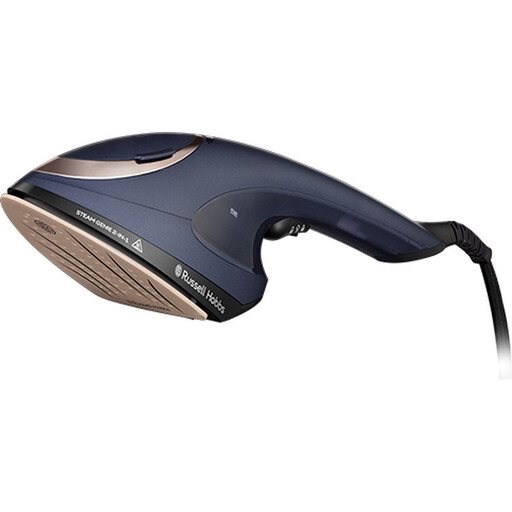
A handheld iron for small ironing jobs; the product description also mentions vertical steaming.
The product name lists 2400 W. The description mentions a non-stick soleplate, adjustable temperature, dry and steam ironing, an anti-drip system and an automatic cleaning function.
 No image available
A 2-in-1 model that combines ironing and steaming; if storage space is limited, remember to allow room for the appliance.
The product description mentions a ceramic soleplate, a steam function and a cord storage system.
 No image available
This compact handheld iron is designed for small ironing jobs; the description also mentions vertical steaming.
Dimensions: 25 × 7,5 × 13,5 cm. The description lists a removable 0,15 l water tank, dry and steam ironing, and manual temperature control. The product name lists Dual Voltage. Place the appliance on a stable, heat-resistant surface when using it and while it cools down.
 No image available
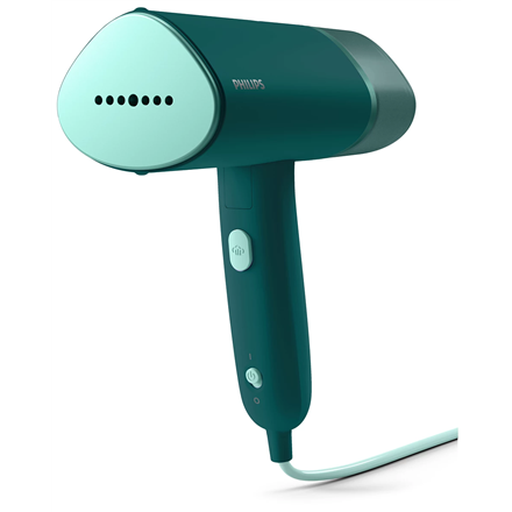
A handheld garment steamer for refreshing clothes without an ironing board; according to Philips, a steamer won’t deliver the same results as an iron, particularly on thicker cotton or linen shirts.
The product name lists 1000 W and a 30-second heat-up time. The description mentions a removable 120 ml water tank, a foldable design and a storage pouch included in the box.
 No image available
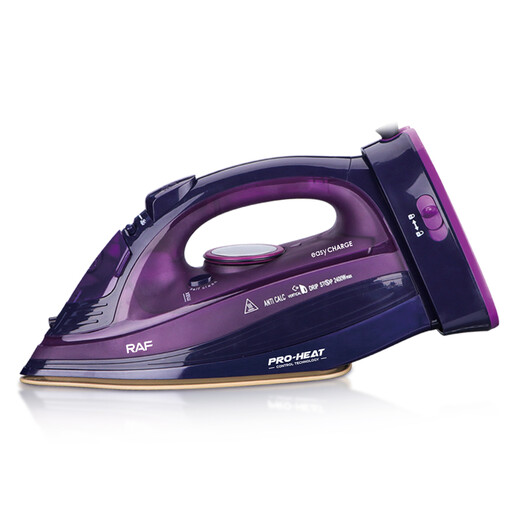
A cordless steam iron with a stated precision tip for small details; remember to allow room for the charging base too.
The product name lists 2400 W and a 320 ml capacity, with a steam output of 15–25 g/min. The description mentions a ceramic soleplate, self-cleaning and a 360° charging base.
Not for every method. Tefal says the Duo Power JF4031E0 comes with an ironing mat, and Philips describes steaming cuffs horizontally. If you’re using a standard or mini iron, check which heat-resistant surface the instructions allow. A small appliance doesn’t automatically make an unprotected tabletop suitable.
Follow the descaling instructions for your model. The Consumentenbond advises emptying the water tank after ironing and explains that heating hard water can cause limescale deposits.
According to the Dutch government, you have a legal guarantee from the retailer. There’s no fixed statutory guarantee period in the Netherlands; what matters is what you could reasonably expect from the product. A manufacturer’s warranty doesn’t replace this right.
CE marking is compulsory for electrical products covered by the Dutch Commodities Act Decree on Electrical Equipment. For low-voltage rules, the Netherlands Food and Consumer Product Safety Authority includes electrical equipment with a rated AC voltage of 50 V to 1000 V. This general requirement doesn’t confirm that an individual product on sale is correctly marked, so check the specific product.