
The cautious tie ironer
You want to remove creases without affecting the shape or finish of a cotton tie. Check the care label and, if ironing is permitted, use a pressing cloth, as Neakasa’s clothing care advice also recommends.


For one tie or a quick ironing session, a smaller iron is usually more practical than a steam generator. The Consumers’ Association lists doing little ironing and having limited storage space as reasons to consider a steam iron. A steam generator becomes more relevant when you also iron a large amount of cotton laundry, but always follow the tie’s care label and use a pressing cloth with light pressure.
You want to remove creases without affecting the shape or finish of a cotton tie. Check the care label and, if ironing is permitted, use a pressing cloth, as Neakasa’s clothing care advice also recommends.
You iron only a few items at a time and want to be ready for the working week without setting up or storing a large appliance. The Consumers’ Association lists doing little ironing and having limited storage space as reasons to consider a steam iron.
You include your ties in a larger ironing session and consider how often you’ll need to refill the tank, as well as the steam available for other laundry. The Consumers’ Association discusses choosing between a steam iron and a steam generator based on how much you iron.
Choose this if: you usually iron one tie or just a few other items and storage space matters.
Bear in mind: a smaller tank and less steam can be less convenient during longer sessions or when dealing with stubborn creases.
Choose this if: you include ties in a larger weekly ironing session, for example alongside heavier cotton laundry.
Bear in mind: the base unit takes up more space, and your ironing board needs to be sturdy enough to support it.
Choose this if: the care label allows steaming and you mainly want to tackle light creases without pressing down with an iron soleplate.
Bear in mind: an approach for light creases won’t necessarily remove sharp folds in the same way.
| What to consider | What should you check? | Who should pay particular attention? |
|---|---|---|
| Protecting the tie | Read the care label; if ironing is permitted, use a clean pressing cloth and light pressure. | I want to avoid heat or pressure affecting the shape or finish; around 33% of consumers prioritise protecting the tie. |
| Quick ironing session | Compare the size, heat-up time and how many items you iron at a time. | I want to quickly freshen up one tie or a few items without setting up a large base unit; around 27% of consumers prioritise a quick ironing session. |
| Larger cotton wash | Compare continuous steam output and tank capacity; distinguish between continuous steam output and a steam boost. | I also iron larger quantities of cotton and want to avoid refilling during a session; around 20% of consumers prioritise a larger ironing session. |
| Space and maintenance | Measure the space available, check whether your ironing board is suitable and read the model’s maintenance instructions. | I want to know whether the base unit will fit and what maintenance it needs; around 20% of consumers prioritise space and maintenance. |
The larger tank and higher steam output are most useful when you have a lot of ironing or stubborn creases to tackle. For one quick ironing session, the larger size and storage space it requires may be more of a drawback.
First, count how many items you usually iron at a time. Also compare a compact steam iron or careful steaming for light creases.
A larger appliance needs more space to set up and store, and may cost more to buy.
A steam specification doesn’t tell you how to care for your particular tie; direct heat or firm pressure can affect its shape or finish.
Follow the care label. If ironing is permitted, use a pressing cloth and light pressure.
Descaling methods vary by model and may require particular parts or maintenance steps.
Read the manual before buying and check which parts your chosen model uses.
The potential cost of model-specific replacement parts may be a factor.
Philips lists a continuous steam output of 120 g/min and a steam boost of 350 g for the PSG3000/20 steam generator. These are the model’s stated specifications.
Tefal lists a continuous steam output of 120 g/min, a removable 1.8-litre tank and Calc Clear for the Express Airglide SV8026E0.
Braun lists manually selectable settings and a continuous steam output of 180 g/min for the CareStyle 7 Pro IS7282BL.
These Joybuy products are steam generators for anyone who includes ties in a larger ironing session. For just one tie, a smaller appliance is also worth considering.
 No image available
Best suited to a larger weekly ironing session; for one tie, a smaller appliance is also worth considering.
Power: 2400 W. Water tank: 1,4 l. Vertical steam function. Steam boost: 350 g.
Only iron the tie if its care label allows it; use a pressing cloth and light pressure.
 No image available
Suited to anyone who irons ties as part of a larger weekly ironing session.
Water tank: 1,3 l. Vertical steam function.
Check the care label before ironing a tie; if ironing is permitted, use a pressing cloth and light pressure.
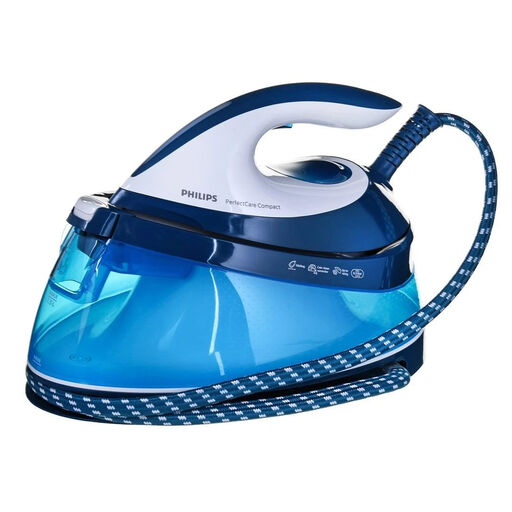 No image available
Suited to a larger ironing session where a bigger tank and steam for other laundry are useful.
Power: 2400 W. Water tank: 1,5 l. Vertical steam function. Steam boost: 400 g.
For a tie, follow the care label and, if necessary, iron it with a pressing cloth and light pressure.
 No image available
Suited to longer ironing sessions where a removable tank is a useful point of comparison.
Power: 2400 W. Removable water tank: 1,8 l. Steam output: 70 g. Steam boost: 120 g. Pressure: 6 bar. ECO mode and self-cleaning function.
These product specifications don’t determine how a particular tie can be treated; follow its care label.
No, don’t rely on the material alone. Check the tie’s care label; if ironing is permitted, Neakasa recommends using a pressing cloth and working carefully without placing the hot soleplate directly on the fabric.
A compact steam iron is usually more practical if you don’t have much ironing to do. The Consumers’ Association lists doing little ironing and having limited storage space as reasons to consider a steam iron; a steam generator makes more sense if you also iron a larger quantity of laundry.
Place it on a stable, heat-resistant surface and check that your ironing board is large and sturdy enough. The Consumers’ Association points out that a steam generator may be too large or heavy for a standard ironing board.
Follow the manual for your exact model, as descaling methods vary. Tefal advises against using vinegar or descaling products inside its steam generators.
According to ACM ConsuWijzer, you can contact the seller if a product is faulty; the solution depends on the circumstances. Don’t assume there is one fixed warranty period for every appliance.