
Skirt ironer with limited space
You want to iron cotton skirts neatly and flat, then store the appliance compactly after your move.


For cotton skirts you want to press flat and precisely, a standard steam iron is the most obvious choice, provided you have a stable ironing surface and set the temperature according to the care label. A handheld garment steamer is best for quickly freshening hanging clothes; a steam generator may be worth considering if you have a lot of ironing to do, but you’ll need space for the whole appliance. GINETEX advises choosing the maximum ironing temperature solely according to the care label, not just the fibre.
You want to iron cotton skirts neatly and flat, then store the appliance compactly after your move.
You mainly freshen up a few hanging garments just before heading out and want minimal set-up; a crisp, pressed finish isn’t your main priority.
As well as skirts, you iron a larger load of laundry and want to refill the appliance less often during a session.
A good choice if: you want to iron a few cotton skirts flat and have limited storage space after your move.
Keep in mind: you’ll need a suitable, stable ironing surface; you may need to refill the iron during longer sessions.
A good choice if: you mainly want to quickly freshen hanging clothes and compact storage matters more to you than a flat, pressed finish.
Keep in mind: steaming clothes while they’re hanging won’t necessarily replace pressing out stubborn creases in sturdy cotton.
A good choice if: you regularly iron a lot of laundry as well as your skirts, or often tackle stubborn creases.
Keep in mind: check that you have room in your new home to store both the separate water tank and the whole appliance.
| What to consider | What should you check? | Who is this more important to? |
|---|---|---|
| Pressing flat and precisely | Check the temperature setting and ironing symbol on each skirt. | If I want to press cotton skirts properly flat, I want to be able to set the temperature according to each garment’s care label. Around 36% of consumers give this ironing result top priority. |
| Compact storage | Compare the space needed for the whole appliance and, if you iron flat, your ironing surface. | When storage space is limited around a move, being able to put an appliance away compactly matters more than handling a large ironing load. Around 29% of consumers choose saving space as their top priority. |
| Quick freshening | Decide whether you want a flat, pressed finish or mainly want to freshen hanging clothes. | When I’m freshening a few garments just before heading out, I want minimal set-up and a crisp, pressed finish matters less. Around 21% of consumers prioritise speed when freshening a small number of items. |
| Maintenance and features | Read the model-specific descaling instructions and check whether the appliance has automatic shut-off. | If I want to clean the appliance before moving and store it safely, I want to know which features and maintenance steps apply. Around 14% of consumers put maintenance and operating features first. |
Steaming clothes while they’re hanging isn’t necessarily suitable for giving stubborn creases in sturdy cotton a crisp, flat finish. Philips advises that a steam iron can often remove creases from thick cotton more quickly; this isn’t a measured comparison for your particular skirt.
First decide what result you want, then compare a handheld steamer with a standard iron.
Tefal states that the specific FV2838E0 model does not have automatic shut-off, so don’t assume every model includes this feature.
Check the safety features against the full model number and follow the instructions for use.
A steam generator may suit you if you have a lot of ironing to do, but you’ll also need to make room for the tank and the whole appliance.
Consider both the amount of laundry you iron and the storage space in your new home.
Philips lists a ceramic soleplate and a 300 ml water tank for its DST3041/30 steam iron, making it a useful reference for smaller ironing loads.
Tefal lists a ceramic soleplate, a 270 ml tank and 40 g/min continuous steam for the Express Steam FV2838E0.
Braun offers both the standard TexStyle 1 SI1050BL steam iron and the separate QuickStyle 3 range of handheld garment steamers.
This selection includes steam irons and 2-in-1 ironing appliances for anyone who wants to press skirts flat and store the appliance after moving.
 Image unavailable
A 2-in-1 model may suit you if you’re looking for one appliance for both ironing and steaming.
Model: 28370-56.
 Image unavailable
This compact, lightweight model may suit you if you have limited storage space; check the voltage information for your intended use.
Model: BHR9034EU; the product name specifies Dual Voltage.
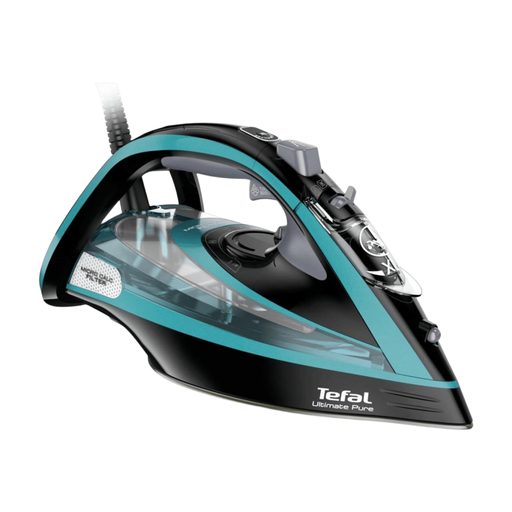 Image unavailable
A standard steam iron is an option if you want to press cotton skirts flat; set the temperature according to each skirt’s care label.
Model: FV9844.
 Image unavailable
This steam iron may suit you if you want to press skirts flat on an ironing surface.
Model: DST1030/20; power rating according to the product name: 2000 W.
 Image unavailable
A standard steam iron is an option if you want to press skirts flat; check that this model has the features you need.
Model: SI5037.
No. Follow the ironing symbol on each skirt’s label, as the fibre name alone doesn’t determine the right temperature. GINETEX advises choosing the maximum temperature solely according to the care label.
Follow the safety and storage instructions for the exact model, unplug it after use and only pack it once it has cooled sufficiently. Braun’s product warnings highlight the risk of a hot soleplate and steam.
Follow the model-specific descaling and cleaning instructions. Consumentenbond points out that limescale can cause problems with irons.
No. In the Netherlands, any manufacturer’s warranty sits alongside your legal rights to a product that meets what you could reasonably expect of it. According to ACM ConsuWijzer, there is no fixed statutory warranty period for every product; contact the seller if you have a problem.
If the appliance falls under the relevant EU product rules, check that it has the required CE marking and is suitable for the intended mains connection. The Netherlands Enterprise Agency lists electrical products as a product group that may be subject to CE rules; the applicable requirements depend on the appliance. A statement on a sales page is not a physical check of the item delivered.