Who is each type of iron suited to?

If you iron a few skirts

You bring out a few cotton skirts when changing over your seasonal wardrobe and want to smooth out the creases without having to store a large appliance. The Dutch Consumers' Association says a regular steam iron is a good choice if you don’t do much ironing or have limited storage space.

If you iron a large seasonal load

You iron your skirts along with lots of other laundry and want to refill less often during a long session. A steam generator iron may be a good fit if you have enough room for the appliance and a suitable ironing board.

If you iron seams and pleats carefully

You want to manoeuvre around seams or pleats, and pay extra attention to the care label if a skirt is made from different materials. GINETEX symbols show the maximum treatment permitted for the garment.

What should you look for when choosing?

Regular steam iron

Best for: a few skirts, occasional ironing or limited storage space.

The trade-off: it’s more compact, but the smaller tank may mean you need to refill sooner during a longer session. The Dutch Consumers' Association recommends this type if you don’t do much ironing.

Steam generator iron

Best for: lots of ironing in one go and frequent stubborn creases, if you have enough space.

The trade-off: the larger separate water tank can reduce the number of pauses needed for refilling, but the whole appliance takes up more room and not every ironing board is suitable. The Dutch Consumers' Association also lists longer heating times and more noise as possible drawbacks.

What to consider What to look for Who should pay extra attention?
Smoothing out creases Compare continuous steam output in g/min separately from the steam shot. Only use steam if the care label allows it. If I want to remove creases from ironable cotton, I look at the steam output while ironing, not just the peak shot. Around 40% of consumers say tackling creases is their top priority.
Compact storage Compare the dimensions, weight and tank capacity with the space you have and the amount of laundry you iron. If you only iron a few skirts, the appliance should also be easy to put away after use. Around 30% of consumers particularly value a compact option for occasional ironing.
Seams, pleats and care labels Check the care label for the whole skirt, the temperature setting and whether steam is allowed. A precision tip can help you manoeuvre around seams. If a skirt has different materials or tricky pleats, I want to be able to adjust the treatment to suit the care label. Around 20% of consumers prioritise precise ironing that follows the care label.
Long sessions and maintenance Compare the tank capacity and descaling method of the specific model; follow the instructions for water and maintenance. If you iron lots of laundry in one go, you’ll want fewer interruptions and maintenance that fits into your routine. Around 10% of consumers name this as their main concern when buying.

Common mistakes when choosing

  • Comparing a steam shot as if it were continuous steam

    A steam shot and continuous steam output are different specifications. So the highest peak figure alone doesn’t tell you how much steam is released while ironing.

    Check both figures separately and choose a setting permitted by the care label.

  • Choosing a steam generator iron without checking how much space it needs

    The larger tank can reduce the number of pauses needed for refilling, but the complete appliance takes up more room. Not every ironing board is suitable for a steam generator iron either.

    Check your available storage space in advance and make sure your ironing board is suitable for the appliance.

  • Assuming ‘anti-calc’ means no maintenance

    According to the Dutch Consumers' Association, an anti-calc system can slow the build-up of limescale, but maintenance is still needed.

    Check the descaling method and any replaceable parts for the exact model, and follow the instructions.

    Cleaning takes time; a model with replaceable cartridges may need them changing periodically.

Brands and models to compare

Tefal

The Express Steam FV2838E0 and Ultragliss Anti-Calc Plus FV6840E0 are two specific models you can compare.

  • Tefal lists continuous steam output of 40 g/min and a 270 ml tank for the FV2838E0.
  • For the FV6840E0, Tefal lists continuous steam output of up to 50 g/min and a removable limescale collector.
  • According to Tefal, the FV2838E0 has no automatic shut-off. These details apply to the models named, not the entire range.

Braun

The TexStyle 7 Pro SI 7181 is worth considering if manual temperature control and precise ironing around seams are important to you.

  • Braun lists a thermostat dial, a 300 ml tank, a precision tip and a self-cleaning function for this model.
  • These features apply to the SI 7181; the manufacturer’s claim about smooth movement doesn’t prove it will be better for every cotton skirt.

Philips

The Azur 8000 DST8070/80 has a single temperature setting for fabrics that the care label says can be ironed.

  • Philips specifies continuous steam output of 110 g/min and a 260 g turbo steam shot for this model.
  • The manufacturer’s claim that it prevents scorching doesn’t replace the care label, and this performance has not been independently tested here.

Rowenta

The Autosteam DW4020D1 combines automatic steam output with a precision tip in a specific model.

  • Rowenta lists continuous steam output of 35 g/min and a steam shot of 130 g.
  • Rowenta’s description of the steam distribution is a manufacturer claim, not an independent comparison with other models.

Irons at Joybuy

These models are designed for steam ironing with a heated soleplate, including compact and portable options for clothes and ironing sessions.
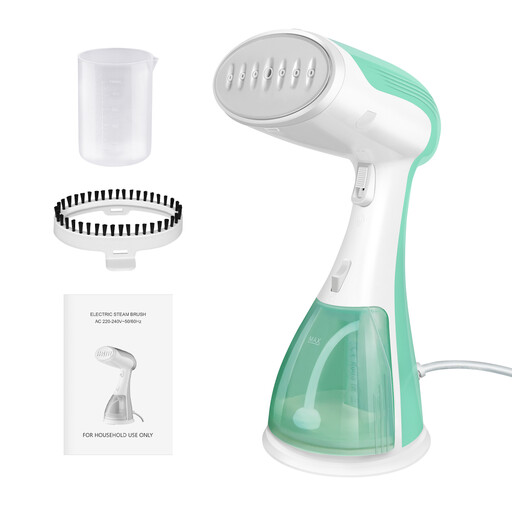
1500 W portable steam iron

Portable steam iron, 1500 W

The description mentions steam and ironing on a flat surface, making it a possible option if you’re looking for a portable ironing solution.

The product information lists steam output of 27 g/min, a 300 ml tank and a steam shot.

Before buying, check that the item on offer has the required CE marking.

View at Joybuy
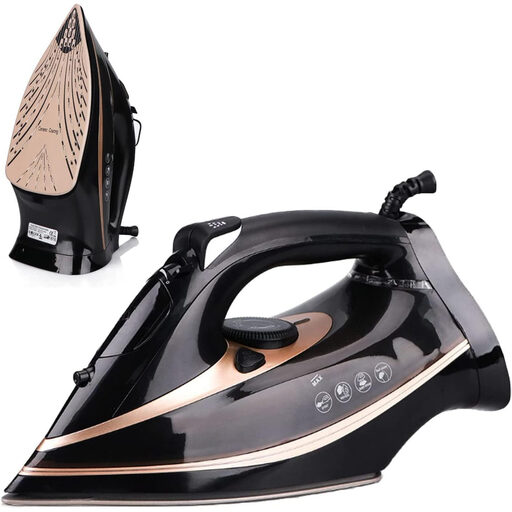
2600 W steam iron with ceramic soleplate

Steam iron, 2600 W, ceramic soleplate

The listed tank capacity may be useful if you iron several items one after another.

The product name lists steam output of 70 g/min, a 120 g steam shot, a 300 ml tank and a self-cleaning function.

Before buying, check that the item on offer has the required CE marking.

View at Joybuy

Tefal Easygliss Plus FV5736 steam iron

Tefal Easygliss Plus FV5736

The listed adjustable steam and extra-thin soleplate may be useful around seams and hard-to-reach areas.

The product information lists continuous steam output of 45 g/min.

Before buying, check that the item on offer has the required CE marking.

View at Joybuy
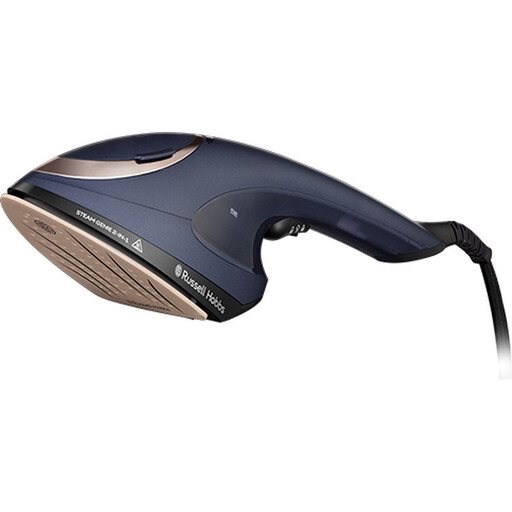
Russell Hobbs Steam Genie 2-in-1, model 28370-56

Russell Hobbs Steam Genie 2-in-1 (28370-56)

The product description mentions both a steaming function and an ironing function; check how this model is intended to be used for ironing on a flat surface.

The description lists a ceramic soleplate and continuous steam output of 20 g/min.

Before buying, check that the item on offer has the required CE marking.

View at Joybuy

Xiaomi handheld steam iron BHR9034EU

Xiaomi BHR9034EU handheld steam iron

The product name describes a compact, lightweight model with dual voltage; the description lists manual temperature and steam settings.

The description lists a 0,15 l tank, steam output of 22 g/min and automatic shut-off.

Before buying, check that the item on offer has the required CE marking.

View at Joybuy

Frequently asked questions

Can I automatically iron a cotton skirt with steam on the highest setting?

No. Follow the care label for the specific skirt: the fibre name alone doesn’t determine the treatment allowed. GINETEX distinguishes maximum soleplate temperatures of 200 °C, 150 °C and 110 °C; the guidance shown for ironing at 110 °C says to iron without steam. So check both the temperature and whether steam is allowed.

What water should I use, and how do I maintain a steam iron?

Follow the model’s instructions for water use and descaling. The Dutch Consumers' Association recommends tap water for ordinary use in the Netherlands, but advises checking the manual if you have a different water supply or softened water. Descale as instructed, and don’t add perfume, starch or other products to the water.

What can I do if my iron breaks too soon during normal use?

If the product doesn’t meet what you could reasonably expect, the seller is responsible for the statutory guarantee, according to ACM ConsuWijzer. Depending on the circumstances, they must offer an appropriate free solution, such as a repair or replacement; a shorter manufacturer’s warranty doesn’t take this right away.

What product safety rule applies to a new electric iron in the Netherlands?

CE marking is mandatory for electrical products placed on the market in the Netherlands. The NVWA also outlines the applicable safety requirements for electrical equipment. Check the marking on the specific item on offer; the general rule doesn’t confirm that the marking has been checked on every individual item.
