
Household with lots of ironing
As well as cotton shorts, you regularly iron a large pile of clothes and want to tackle creases without having to keep refilling the tank.


For a few pairs of cotton shorts, a standard steam iron is usually enough. According to the Consumers’ Association, this type is suitable for smaller loads and limited storage space, while a steam generator is worth comparing if you have a lot of ironing to do. Check the care label on each pair of shorts, and compare the storage space required, maintenance and safety features before deciding.
As well as cotton shorts, you regularly iron a large pile of clothes and want to tackle creases without having to keep refilling the tank.
You want to iron a few pairs of shorts quickly and then put away a compact appliance.
If the appliance is shared at home, you pay attention to safe operation, care labels and maintenance suited to the model you choose.
The Consumers’ Association describes a steam iron as suitable for smaller loads and limited storage space, and a steam generator as an option for larger amounts of ironing. So start by working out how much laundry you usually iron in one go.
Suitable if: you iron a few pairs of shorts or smaller loads and have limited storage space.
Things to consider: the built-in tank may need refilling more often during longer ironing sessions.
Suitable if: you regularly iron large family loads, for example with stubborn creases or thicker cotton.
Things to consider: the appliance takes up more storage space and has a different maintenance system. It may be more than you need for just a few pairs of shorts.
| What to consider | What should you check? | Who should pay particular attention? |
|---|---|---|
| Smoothing out creases | Compare adjustable continuous steam output in g/min separately from a temporary steam boost. If you iron lots of thick cotton, compare steam generators too. | If I want to smooth creases out of shorts and sometimes iron several items one after another, I look at both the continuous steam output and the steam boost. Around 33% of consumers put crease removal first. |
| Small loads and storage space | Check the dimensions, weight, tank capacity and how easy it is to refill the exact model. | For a few pairs of shorts at a time, I want an appliance that’s easy to put away after use. Around 27% of consumers prioritise compact, quick-to-use appliances. |
| Clothing and safe use | Follow the care label and check whether the temperature and steam can be adjusted. Also check for the CE marking on products covered by the relevant rules; the NVWA explains when it is required. | If the appliance is shared at home, I want to match the settings to the care label on each pair of shorts and know what safety features the model has. Around 20% of consumers put safe use and clothing care first. |
| Descaling and maintenance | Look up the maintenance instructions for the exact model. Don’t use vinegar or descaler in a tank unless the manual explicitly allows it. | If you’re looking for a straightforward maintenance routine, it’s worth checking the model’s manual in advance. Around 20% of consumers make ease of maintenance their top criterion. |
A steam boost is not the same as continuous steam output. When you’re ironing several pairs of shorts one after another, continuous steam may be more important.
Compare both figures separately and match them to the amount of laundry you usually iron.
Shorts may be made from a blend, have a print or feature another type of finish. The care label tells you how they can be treated.
Check the ironing symbol before you start, then adjust the temperature and steam accordingly.
Maintenance instructions vary between irons, detachable parts and steam generators. Using the wrong method could damage the steam tank.
Look up the manual using the model number before rinsing a tank or cleaning a part. Tefal recommends following the instructions for the relevant model.
These are different features. The Joybuy listing for the Tefal FV2838E0 states that it does not have automatic shut-off.
Check the safety features against the full model code and the manufacturer’s documentation; don’t treat an unclear product listing as confirmation.
The 3000 Series includes the DST3031/20 steam iron, a model worth comparing for smaller loads.
The range includes standard steam irons, such as the Express Steam FV2838, and steam generators for comparing different ironing sessions.
The TexStyle 7 Pro SI 7160 is worth comparing if easy handling around buttons and pockets, and automatic shut-off, matter to you.
Another option to compare for home use, with model-specific manuals and support.
This Joybuy selection includes standard steam irons for smaller ironing loads and steam generators to compare for larger family loads.
 No image available
A steam generator worth comparing if you iron several items one after another.
The product name lists 2400 W, a 350 g steam boost, a 1,4 l water tank and vertical ironing.
 No image available
If you’re considering a steam generator for larger ironing sessions, this model is one option to compare.
The product name identifies it as a Philips steam generator; check the manual and features of the exact version before choosing.
 No image available
A steam iron worth comparing if you usually have shorter ironing sessions.
The product name lists a 180 g steam boost, a steam output of 40 g/min and a 300 ml water tank.
 No image available
A steam generator worth comparing if you regularly have larger amounts of ironing to do.
Check the specifications and maintenance instructions for the exact version before choosing.
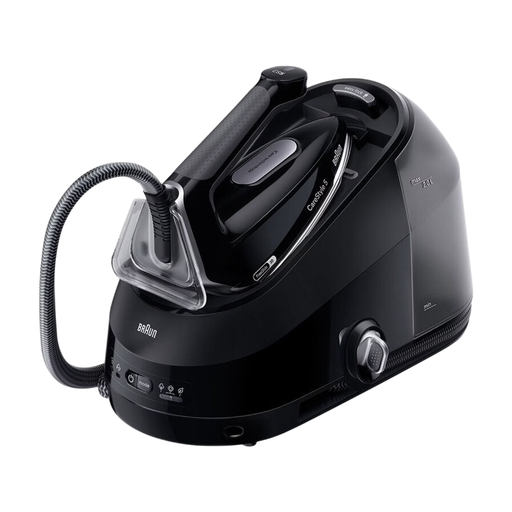 No image available
A steam generator worth comparing if you iron larger loads of laundry.
The product name lists the CareStyle 5 IS5249BK version in black; check the product-specific manual for features and instructions for use.
Follow the ironing symbol on the shorts in question, not just the name of the fabric. GINETEX specifies maximum soleplate temperatures of 110 °C without steam, 150 °C and 200 °C; don’t iron the garment if the label says not to.
A standard steam iron does not need a separate permanent installation. Before using it for the first time, read the manual for the exact model for instructions on filling, settings and safe use. Don’t use it if the iron, cord or plug is damaged.
Don’t simply pour vinegar into the tank. Tefal warns against using vinegar or descaler when rinsing the steam tank; certain models may have different instructions for a removable anti-scale rod. Always follow the manual for the exact model.
No. According to ACM ConsuWijzer, the statutory guarantee is separate from a manufacturer’s or seller’s guarantee. If a product becomes faulty after normal use, the seller is responsible for providing an appropriate solution free of charge; there is no single fixed statutory guarantee period of exactly two years for every iron.
CE marking is required for electrical products covered by the relevant rules. For the low-voltage rules, the NVWA includes electrical equipment with a rated AC voltage of 50–1000 V. The marking is not an independent quality mark for ironing performance.