If you iron a few cotton aprons at a time and want an appliance that’s easy to put away, a standard steam iron is the obvious choice. For larger batches, a steam generator with a separate water tank may be worth considering, provided you have enough room for the base and ironing board. Always check the care label on the entire apron first: a larger tank or higher steam output doesn’t prove that a particular model will iron your aprons better.
Who is this buying guide for?
Someone managing a pile of aprons
If you iron several cotton aprons one after another between changes, fewer pauses to refill the water tank may be important. Remember to allow space for the complete appliance and ironing board, too. The Consumers' Association notes that storage space is a factor when choosing between a steam iron and a steam generator.
A holiday-let owner with a few aprons
If you only iron a few aprons at a time, a compact appliance that’s easy to pick up and put away may be more practical than a system with a separate base. The Consumers' Association suggests a standard steam iron for anyone who irons infrequently or has limited storage space.
Someone managing aprons with details
For prints, ties, seams or special finishes, check the care label on the entire apron, not just the cotton fibre. GINETEX describes the label as a guide to the maximum treatment permitted. A precision tip can be useful around seams and ties, but it doesn’t guarantee a better overall result.
What should you look for?
Standard steam iron
Best for: a few aprons at a time, limited storage space or an appliance that’s quick to get ready.
Trade-off: the water tank is built into the hand-held appliance, so you may need to refill it more often when tackling a larger pile.
Steam generator
Best for: ironing lots of aprons one after another, if you have space for the separate base and ironing board.
Trade-off: the larger set-up takes up more space and is less easy to move.
The Consumers' Association recommends considering factors such as continuous steam, tank capacity, temperature settings and descaling. Manufacturer specifications describe individual models; they are not comparative ironing test results.
| What to consider |
What to look for |
Who should pay particular attention? |
| Smoothing out creases |
Compare continuous steam with a separate steam boost; don’t mistake the latter for continuous output. Independent test results for cotton may provide additional information. |
If I want to tackle stubborn creases, I look for continuous steam and a suitable setting. Around 33% of consumers put crease removal at the top of their list. |
| Getting through a pile |
Compare tank capacities and check whether you can refill the appliance while it’s in use. Also consider how much space the ironing set-up takes up. |
If you iron several aprons in a row, you won’t want to keep stopping to refill the water. Around 25% of consumers say being able to keep going is their top priority. |
| Protecting the fabric and details |
Read the care label and check any prints, ties and embellishments; see whether the temperature and steam can be adjusted. A precision tip can be useful around seams and ties. |
If my aprons have delicate details or an unusual care label, I want to adjust the treatment accordingly. Around 17% of consumers put fabric care first. |
| Maintenance |
Check the descaling procedure for the exact model, and whether it differs between a steam iron and a generator. |
If I use the appliance regularly, I want to know what maintenance it requires. Around 17% of consumers make maintenance their main priority when choosing. |
| Storage and handling |
Check the dimensions and weight of the model you’re considering. If you’re buying a generator, also check that your ironing board is suitable for the set-up. |
If storage space is limited or I need to move the appliance often, a practical set-up matters a lot. Around 8% of consumers prioritise storage and handling. |
Common pitfalls
-
Treating an apron like plain cotton
The cotton fibre alone doesn’t tell you how to treat prints, finishes or other delicate parts. GINETEX explains that the care label shows the maximum treatment permitted for the item.
Read the label and check the whole apron before ironing. Adjust the temperature and steam to match the instructions.
The wrong setting could damage the apron or its finish.
-
Confusing a steam boost with continuous steam
A steam boost is a separate function and doesn’t tell you how much steam the appliance produces while you’re ironing continuously.
When ironing several aprons in a row, compare the stated continuous steam output and tank capacity separately. Don’t treat manufacturer specifications as proof of better ironing results.
-
Choosing a generator without checking the set-up
A steam generator takes up more space because of its separate base, and your existing ironing board may not be suitable. The Consumers' Association highlights the space required for this type of system.
Measure the available space and check that your board is suitable before choosing a generator.
You may also need a different ironing board or additional storage space.
-
Assuming a business purchase is the same as a consumer purchase
Consumer protection doesn’t automatically apply when an agreement is used mainly for business purposes. ACM ConsuWijzer points out that how the agreement is used is relevant.
Check who the contracting party is, how the appliance will mainly be used and what service the seller promises for that purchase.
If the appliance is used mainly for business, different contractual service and warranty terms may apply.
Brands to consider
Philips
According to Philips, the 3000 Series DST3031/20 is a standard steam iron with a 300 ml tank, designed for smaller ironing sessions.
- Philips lists a ceramic soleplate for this model.
- Tank capacity doesn’t tell you how well the model will smooth your cotton aprons. Follow the instructions for the exact model when descaling; Philips has different procedures for irons and steam generators.
Braun
The TexStyle 3 SI3053 is a standard steam iron with manual temperature control and a precision tip—features worth considering for aprons with seams and ties.
- Braun lists 45 g/min in Turbo mode, a 170 g/min steam shot and a 270 ml tank.
- The Turbo mode figure isn’t directly comparable with the continuous steam output quoted for other models.
Tefal
Tefal offers both standard steam irons, such as the Easygliss Plus FV5736, and steam generators, such as the Express Easy SV6131.
- For the FV5736, Tefal lists 45 g/min of continuous steam and a 270 ml tank. For the SV6131, it lists 120 g/min and a removable 1,7 l tank.
- These are manufacturer specifications for individual models, not independent evidence of time saved or ironing results on aprons.
Irons and steam generators on Joybuy
This selection includes standard steam irons and steam generators for ironing cotton aprons. For every electric iron, check that it carries the required CE marking; the NVWA states that this marking is compulsory for electrical products.
 No image available
Steam iron, 2400 W
The adjustable temperature settings may be useful if you want to tailor the heat to different details on your apron; always follow the care label.
Five temperature settings; 350 ml tank; 50 g/min continuous steam; non-stick soleplate and automatic cleaning function.
Joybuy
 No image available
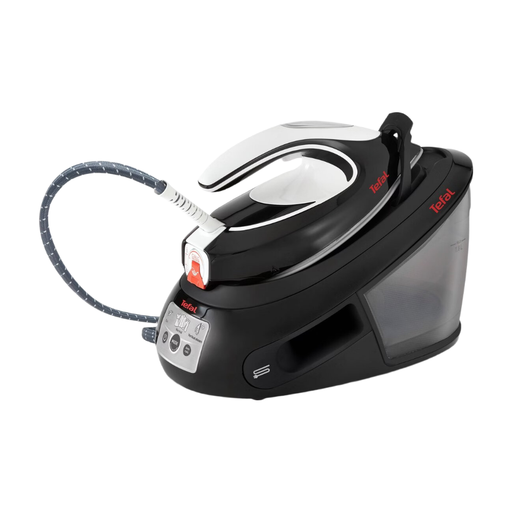
Tefal SV8055 Express Anti-Calc
The separate base and larger tank may suit ironing several aprons in a row, if you have enough room for the set-up.
Removable 1,4 l tank; 120 g/min continuous steam; 350 g steam boost; ceramic soleplate; stated pressure of 6,5 bar.
Check that your ironing board is suitable for a steam generator.
Joybuy
 No image available
Philips 3000 Series PSG3000/20
A steam generator is worth comparing if you regularly iron several aprons in a row and have room for the base.
Check the tank capacity and steam specifications for the exact variant before buying.
Joybuy
 No image available
Philips PerfectCare Compact Essential GC6842/30
The stated tank capacity and steam output are useful points of comparison if you iron several aprons in a row; remember to allow room for the base.
Removable 1,3 l tank; 120 g/min continuous steam; 360 g steam boost; stated running time of over an hour in ECO mode.
Joybuy
 No image available
Xiaomi handheld steam iron BHR9034EU
Manual temperature and steam controls may be useful if you need to take details on your apron into account; follow the care label when choosing how to treat it.
0,15 l tank; steam output up to 22 g/min; weight 0,77 kg; dry and steam ironing functions; dual voltage.
Joybuy
Frequently asked questions
Can I always iron a cotton apron with steam on the highest setting?
No. Follow the care label for the entire apron, not just the information that it’s made of cotton. The GINETEX table specifies ironing temperatures of up to 200 °C, 150 °C and 110 °C. The 110 °C symbol means you should iron without steam.
How do I descale a steam iron?
Follow the instructions for the exact model. Philips describes different procedures and makes clear that instructions for steam irons don’t necessarily apply to steam generators.
Does consumer law automatically apply if I buy the iron for my holiday let?
No. Consumer protection doesn’t automatically apply if the agreement is used mainly for business purposes. According to ACM ConsuWijzer, how the agreement is used is one of the relevant factors. So check who the contracting party is, how the appliance will be used and what service is offered.
What product safety marking must an electric iron have in the Netherlands?
The NVWA says that electrical products must carry the CE marking. This marking declares compliance with applicable requirements; on its own, it isn’t an independent test of ironing performance.


