
Uniform wearers who need to iron sleeves precisely
If you want to press cuffs, seams and sleeves flat, pay attention to the soleplate tip and a suitable support surface, not just the amount of steam.


For a few uniform items and precise work on sleeves, a compact steam iron with a useful precision tip is a more practical choice than a steam generator. Check the care label, the controls and whether an ironing board or sleeve board provides enough support. According to the Consumentenbond, a steam generator may be more relevant when small ironing jobs involve lots of heavy or stubbornly creased fabrics.
If you want to press cuffs, seams and sleeves flat, pay attention to the soleplate tip and a suitable support surface, not just the amount of steam.
If you only iron a few items at a time, it helps to have an appliance that’s easy to get ready and a tank suited to a small ironing job.
If you iron fabrics with different care requirements, adjust the temperature and steam for each garment according to its care label.
For small ironing jobs where a smooth sleeve matters, start by considering a standard steam iron and the support surface available. The Consumentenbond says a steam generator is mainly relevant for larger loads; Philips describes a garment steamer as not equivalent to an iron when you need a sharply pressed sleeve.
| What to consider | What to look for when buying | Who is this important for? |
|---|---|---|
| Pressing sleeves and cuffs flat | Check the soleplate tip on the exact model and make sure a sleeve board is suitable for your sleeves. | If I want to press cuffs and narrow sleeves flat, I focus on the soleplate tip and having enough support. Around 36% of consumers say precision on sleeves is their main concern when buying. |
| Getting started quickly for small ironing jobs | Compare the stated heat-up time and tank capacity; wattage is not the same as heat-up time. | When I often iron only a few items, I want to get started quickly and put the appliance away easily. Around 29% of consumers prioritise getting started quickly for small ironing jobs. |
| Protecting uniform fabrics | Read the care label and check whether the appliance lets you set a suitable temperature and steam level. | When uniforms are made from different fabrics, I want to follow the permitted heat setting for each garment. Around 21% of consumers give fabric protection top priority. |
| Maintenance and ease of use | Check the descaling instructions for the model and whether you’ll need to buy a sleeve board separately. | If I want to keep maintenance and extra accessories to a minimum, I check the maintenance steps and support surface in advance. Around 14% of consumers say maintenance and additional accessories are their main consideration. |
Philips says a garment steamer doesn’t give the same result as an iron, particularly on thick cotton or linen. This matters if you want a sharp crease in a sleeve.
Choose a garment steamer mainly for removing creases, and decide in advance whether your uniform needs a smooth or sharply pressed finish.
You may also need an iron and a suitable surface for pressing garments flat.
For short ironing jobs, the soleplate tip, support surface and time needed to get the appliance ready may matter more. The Consumentenbond describes a steam generator as larger and slower to heat up than a standard steam iron.
Consider how the appliance as a whole suits your short ironing jobs, rather than treating one power or steam figure as the deciding factor.
A self-cleaning function doesn’t mean you can ignore the maintenance instructions. Tefal says descaling requirements vary by model.
Read the manual for the exact model and follow the maintenance steps it describes.
Allow time for maintenance specific to the model.
The TexStyle 3 SI 3030 is a standard steam iron with a precision tip. Braun states that this model heats up to the Max setting in 35 seconds.
The Express Steam FV2838E0 is a standard steam iron with a precision tip and adjustable settings, according to Tefal.
The 3000 Series DST3041/80 has a ceramic soleplate and a 300 ml tank, according to Philips, which says it’s suitable for smaller loads.
The Autosteam DW4020D1 has a soleplate with a precision tip and an automatic steam setting, according to Rowenta.
This selection mainly features steam irons for short ironing jobs. Features vary by model, so check that the controls and support surface suit your uniform.
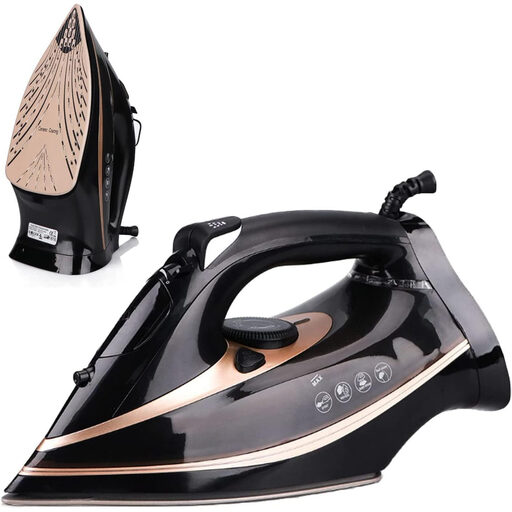 Image unavailable
A standard steam iron for small ironing jobs; check that the soleplate tip and your support surface are suitable for uniform sleeves.
The product description lists a continuous steam output of 70 g/min, a 120 g steam boost, a 300 ml tank and a self-cleaning function.
 Image unavailable
The description says it can be used for dry and steam ironing; check whether this model’s shape suits the support you need for uniform sleeves.
The stated heat-up time is 30 seconds, the reservoir holds 0.15 l and the weight is 0.77 kg. The description mentions manual temperature and steam controls.
 Image unavailable
The description mentions a slim soleplate tip for working around details; check that its shape suits your uniform and ironing technique.
Listed features include 2000 W power, temperature control and an adjustable steam setting.
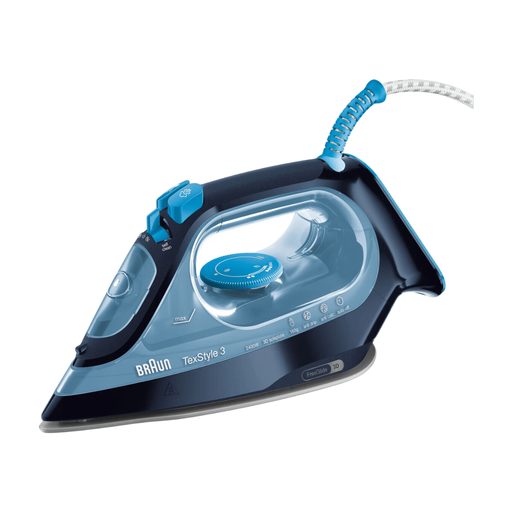 Image unavailable
The precision tip is designed to reach awkward spots; also check that the support surface leaves enough room for a sleeve.
The description lists a ceramic soleplate, automatic shut-off and a heat-up time of up to 35 seconds.
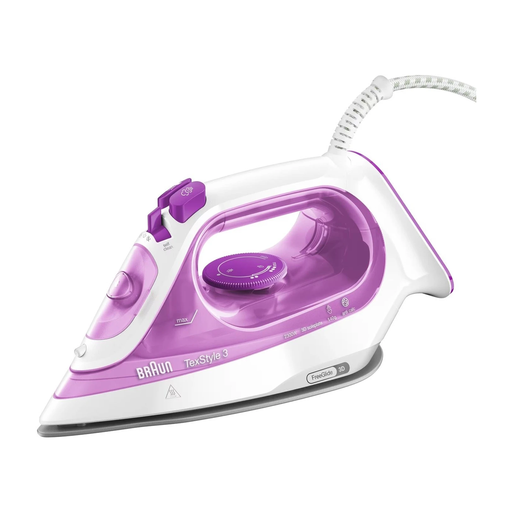 Image unavailable
The description mentions a precision tip for collars and seams; check that the soleplate shape suits the details you want to iron.
Listed features include a 35-second heat-up time and a 270 ml tank. The description also mentions a ceramic soleplate and self-cleaning.
Read the care instructions for each garment and adjust the temperature accordingly. The Consumentenbond warns that too much heat can damage or make fabric shiny; only use steam once the iron is hot enough.
No, a sleeve board is a useful aid, not a necessity. Brabantia describes a 60 × 10 cm board as suitable for standard and steam irons; check that your sleeve fits over it properly.
Not if you need a sharply pressed sleeve. Philips says a garment steamer doesn’t give the same result as an iron, particularly on thick cotton or linen.
Follow the manual for the exact model, as the descaling method varies from one appliance to another. Tefal describes different systems and warns that vinegar or descaler in the steam tank can damage it.
No. According to ACM ConsuWijzer, the statutory guarantee depends on what you can reasonably expect from the product; a two-year manufacturer’s guarantee doesn’t automatically end your statutory rights. If a product is faulty, contact the seller.