For a few covers between guest stays, a compact steam iron is often the practical choice. If you have lots of covers to iron in one go or stubborn creases to tackle, a steam generator is worth considering. Always follow the care label on the finished cover, and weigh up a generator’s larger water tank against the extra space it needs to use and store.
Which appliance is right for you?
Let owners with frequent guest turnovers
If you regularly iron several covers in a row, a steam generator with a separate tank can mean fewer refills. Consumentenbond lists a generator as an option for people who do a lot of ironing; bear in mind that it takes up more space.
Let owners with covers featuring delicate details
The finish, print or fabric composition can affect the ironing instructions. GINETEX advises using the care label, not just the fibre name, to determine the maximum temperature.
Let owners with limited storage space
If you only iron a few covers between guest stays and need to put the appliance away afterwards, compare irons with a built-in water tank. Consumentenbond lists limited storage space and smaller loads as reasons to consider a steam iron.
What should you look for when choosing?
Start by considering how many covers you iron in one session and how much space you have. Then check the ironing instructions on the finished cover. Consumentenbond explains the trade-offs between an iron and a steam generator, while GINETEX emphasises that the care label sets the maximum temperature.
| What to consider |
What should you check? |
Who is this important for? |
| Lots of covers in a row |
Compare the tank type and capacity, continuous steam output, space required and whether your ironing board is suitable. Consider steam boost separately from continuous steam. |
If I need to iron a pile of covers between guest stays, I want to refill less often without a bulky set-up. Around 33% of consumers with this purchasing priority mainly want to iron lots of covers in a row. |
| Following the care label |
Read the label on the specific cover and check that you can set a suitable temperature and steam level. |
If a cover needs a lower temperature or special treatment, I want to be able to follow its care instructions rather than assume that ‘cotton’ tells me everything. Around 27% of consumers with this purchasing priority mainly want to match the treatment to the cover’s care label. |
| Small loads and storage |
Compare the size, the iron’s built-in water tank and how easy the appliance is to store. |
If I only iron a few covers at a time, I want an appliance that’s easy to get out and put away. Around 20% of consumers with this purchasing priority mainly want an appliance for small loads and limited storage space. |
| Maintenance with repeated use |
Check the descaling method for the exact model and whether you can follow the steps in the manual. |
If I use the appliance regularly, I want to know what maintenance it needs, so limescale doesn’t become a forgotten part of the job. Around 20% of consumers with this purchasing priority mainly value a suitable maintenance routine. |
Common pitfalls when choosing
-
Comparing steam boost with continuous steam
Steam boost is designed for stubborn creases in specific areas, while continuous steam describes a different product feature for longer ironing sessions. The figures are not directly comparable.
Compare the two specifications separately, and also consider the water tank and the type of appliance that suits your ironing sessions.
-
Assuming every cotton cover can be ironed on the hottest setting
The fibre name alone doesn’t determine the maximum ironing temperature for a finished cover. Choosing the wrong setting could damage the fabric or its details.
Before ironing, check the symbol on each cover’s care label, especially if the finish or print varies.
-
Choosing a steam generator without checking your set-up
A separate tank can mean fewer refills during longer sessions, but a generator takes up more space and may be too large or heavy for a standard ironing board.
Measure the space available for use and storage, and check that your ironing board can support the set-up.
Brands to consider
Philips
The models listed range from an iron for smaller loads to a model with a larger water tank and higher stated continuous steam output.
- Philips lists a 300 ml water tank for the DST3031/20 and a 350 ml tank with up to 100 g/min continuous steam for the DST8050/20.
- These are model specifications, not proof that a cover will be crease-free faster. Follow the instructions for the exact model when descaling.
Tefal
The FV9844 is an iron, while the SV8110 is a steam generator with a separate tank to consider if you often iron larger loads.
- Tefal lists up to 60 g/min variable steam and a 250 g/min steam boost for the FV9844. For the SV8110, Tefal specifies 120 g/min continuous steam and 6,3 bar pump pressure.
- The claim about the Micro-Calc filter comes from Tefal. A generator also needs more space than an iron.
Braun
The TexStyle 7 Pro SI 7160 may suit you if you want to adjust the temperature manually to match a cover’s care label.
- Braun specifies 50 g/min steam, a 225 g/min steam boost, a 300 ml water tank and automatic shut-off for this model.
- A manufacturer’s claim about gliding smoothly around obstacles isn’t a separate test of a stitched cushion-cover edge.
Rowenta
The Steamforce DW9240D1 is an iron to compare if you’re looking for a higher stated continuous steam output within this appliance type.
- Rowenta lists 65 g/min continuous steam and a 230 g steam boost for the DW9240D1.
- These model specifications aren’t an independent comparison of results on cotton cushion covers; the water tank is still part of the iron.
Joybuy products
This selection includes irons for smaller sessions and steam generators to compare when you have several covers to iron in a row. Before buying, check that the specific appliance meets the applicable EU product safety requirements and carries the required CE marking. The Rijksoverheid and the European Commission outline these requirements for electrical appliances.
 No image available
2400 W handheld steam iron
An iron to consider for smaller sessions; check that its settings suit the care label on your cover.
2400 W, as stated in the product name.
Joybuy
 No image available
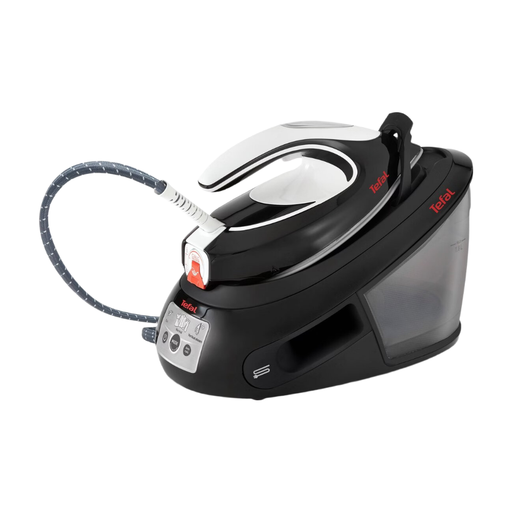
Tefal SV8055 Express Anti-Calc steam generator
A steam generator to compare if you iron several covers in a row; bear in mind the extra space needed for the set-up.
The product name specifies 6,5 bar.
Joybuy
 No image available
Tefal SV8026 steam generator
A steam generator to consider for longer sessions; check that your ironing and storage space, and your ironing board, are suitable for this type of appliance.
Joybuy
 No image available
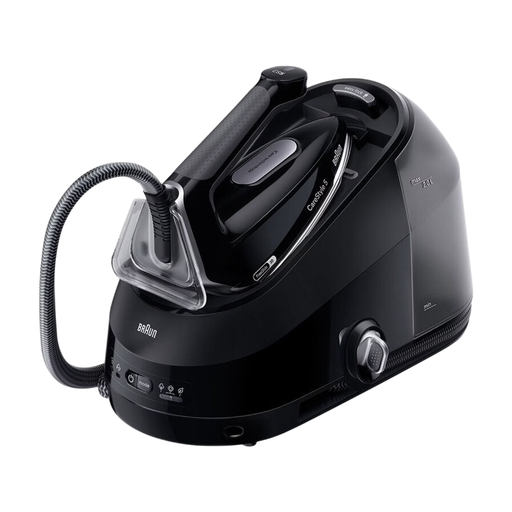
Braun CareStyle 5 IS5249BK steam generator
A steam generator to compare if you iron lots of covers in a row; bear in mind the larger set-up and check that your ironing board is suitable.
Joybuy
 No image available
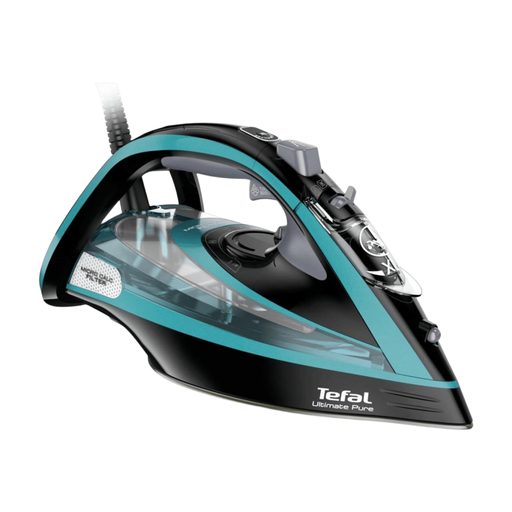
Tefal Ultimate Pure FV9844 steam iron
An iron to compare if, for smaller loads, you’re weighing up manual temperature and steam settings against maintenance.
Tefal lists up to 60 g/min variable steam and a 250 g/min steam boost for the FV9844. Tefal describes the Micro-Calc filter as one of its own product features.
Joybuy
Frequently asked questions
Can I automatically iron a cotton cushion cover on the hottest setting?
No. Choose the maximum temperature based on the care label on the finished cover, not just the word ‘cotton’.
When is a steam generator worth the extra space?
A steam generator is worth considering if you often iron lots of covers in a row and stubborn creases keep coming back. The separate tank can mean fewer refills, but the appliance takes up more space; check that your ironing board is suitable too.
How can I prevent limescale problems when ironing regularly?
Follow the descaling procedure for the exact model. Philips warns that limescale in its steam irons can cause brown stains, brown water and leaks; the procedure may vary from one appliance to another.
Does statutory consumer protection apply if I buy the iron for my holiday let?
Not automatically. ACM ConsuWijzer distinguishes between predominantly private use and purchases used mainly or exclusively for business. Check the terms that apply to your purchase.
What should I check for when it comes to the safety of an electric iron?
Check that the specific appliance meets the applicable EU product safety requirements and carries the required CE marking. The Rijksoverheid and the European Commission outline the relevant requirements for electrical appliances; a product listing alone doesn’t confirm that a particular item meets them.


