
Occasional shirt ironer
You mainly want to press cuffs and other small areas accurately, without taking up much storage space.


For a single shirt, a compact steam iron with a pointed soleplate tip is generally a more sensible choice than a steam generator. The Consumentenbond recommends a standard steam iron if you have little ironing to do or limited storage space. Check the care label first: extra steam is only useful if the fabric allows it and you regularly iron larger loads or stubborn creases too. For the specific appliance, also check for the CE marking and the required instructions and safety information in a language you can understand.
You mainly want to press cuffs and other small areas accurately, without taking up much storage space.
You have a shirt whose care label limits the temperature or rules out steam, and you want to adjust the settings accordingly.
You also iron larger loads and weigh up refilling, steam and storage space.
| What to consider | What to look for | Who is this most important for? |
|---|---|---|
| Precision around seams and buttons | Look at the shape of the soleplate tip and whether you can manoeuvre it around buttons and narrow seams. | I want to reach cuff seams and buttons accurately. Around 40% of consumers would choose precision as their main reason for buying. |
| Following the care label | Check the permitted temperature, whether ironing is allowed and whether you can use steam. | If the label limits heat or rules out steam, I want to adjust how I treat the garment. Around 30% of consumers would choose fabric protection as their main reason for buying. |
| Compact and quick to use | Compare the size and storage requirements, and check whether the water tank suits the amount of ironing you do. | For a quick ironing task, I want an appliance that’s easy to take out and put away. Around 20% of consumers would choose compact convenience as their main reason for buying. |
| Larger ironing sessions | Weigh up the tank capacity and appliance size against how often and how much you iron. | I regularly iron a large load in one go and want to refill less often. Around 10% of consumers would choose larger ironing sessions as their main reason for buying. |
For cuffs, it’s also important to be able to manoeuvre around buttons and follow the fabric’s care instructions. A model’s specifications don’t prove how well the iron will work on your shirt.
Check the care label and the shape of the soleplate tip first; then decide whether you need extra steam.
A separate tank and more steam are most useful for longer sessions. A steam generator takes up more room and may require a suitable ironing board.
Choose one mainly if you also regularly iron large loads or stubborn creases.
Allow for extra storage space and check that your ironing board is suitable for a steam generator.
According to the Dutch government, your statutory guarantee is separate from a manufacturer’s guarantee. If a product is faulty, the retailer is your point of contact for a solution.
Before choosing an extended guarantee, compare what additional rights it actually provides.
Braun describes the TexStyle SI 3030 as having a triangular precision tip and a rounded soleplate, designed for working around buttons.
Tefal describes the Smart Protect Plus FV6870 as a steam iron with a precision tip and automatic steam and temperature settings for fabrics that can be ironed.
Philips describes both a refurbished dry iron, the GC160/02R1, and the PerfectCare steam generator PSG7300/70. These are different products for different ironing needs.
This selection includes compact handheld steamers and steam irons for smaller ironing tasks, with different options for dry or steam ironing. Before buying, check the specific appliance for the CE marking and the required instructions and safety information in a language you can understand.
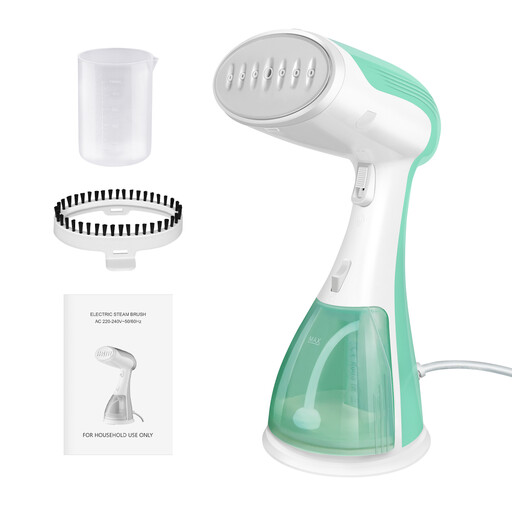 No image available
The product description says it can be used on clothes on a hanger or on a flat surface.
The product name lists a 25-second heat-up time.
 No image available
According to the product description, this model offers both dry and steam ironing, with manually adjustable temperature and steam settings.
The description mentions a removable water tank. The product name lists a compact, lightweight design and dual voltage; check that the voltage is suitable for your use.
 No image available
The product description mentions a slim tip for reaching around buttons and small garment details more precisely, with adjustable temperature and steam.
It also has a dry setting and Calc-Clean maintenance; the description lists a 1.6 m cord. According to the description, steam isn’t available on the synthetic temperature setting.
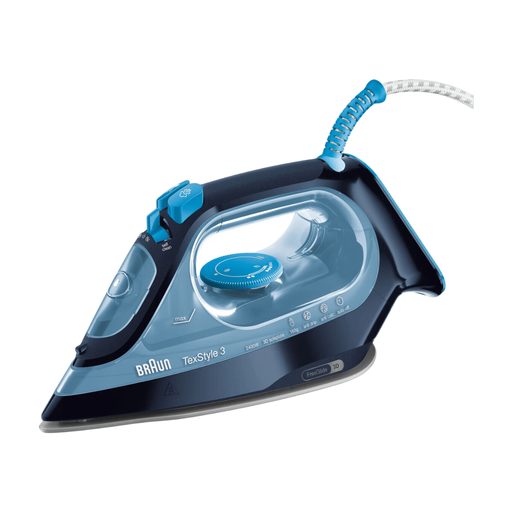 No image available
The product description mentions a triangular precision tip for hard-to-reach areas such as collars and around buttons.
The stated heat-up time is up to 35 seconds; the description lists a steam boost of up to 170 g.
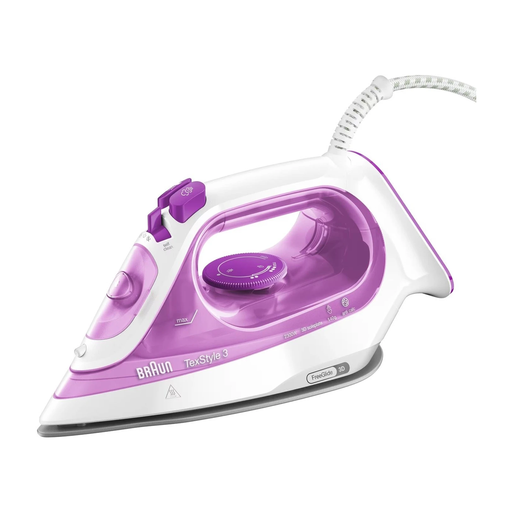 No image available
The product description mentions a triangular precision tip for working around cuffs and seams, and a soleplate that glides over obstacles such as buttons.
According to the description, this model has a 270 ml water tank and a self-cleaning function.
Read the care label first: the ironing symbol tells you whether ironing is allowed and what temperature is safe; a separate symbol may rule out steam. Don’t iron a garment marked with a crossed-out iron.
Usually not: according to the Consumentenbond, a standard steam iron is suitable if you have little ironing to do or limited storage space. A steam generator is mainly worth considering if you often iron large loads or stubborn creases and have room for a separate tank.
Follow the descaling instructions for the exact model, as maintenance methods vary. The Consumentenbond explains that limescale can reduce steam output in some appliances.
For electrical equipment within the voltage range covered by Directive 2014/35/EU, requirements for placing it on the EU market include a CE marking, as well as instructions and safety information in a language that can be understood. This is a legal product requirement, not an independent assessment of a specific item.
According to the Dutch government, you have statutory rights if a product is faulty, and the retailer must provide a solution. For eligible online consumer purchases, you generally have a 14-day cooling-off period; check your purchase terms before choosing an extended guarantee.