
Patch maker with limited space
You apply patches but don’t want to store a bulky ironing set-up. Check the contact area, whether there’s a safe place to set the appliance down and whether the temperature suits your fabric.


For patches in a small ironing space, an adjustable mini iron is a versatile option, provided its temperature suits both the patch and the fabric. A precision iron is designed mainly for small details, while a compact heat press with a single fixed setting is only suitable if that temperature works for your materials. If you also want to iron clothes, a standard steam iron may be more practical, as long as you can switch off the steam when the patch instructions require it.
You apply patches but don’t want to store a bulky ironing set-up. Check the contact area, whether there’s a safe place to set the appliance down and whether the temperature suits your fabric.
You work with small appliqués, seams or hard-to-reach areas. A pointed tip can be more convenient than a large soleplate, as long as the contact area is suitable for the patch.
You want to use the same appliance for everyday clothes, too. Weigh the larger soleplate and steam function against the space you have for using and storing it, and check that you can switch off the steam.
When applying patches in a small ironing space, first check that the heat is suitable for both the patch and the garment fabric. Then consider the contact area, the space you’ll press on and whether you’ll also use the appliance for everyday laundry.
| What matters | What to look for | Who it matters to |
|---|---|---|
| Temperature and adhesion | Compare the patch instructions with the garment’s care label. Check whether you can adjust the temperature and steam separately. | When I press patches onto different fabrics, I want to know what level of heat both materials can withstand. Around 36% of consumers prioritise material suitability. |
| Work and storage space | Check the size and shape of the soleplate and whether a stand is included. Make sure you have a flat, stable, heat-resistant surface for pressing. | In a small ironing space, I want to use the appliance and set it down safely without having to store a large set-up. Around 29% of consumers give space top priority. |
| Pressing small details | Compare the tip and contact area with the patch. Check that you can press the whole patch according to the instructions. | For small appliqués or seams, I want to apply heat precisely. Around 21% of consumers focus mainly on working accurately on details. |
| Ironing everyday laundry, too | Check whether you can switch off the steam and whether the size and temperature suit both clothes and patches. | If I want one appliance for patches and clothes, I weigh its versatility against the space it takes up. Around 14% of consumers prioritise being able to use it for both. |
According to Cricut, the Cricut EasyPress Mini LT has a single setting of up to 180 °C. The Dutch Consumers’ Association warns that too much heat can damage fabric fibres.
Before buying, check the instructions for your patch and the garment’s care label. If you work with different materials, choose an appliance with suitable adjustment options.
Pindolleke’s instructions for iron-on appliqués say to switch off the steam. So a high steam output alone doesn’t tell you whether an appliance is suitable for your patch.
Check the heat, contact area and pressure specified in the instructions for your particular patch. Make sure you can switch off the steam if needed.
For its Iron-On Patches, Cricut recommends a firm, flat work surface rather than a soft ironing board.
Think ahead about where you can press safely and set the hot appliance down between steps.
You may need a suitable heat-resistant surface as well as the appliance.
Prym offers mini irons for sewing and small work surfaces.
Clover describes the Mini Iron II 8003EU as a precision iron for small work surfaces.
Cricut positions the EasyPress Mini LT as a compact press for suitable iron-on projects.
Tefal offers standard steam irons, including the Easygliss Plus FV5736E0, for anyone who also wants to iron clothes.
The Philips 5000 Series DST5021/20R0 is an example of a standard steam iron for dual use.
These Joybuy products are clothing irons and steam appliances for anyone who wants to press patches and may also iron everyday clothes. For each model, check that its functions and settings suit the instructions for your patch and fabric.
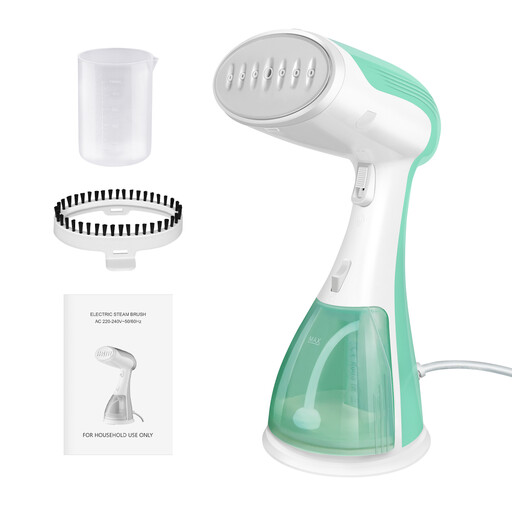 Image unavailable
A portable appliance for anyone who wants to iron clothes flat. Check that the way you use it suits your patch instructions.
Water tank: 300 ml. Steam output: 27 g/min.
 Image unavailable
A steam generator for anyone who also wants to iron everyday laundry. Before using it for patches, check that its settings and steam function suit the patch instructions.
Water tank: 1.4 L. The product information specifies temperature selection by fabric type and adjustable steam.
 Image unavailable
A handy 2-in-1 dry and steam iron for anyone who wants both options. Check whether dry pressing is suitable for your patch.
Water tank: 0.15 L. Dimensions: 25 × 7,50 × 13,50 cm. Weight: 0,77 kg. The product information specifies manual temperature and steam controls.
 Image unavailable
A steam generator for anyone who also wants to iron clothes. Bear in mind that the product information doesn’t mention a manual temperature setting, so check carefully whether the appliance suits the instructions for your patch and fabric.
The product information specifies OptimalTEMP, automatic shut-off and a 1.3 L water tank.
Not necessarily: some patch instructions say to press with the steam switched off. Follow the instructions for your patch and the care label for the fabric. The temperature and pressing time for one patch won’t automatically apply to another.
Use a firm, flat, heat-resistant surface that’s suitable for the task. Cricut advises against using a soft ironing board for its Iron-On Patches. Also follow the instructions for your own press or iron.
Follow the descaling and water instructions for your specific model. The Dutch Consumers’ Association points out that an anti-scale system doesn’t eliminate the need for maintenance, and advises against using water with perfume or other additives.
Electrical appliances placed on the market in the Netherlands must meet the applicable Dutch and European requirements. Where the regulations require it, the CE marking must be affixed. A CE marking on its own is not an independent safety test of a specific appliance.