
Patch maker with limited drying space
You want to attach patches without unwanted steam or damp fabric. Check the instructions for the patch and fabric, and make sure the appliance can be used for dry ironing.


For patches whose instructions call for dry heat, following the patch instructions and being able to press without steam matter more than the appliance’s steam output. A standard iron is the more practical choice if you do little ironing and have limited storage space. A steam generator may suit you if you also regularly iron large loads of laundry. The Consumers’ Association highlights the extra space a generator takes up, while patch instructions from brands including MrPatch and Patchy say to turn off the steam.
You want to attach patches without unwanted steam or damp fabric. Check the instructions for the patch and fabric, and make sure the appliance can be used for dry ironing.
You only iron now and then, and don’t want a base unit and ironing board taking up more space than you need for the job. The Consumers’ Association lists limited storage space as one reason to consider a standard iron.
You attach patches, but also regularly iron large amounts of fabric or heavily creased clothes. Consider patch work and steam ironing as two separate uses.
Choose this if: you mainly attach patches, do little ironing or have limited storage space. Check that it can operate without steam.
Trade-off: it takes up less storage space, but may be less suitable for long ironing sessions. The Consumers’ Association describes a smaller water tank as a common difference.
Choose this if: you regularly iron large loads or heavily creased laundry as well as attaching patches, and the manual confirms that you can use the appliance dry for your patch.
Trade-off: the larger tank and steam output are designed for everyday ironing, but the separate base takes up more space. Philips describes condensation on the cover or clothes for applicable models; this is not a confirmed feature of every generator.
| What to consider | What to look for | Who is it important to? |
|---|---|---|
| Patch and fabric | Check the patch instructions, the garment care label and whether the appliance can press at the required temperature without steam. | If I want to attach a patch using the specified heat and pressure, I’ll check the instructions for my patch and fabric first. Around 33% of consumers prioritise getting the patch to adhere correctly. |
| Moisture | Check whether the steam output is adjustable and whether you can press without steam when working with patches. | If I have little space to dry a damp cover or clothes, I want to avoid unnecessary steam and moisture. Around 27% of consumers make minimising moisture their top priority. |
| Storage space | Measure the space available for the entire appliance and compare the dimensions of the base unit. | If I have limited space in my cupboard or work area, I want to know whether the whole appliance will fit. Around 20% of consumers prioritise the space it takes up. |
| Lots of ironing | Compare tank capacity and steam output for everyday ironing; assess patch suitability separately. | If I often iron a large pile of laundry as well as working with patches, I weigh up capacity against the extra space required. Around 20% of consumers prioritise handling large amounts of ironing. |
MrPatch and Patchy’s patch instructions say to turn off the steam when applying their patches. A steam specification therefore doesn’t tell you whether the appliance meets the instructions for your patch.
Read the instructions for the patch and fabric, then check what the specific appliance can do.
Laurastar says that ‘Dry Microfine Steam’ describes its own steam technology. This doesn’t automatically mean the steam is suitable for patch instructions that rule it out.
Use the patch instructions as your guide, and don’t treat product claims about steam as a substitute for them.
A steam generator also has a separate base. The Consumers’ Association describes it as larger and more difficult to store than a standard iron.
Before buying, measure the space for the complete set and check that you have enough room to use it too.
According to the Dutch Government, you have statutory rights in the Netherlands; there is no fixed statutory two-year warranty period. An extended warranty may offer additional rights, depending on its terms and conditions.
Compare the terms of any additional cover with your statutory rights before deciding whether it offers anything extra.
The CareStyle Compact is aimed at anyone looking for a steam generator who is also mindful of storage space. Braun describes the IS 2143 BL as having a vertical design and a 1.5-litre tank.
For the PSG3000/20, Philips lists continuous steam output of 120 g/min and a steam boost of 350 g. This may be relevant if you have lots of everyday ironing to do as well as attaching patches.
For the Express Anti-Calc SV8055, Tefal lists a removable scale collector and removable tank. These are features to consider if you regularly use steam when ironing.
Laurastar describes the Lift Swiss Edition as a portable steam generator for ironing on a table or steaming hanging clothes.
This selection includes compact irons and steam generators for attaching patches alongside everyday ironing. A product description mentioning dry ironing doesn’t replace the instructions for the patch and fabric.
 No image available
A compact option to compare if you have limited storage space and want to use both the steam and ironing functions.
The description lists a ceramic soleplate and a 3 m cord.
 No image available
A compact option to compare if you want manual control of the temperature and steam; the description also mentions dry ironing.
The stated weight is 0,77 kg. Check that the temperature and method of use are right for your patch and fabric instructions.
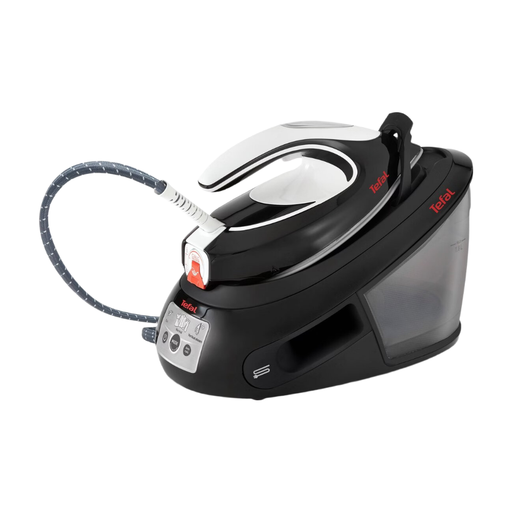 No image available
Worth comparing if you regularly do lots of everyday ironing as well as patch work; the larger base does require enough storage space.
The stated specifications are 6,5 bar, continuous steam of 120 g/min and a steam boost of 450 g/min. These figures don’t confirm that it’s suitable for dry patch pressing.
 No image available
Worth comparing if you’re looking for a steam generator for everyday ironing and have space to store its base and tank.
The product information lists continuous steam of 120 g/min, a steam boost of 350 g, a removable 1,4-litre tank and 2400 W. Steam specifications don’t tell you whether you can dry-press your patch.
 No image available
Worth comparing if you have lots of everyday ironing to do as well as patch work, and are looking for a steam generator with a stated descaling feature.
The product information mentions Calc Clear maintenance technology and a Durilium AirGlide soleplate. The generator takes up more storage space than a standard iron, so check the dimensions of the complete set.
No. Don’t assume you can use steam without checking the instructions for your patch. MrPatch and Patchy say to turn off the steam for their own patches. Check the fabric’s heat tolerance too, and don’t automatically use the times or temperatures given by another brand.
First check whether steam is condensing on the cover and whether your model has an Eco setting. For the models covered by its guidance, Philips recommends replacing a worn cover and using the Eco setting, if available, to reduce steam output. For other models, follow their own manuals.
Follow the maintenance instructions for your exact model, as the process can vary between appliances. For the generators covered by its guidance, Tefal recommends unplugging the appliance and allowing it to cool before maintenance. Don’t apply these instructions to another model without checking.
No. Your statutory rights apply even if you don’t buy an extended warranty. According to the Dutch Government, there is no fixed statutory warranty period in the Netherlands; the seller must provide an appropriate remedy for a faulty product. An extended warranty may offer additional rights under its own terms and conditions.
The Dutch Government states that electrical appliances sold in the EU must carry a CE marking. Check the marking and instructions for the specific appliance; information on a product page doesn’t confirm that the item you receive has been physically checked.