
Patch maker with limited space
You want to apply patches without setting up a large ironing station. MrPatch and Creapatch instructions emphasise dry heat, while Cricut recommends a firm, flat surface for its heat transfers.


A compact steam generator isn’t automatically the right choice for patches: instructions from brands such as Creapatch and MrPatch call for dry heat and pressure, while the suitability of the steam generators reviewed for this purpose has not been confirmed. A generator may be a good fit if you also regularly iron large loads of laundry, but check the instructions for your patch and fabric, as well as the capabilities of the exact appliance.
You want to apply patches without setting up a large ironing station. MrPatch and Creapatch instructions emphasise dry heat, while Cricut recommends a firm, flat surface for its heat transfers.
You want to apply patches and also regularly iron a large amount of everyday laundry. The Consumers’ Association lists a standard iron as an option if you have little storage space or don’t do much ironing; weigh this space-saving benefit against the separate base of a steam generator.
You work with a range of patches and backing fabrics, so you check the heat and pressing instructions for each material. A setting for everyday clothes alone doesn’t prove that the adhesive on a particular patch can be applied properly.
Start with the instructions for your patch and fabric. Then decide whether the appliance will also be useful for your everyday ironing and whether you have enough space for it.
A good fit if: you have limited space and the exact model is confirmed to offer the temperature and dry operation required for your patch and fabric.
Consider: the Consumers’ Association says a standard iron is an option if you do little ironing or have limited storage space; it has a smaller water tank than a steam generator.
A good fit if: you regularly iron large loads of laundry or heavily creased items as well as patches, and have space for the separate base.
Consider: tank capacity and steam output matter for everyday ironing, but they don’t tell you whether the appliance can provide the dry heat needed for patches.
A good fit if: small heat transfers are your main task and you can set up a firm pressing area with heat-resistant protection.
Consider: a heat press won’t necessarily replace a steam generator for large loads of creased laundry; check whether your specific patch is compatible with the press you choose.
| What to consider | What should you check? | Who should pay particular attention? |
|---|---|---|
| Dry heat and pressure | Compare the patch and backing fabric instructions with the manual for the exact appliance; check that it can be used without steam and has temperature control. | If I press patches, I want to know whether the appliance can provide the specified dry heat and pressure. Around 34% of consumers prioritise suitable dry application for patches. |
| Working and storage space | Measure the appliance and the space needed for its hose and controls; also plan for a flat, firm pressing area with heat-resistant protection. | If I have limited floor or cupboard space, I want to know whether both the base and my work area will fit. Around 33% of consumers give limited space top priority. |
| Everyday ironing | Compare your needs with the tank capacity and steam output; don’t treat steam specifications as a measure of patch suitability. | If I regularly iron a large load of laundry as well as patches, I weigh the extra capacity against the separate base. Around 20% of consumers prioritise this combination. |
| Fabric, safety and maintenance | Follow the instructions for each material, check the maintenance procedure for the model, and review the product and safety information. | If I work with different fabrics, I want to know in advance what heat and care they need. Around 13% of consumers prioritise fabric protection and maintenance. |
Steam specifications describe steam output for everyday ironing. The MrPatch and Creapatch instructions we consulted specify dry heat for their patches.
Before buying, check the heat and pressure requirements for your patch and fabric, and compare them with the manual for the exact appliance.
A steam generator has a separate base, and a flexible surface may not offer enough support for heat transfers. Cricut recommends a firm, flat surface for its transfers.
Measure the appliance and the available storage space, and plan a suitable pressing area separately. You may need a stable work surface with heat-resistant protection.
ACM ConsuWijzer explains that statutory guarantees in the Netherlands do not have a fixed period that ends after two years for all products.
Keep your purchase and product information, and contact the seller if a product is faulty.
Assess the exact model and how you plan to use it: a compact product range or steam specification alone doesn’t confirm that an appliance is suitable for your patch.
Relevant models to compare individually include the 3000 Series PSG3000/20 and PerfectCare Compact Essential GC6842/30.
According to Tefal, the Power Pro Compact 200 SV6211E0 is designed for everyday ironing and has a 1.7 l water tank.
According to Braun, the CareStyle Compact IS 2143 BL has Eco, iCare and Turbo programmes.
This selection includes standard steam irons and steam generators for patch work as well as everyday ironing. The models listed have not thereby been confirmed as suitable for applying patches; check the instructions and specifications for the exact model.
 Image unavailable
A standard iron may be an option if you have limited storage space; for patch work, check that the exact model meets the dry-heat instructions.
The product name lists a 180 g steam boost, 40 g/min and a 300 ml water tank.
 Image unavailable
A handheld model may suit limited storage space; for patches, check that its temperature and dry operation meet the instructions for your patch and fabric.
The product name lists dual voltage. Before use, check the voltage specified for your situation.
 Image unavailable
Consider this type mainly if you also regularly iron everyday laundry as well as patches; steam capacity doesn’t tell you whether the model provides the right dry heat for patches.
The product name lists 2400 W, a 350 g steam boost and a 1,4 l water tank. Philips lists 120 g/min continuous steam for the PSG3000/20.
 Image unavailable
A steam generator may be a good fit if you also regularly iron everyday laundry and have room for the separate base; check separately whether the exact model meets the patch instructions.
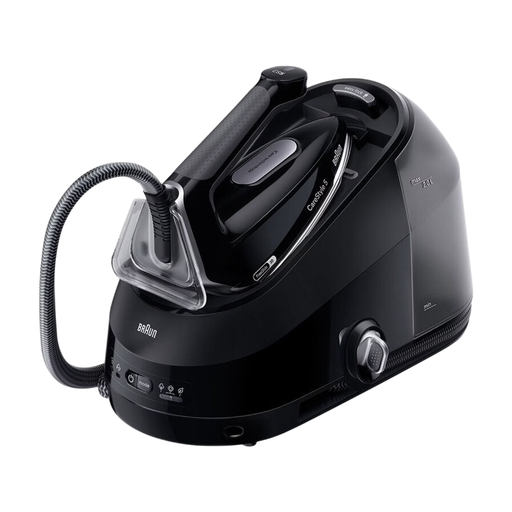 Image unavailable
Consider a steam generator if you also iron everyday laundry; the product name alone doesn’t confirm that this model is suitable for your patch and fabric.
Not if your patch instructions specify dry heat. MrPatch and Creapatch recommend switching off the steam for their own patches; don’t automatically apply their temperature and pressing time to other patches or fabrics.
Not always. Cricut warns against using a thin or flexible surface for its heat transfers and recommends a firm, flat base. Protect the surface in accordance with the material manufacturer’s instructions.
Follow the descaling procedure for the exact model number. Philips says the procedure can vary by series; don’t assume those instructions also apply to a model from another brand.
For an electrical appliance, check the product identity and safety information, and make sure the applicable CE marking relates to the specific product. The Dutch Government explains the CE requirement for electrical appliances, among other products, that are placed on the market in the EU. If a product is faulty, you also have statutory rights against the seller; ACM ConsuWijzer explains that the statutory guarantee is not limited to a fixed period of just two years.