
Pressing linen with care
You want to remove creases from linen scarves and set the temperature according to the care label, even if a scarf has a lining or finish. GINETEX describes the care label as a guide to the treatments permitted.


For a few linen scarves, a standard steam iron with adjustable temperature and steam is usually a sensible choice. Always follow the care label for the whole scarf, not just the fibre name. If you share the appliance with housemates, pay extra attention to automatic shut-off and safe plugging in. Choose a travel iron mainly if saving storage space matters more to you than having a larger tank and being able to iron for longer.
You want to remove creases from linen scarves and set the temperature according to the care label, even if a scarf has a lining or finish. GINETEX describes the care label as a guide to the treatments permitted.
You share the appliance with others, so you look for automatic shut-off, a safe electrical connection and straightforward controls. The Netherlands Fire Service recommends plugging high-power appliances directly into a socket wherever possible.
You iron briefly and occasionally, but need to store the appliance in a small room or shared cupboard. The Dutch Consumers’ Association cites limited storage space as one reason to consider a steam iron.
Start with the care label and think about how you’ll share and store the iron. GINETEX explains which treatments the label permits, so the right setting depends on the whole scarf, not just the linen.
| What to consider | What to look for when buying | Who is this important for? |
|---|---|---|
| Temperature and steam | Check whether you can adjust the temperature and steam separately, and compare the settings with the care label. Also consider whether the soleplate and tip are suitable for the edges and details you want to press. | If I iron scarves with different care labels or finishes, I want to adjust the setting for each one. Around 36% of consumers put temperature control and the results on linen first. |
| Shared use and safety | Check whether the exact model has automatic shut-off, and inspect the condition of the cord and plug. Follow the Netherlands Fire Service’s advice to plug high-power appliances directly into a socket wherever possible. | In a shared house, I don’t want to rely on the last person to remember to switch the iron off. Around 29% of consumers prioritise safety when sharing an appliance. Automatic shut-off is an extra safeguard, not a substitute for switching it off carefully. |
| Size and storage | Compare how the appliance, cord and any accessories can be stored with the space available in your cupboard. Consider the dimensions alongside the tank capacity and the likely length of your ironing sessions. | If my room or shared cupboard has little space, compact storage matters more than a large tank. Around 21% of consumers prioritise storage space; a small tank may mean more frequent refills during a longer session. |
| Maintenance and costs after purchase | Check the descaling instructions for the exact model and whether parts are available for it. Compare paid-for extended cover with your existing statutory rights. | Once the basic function meets my needs, I want to know what maintenance is required and what my options are if the appliance develops a fault. Around 14% of consumers put maintenance and costs after purchase first. |
They are different features. Joybuy’s product description for the Tefal FV2838E0 does not mention automatic shut-off, while Tefal describes five pre-set temperature settings for this model.
Check how the temperature is set and whether the appliance switches itself off, separately, using the full model number.
According to Tristar, the Tristar ST-8152 has a 0,06 L tank; the Tefal FV2838E0 and Braun SI 3055 mentioned here have 270 ml tanks. A smaller tank may mean more frequent refills during longer sessions.
Choose a compact model mainly if you expect to iron for short periods. If you iron several scarves in a row, compare tank capacities using the same units.
Philips describes garment steamers as an alternative to irons and notes that results can vary on thicker linen.
Decide in advance whether you want to remove light creases from a hanging scarf or press it flat, then choose an appliance that suits the finish you want.
The Express Steam FV2838E0 is a standard steam iron with five pre-set temperature settings, described as a choice for people who want to select the setting themselves.
The Braun TexStyle 3 SI 3055 is a standard iron with automatic shut-off described for this exact model.
The ST-8152 is a compact travel iron for occasional use when storage space is a priority.
The Philips 3000 Series includes standard steam irons; the DST3041/30 is a model described as having a ceramic soleplate and a 300 ml tank.
The products below are steam irons. Compare the temperature and steam settings, listed features and details relevant to your storage space and how you plan to use each model.
 No image available
Could suit you if you want to adjust the ironing setting for each scarf; check the controls and follow the care label.
The product name lists a 180 g steam boost, steam output of 40 g/min and a 300 ml tank.
 No image available
Could suit you if you want adjustable steam to tackle creases; check the settings for this exact model and follow the care label.
 No image available
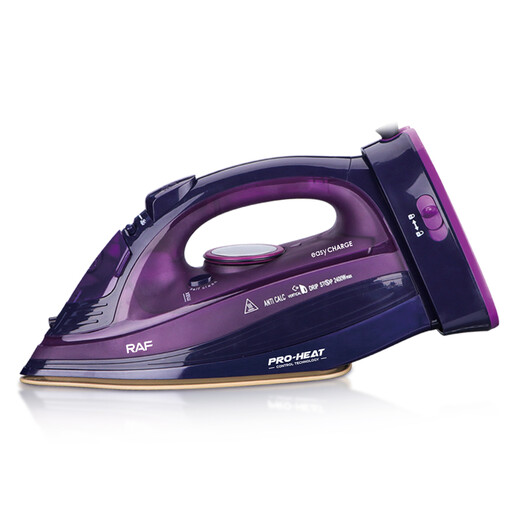
Could suit you if freedom of movement while ironing matters; bear in mind the warning not to leave the hot appliance unattended.
The product name lists a cordless design, 2400 W, a 320 ml tank, steam output of 15–25 g/min, a ceramic soleplate and self-cleaning.
 No image available
Could suit you if a precision tip for edges and small areas is useful; check the controls and shut-off feature for the exact model.
 No image available
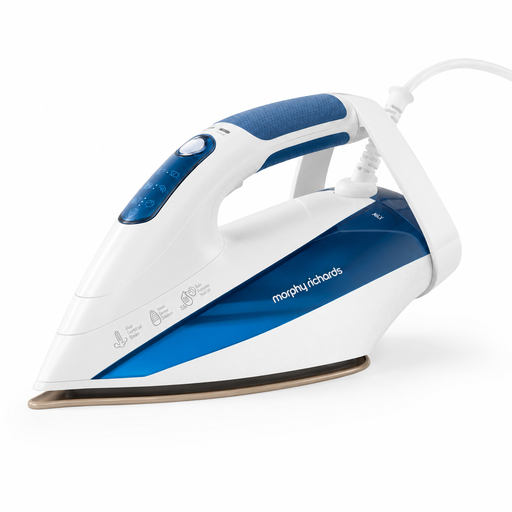
Could suit you if you want to combine variable steam settings with a precision tip; check whether the model manual meets your maintenance needs.
The product name lists 2400–2800 W, 50 g/min steam, a 350 ml tank, anti-drip and self-cleaning.
No. Follow the maximum treatment shown on the care label for the whole scarf, even if the main fabric is linen. GINETEX gives a maximum soleplate temperature of 200 °C for the hot-ironing symbol; a lower-temperature symbol or a do-not-iron symbol takes precedence over the fibre name.
Agree on who will switch the appliance off and let it cool down. The Netherlands Fire Service recommends plugging high-power appliances directly into a socket wherever possible, rather than using a cable reel or multi-socket extension lead. Automatic shut-off is an extra safeguard, not a substitute for careful use.
Follow the manual for the exact model. Philips describes different descaling procedures for its steam irons; don’t assume those instructions apply to an iron from Tefal, Braun or Tristar.
You don’t need it to get your statutory rights: these already apply when you buy a product. According to the Government of the Netherlands, there is no fixed statutory guarantee period in the Netherlands; if a product is faulty, contact the seller. Check whether paid-for extended cover actually adds anything to your existing rights.
The Netherlands Food and Consumer Product Safety Authority says CE marking is required for electrical products. This doesn’t mean that careful use is unnecessary; follow the product instructions and check the information for the exact model.