If you only need to press a few linen napkins flat now and then, a compact steam iron with adjustable temperature is the most practical choice. The Consumentenbond recommends a steam iron for smaller ironing sessions and limited storage space. A handheld steamer is an option if easy storage matters more than crisp creases, while a steam generator is better suited to regularly ironing larger loads. Always follow the care label on your napkin for the maximum temperature.
Who irons linen napkins?
The napkin presser
You want to iron a few linen napkins flat and give them neat creases. Follow the care label and choose an appliance that lets you adjust the temperature and steam. The Consumentenbond and GINETEX explain what to consider when choosing and caring for textiles.
The small-room ironer
You do little ironing and have limited storage space. A compact iron may be more practical than a steam generator, which takes up more room. The Consumentenbond discusses this difference when comparing the two types.
The shared-household user
Several housemates use the appliance. So it’s worth considering where to place it safely, how to switch it off and how to maintain it. The Dutch Fire Service warns, among other things, that a coiled cable reel can heat up.
What should you consider when choosing?
Compact steam iron
Best if: you occasionally want to iron a few napkins flat and adjust the temperature and steam.
Bear in mind: a smaller built-in tank may need refilling more often during longer sessions than a steam generator. The Consumentenbond explains the difference in tank design.
Dry iron
Best if: you do little ironing and don’t need a built-in steam function.
Bear in mind: it has no built-in steam function. The Philips GC160/02R1 mentioned here is also a refurbished model.
Handheld steamer
Best if: not having room for an ironing board is your main concern, and removing creases matters more than creating crisp, pressed folds.
Bear in mind: a handheld steamer doesn’t have a conventional soleplate for pressing a napkin flat.
Steam generator
Best if: you regularly iron larger loads in your student accommodation and have room for the appliance and a suitable ironing board.
Bear in mind: the larger system needs more storage space. Also check that your ironing board can support it.
| What to consider | What should you check? | Who is this important for? |
|---|
| Pressing linen flat |
Check the ironing symbol and choose an appliance with adjustable temperature and steam settings. |
If I want to press napkins flat without exceeding the instructions on the care label, I focus on temperature control; around 36% of consumers prioritise the pressing result. |
| Storage space |
Measure the space where you’ll store it and consider whether you have a suitable surface for ironing. Compare the size and tank design. |
If I have limited space and want to store the appliance easily, this matters more than having a large tank; around 29% of consumers prioritise space and ease of use. |
| Shared use |
Check whether the model has automatic shut-off, and agree on a safe place to use the appliance and let it cool down. |
In a shared home, I want to make sure a hot appliance isn’t left unattended; around 21% of consumers make safe use their top priority. |
| Maintenance |
Check the manual for guidance on suitable water, cleaning and descaling; the method varies by model. |
If I want to keep maintenance to a minimum, I check what the exact model requires and whether it has a water tank; around 14% of consumers prioritise ease of maintenance. |
Common mistakes when choosing
-
Choosing the hottest setting just because the napkin is linen
The care label on the specific napkin tells you how it can be treated; the fibre name alone doesn’t determine the right temperature.
Check the ironing symbol before you start and set the appliance accordingly.
-
Buying a steam generator for just a few napkins
According to the Consumentenbond, a steam generator is mainly suited to ironing large loads frequently. It takes up more space and may be too heavy for a standard ironing board.
Work out how much you iron at a time, measure your available storage space and check that your ironing board is suitable.
-
Assuming a handheld steamer can fully replace pressing
A handheld steamer doesn’t have a conventional soleplate for pressing napkins flat. This distinction is based on how the appliance is used, not on a measured comparison of ironing results on linen.
Choose a handheld steamer if quick crease removal and compact storage come first; choose an iron if pressing napkins flat is the main job.
-
Confusing your legal rights with a manufacturer’s guarantee
The Dutch Government states that the Netherlands has no fixed statutory guarantee period. If a product doesn’t meet reasonable expectations, the retailer is your point of contact.
Check any additional guarantee terms alongside your statutory rights.
Brands to consider
Philips
The range includes steam irons, dry irons and handheld steamers. Check the features of each model.
- Philips lists a 300 ml tank for the DST3041/30.
- The GC160/02R1 mentioned here is a refurbished dry iron with no built-in steam function. The refurbished STH3010/30R1 is foldable and can be used without an ironing board.
Tefal
The brand offers steam irons and steam generators for different amounts of ironing.
- For the Easygliss Plus FV5736E0, Tefal lists 45 g/min of continuous steam and automatic shut-off. For the Express Essential SV6115E0, the brand specifies a 1.4-litre tank.
- The tank capacity and features apply to these models; Tefal says descaling requirements vary by model.
Braun
The TexStyle 3 range includes steam irons with manual temperature controls. Check the features of the specific model.
- For the SI 3041 Groen, Braun lists a thermostat dial, self-cleaning and 45 g/min in turbo mode.
- The stated output applies to turbo mode and isn’t directly comparable with the continuous steam output of other models.
Joybuy products
These product picks are aimed at ironing linen napkins in a small living space, where storage and the available ironing surface are important considerations.
 No image available
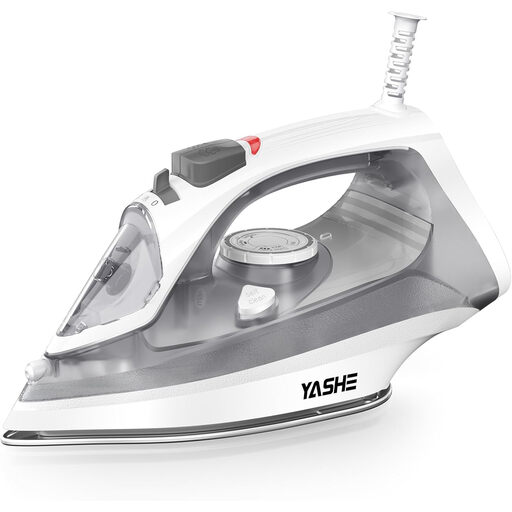
YASHE WSD-218
A steam iron for finishing napkins on an ironing surface.
The product name lists 2300 W, a 300 ml tank, a non-stick soleplate, automatic cleaning and an anti-drip system.
View at Joybuy
 No image available
Tefal Easygliss Plus FV5736
A steam iron for anyone who wants to use a soleplate to finish napkins flat.
For this model, Tefal lists 45 g/min of continuous steam, a 220 g/min steam boost and automatic shut-off.
View at Joybuy
 No image available
Xiaomi BHR9034EU
A compact handheld model for anyone short on storage space.
The product name lists a lightweight design and Dual Voltage.
View at Joybuy
 No image available
Philips 1000 Series DST1030/20
A steam iron for finishing napkins on an ironing surface.
The product name lists a power rating of 2000 W.
View at Joybuy
 No image available
Braun FreeStyle 5 SI5037
A steam iron for finishing napkins with a soleplate.
Check the manual for this model for temperature settings and maintenance instructions.
View at Joybuy
Frequently asked questions
What temperature should you use for linen napkins?
Follow the care label on the specific napkin, not just the fibre name. GINETEX’s symbol chart gives a maximum soleplate temperature of 200 °C for the hot-iron symbol; a symbol for a lower temperature means you should use a lower setting.
Do you need a steam generator for a few napkins?
For a few napkins that you iron now and then, a steam generator is generally unnecessary. The Consumentenbond recommends a steam iron for smaller loads and limited storage space. A steam generator is better suited to frequent ironing and stubborn creases.
How do you maintain a steam iron?
Follow the manual for the exact model, as descaling methods vary. For the models discussed, Tefal advises against using vinegar or descaling products in the steam tank.
What should you consider when using an iron in a shared home?
Switch the appliance off after use and let the hot soleplate cool down somewhere safe. The Dutch Fire Service warns that a coiled cable reel can heat up, and recommends plugging high-power appliances directly into a wall socket rather than using a cable reel or multi-socket adaptor.
What guarantee applies in the Netherlands if your iron breaks?
The retailer is your point of contact if a product doesn’t meet reasonable expectations. According to the Dutch Government, the Netherlands has no fixed statutory guarantee period; check any additional guarantee separately from your statutory rights.


