
Small pile, limited space
If you press a few napkins now and then, a steam iron is generally easier to store than a model with a separate base unit. The Dutch Consumers’ Association cites limited storage space as a reason to consider a steam iron.


For a few napkins and limited storage space, a steam iron is an obvious choice. For large piles, a steam generator may suit you, provided you have room for the base unit and a suitable ironing board. If you want to press without built-in steam, consider a dry iron and lightly dampen the fabric if needed, as long as the care label allows it. The Dutch Consumers’ Association advises choosing according to how much you iron and how much space you have; always follow the napkin’s care label for the temperature.
If you press a few napkins now and then, a steam iron is generally easier to store than a model with a separate base unit. The Dutch Consumers’ Association cites limited storage space as a reason to consider a steam iron.
If you regularly iron large piles, a steam generator could be worth considering, provided you have room for the base unit and a suitable ironing board. The Dutch Consumers’ Association highlights the trade-off between longer ironing sessions and the space a generator requires.
If you want to control the steam or finish pressing without it, check whether the appliance lets you turn the steam down or switch it off. The Dutch Consumers’ Association advises ironing fabric while damp when needed; for linen napkins, follow the care label too.
Suitable if: you want to set the temperature yourself and don’t need built-in steam.
Trade-off: you’ll need to lightly dampen the fabric yourself if necessary; check the care label first.
Suitable if: you iron a small or modest pile and want an appliance with a built-in water tank.
Trade-off: you may need to refill it during longer sessions; the tank is part of the iron.
Suitable if: you often iron large piles in one go and have room for a separate base unit.
Trade-off: the larger set-up takes up space and may not fit every ironing board, according to the Dutch Consumers’ Association.
| What to consider | What should you check? | Who should pay particular attention? |
|---|---|---|
| Steam control | Check whether you can adjust or switch off the steam and finish pressing without it. | I want to smooth out creases without putting damp napkins away. Around 36% of consumers say a smooth finish and control over moisture are their main priorities. |
| Space and storage | Compare the appliance’s dimensions with the storage space available. | If I’m short on space, I want to be able to put the iron away easily after use. Around 29% of consumers prioritise a compact design and choosing an appliance that suits their needs. |
| Large piles | Compare tank capacity and continuous steam output; also check that the base unit fits on your ironing board. | When ironing lots of napkins in one go, I want to minimise interruptions to refill the tank. Around 21% of consumers prioritise tackling large piles. |
| Maintenance and use | Check the care instructions and whether the specific model switches off automatically. | I don’t want to maintain a water tank, and I also look for a safe way to put the iron away. Around 14% of consumers prioritise easy maintenance and a safety feature that suits their needs. |
A steam boost is a separate function. It doesn’t tell you how much steam the iron produces throughout an ironing session.
Compare continuous steam output in g/min separately from the steam boost. Also check the tank capacity and whether you can adjust the steam.
The separate base unit takes up space and may be too large or heavy for a standard ironing board, according to the Dutch Consumers’ Association.
Before buying, check that you have room for the appliance and that your ironing board is suitable. You may need a different set-up or ironing board.
The care label may specify a lower temperature than you’d expect based on the fibre, due to the finish or other components.
Follow the ironing symbol on the label and adjust the temperature and steam accordingly. GINETEX emphasises that the permitted temperature depends on the care label.
The Philips 3000 Series mentioned here includes both a steam iron and a model with a separate base unit.
The models mentioned include a steam iron and a steam generator for longer ironing sessions.
According to Braun, the TexStyle 5 SI5256BL is a steam iron with manual temperature control, adjustable steam and a precision tip.
According to Severin’s product specifications, the BA 3211 is a dry iron with variable temperature control.
The selection below includes steam irons and steam generators for ironing linen napkins, from smaller quantities to larger piles.
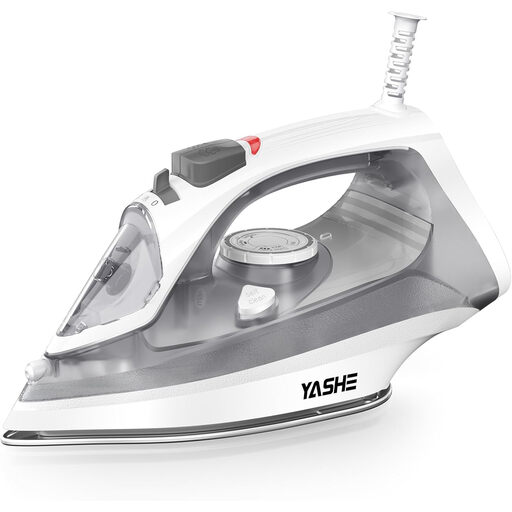 Image unavailable
Suitable if you want to switch manually between dry ironing and using steam.
Manual temperature and steam control; dry and steam functions.
 Image unavailable
Suitable for longer ironing sessions if you have room for a separate base unit.
Philips lists a 1.4 l tank, 120 g/min of continuous steam and a 350 g steam boost.
 Image unavailable
The larger tank could suit longer ironing sessions when you want to refill less often.
1.3 l tank capacity; continuous steam and steam boost; automatic shut-off.
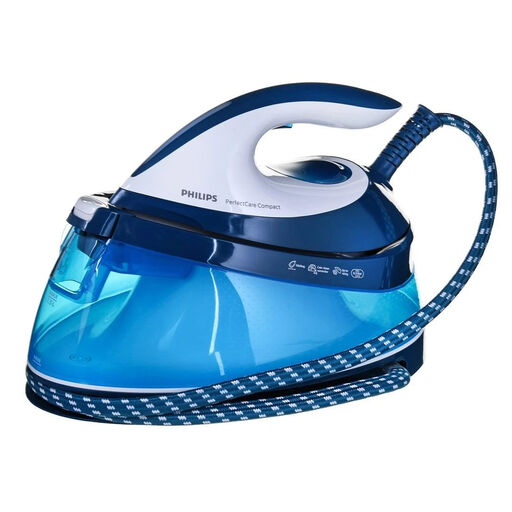 Image unavailable
Suitable if you’re looking for a separate generator set-up for longer ironing sessions.
1.5 l tank capacity; 120 g/min of continuous steam; 400 g steam boost; vertical steaming.
 Image unavailable
Suitable if you want to adjust the steam and have the option of dry ironing too.
Manual temperature and steam control; dry and steam functions.
Follow the care label, not just the fact that it’s linen. GINETEX sets maximum temperatures for ironing symbols at 110 °C without steam, 150 °C and 200 °C; the label on the complete napkin determines which temperature is permitted.
Use steam sparingly and, if needed, finish pressing without steam. The Dutch Consumers’ Association advises ironing fabric while slightly damp when this helps with creases; leave napkins to cool and dry before folding or storing them.
That depends on the dimensions and weight capacity of your ironing board, as well as the base unit. The Dutch Consumers’ Association warns that a generator may be too large or heavy for a standard ironing board; check both before buying.
If a product is faulty, the retailer is responsible under the statutory guarantee; a manufacturer’s warranty doesn’t replace this right. Online consumer purchases generally come with a 14-day cooling-off period from delivery, subject to legal exceptions, according to ACM ConsuWijzer.
No. Philips/Versuni lists certain PerfectCare 8000, 9000 and Elite models with model codes beginning PSG8, PSG90 or GC96 and product codes from 2419 to 2441 inclusive. The notice doesn’t apply simply because of the brand name or because an appliance is a steam generator; check the exact model and product code.