
Careful tie wearer
You want to smooth out a cotton tie without choosing too high a temperature based on the word ‘cotton’ alone. GINETEX advises setting the maximum temperature according to the care label.


If you only iron a cotton tie now and again, choose a standard steam iron that suits your available space and lets you adjust the temperature and steam. Always follow the care label, as the fact that a tie is made of cotton alone doesn’t determine a safe setting. A handheld steamer is better suited to de-wrinkling hanging clothes, while a steam generator makes sense if your housemates also regularly iron larger loads and you have room for the appliance. GINETEX and the Consumers’ Association offer relevant guidance.
You want to smooth out a cotton tie without choosing too high a temperature based on the word ‘cotton’ alone. GINETEX advises setting the maximum temperature according to the care label.
You iron occasionally and want an appliance that fits into a small, shared living space. The Consumers’ Association recommends a standard steam iron if you have little laundry to iron and limited storage space.
You want to use the same appliance for ties and regular, larger ironing sessions. In that case, the water tank, the space needed to set it up and how it will be used by the household become more important.
Best for: occasional ironing on a flat ironing surface, with limited storage space.
Bear in mind: it has a smaller water tank and produces less steam than a generator.
Best for: de-wrinkling hanging clothes without an ironing board, when you don’t need a crisply pressed tie.
Bear in mind: Philips says a garment steamer won’t give the same results as an iron, especially on thick cotton.
Best for: households that regularly tackle larger loads of laundry or stubborn creases.
Bear in mind: according to the Consumers’ Association, a generator is larger and harder to store than a standard steam iron.
| What to consider | What should you check? | Which consumers is this for? |
|---|---|---|
| Protecting your tie | Read the care label and check whether you can adjust the temperature and steam. | I want to smooth my tie without damaging the fabric; protecting it matters most to me. Around 36% of consumers put avoiding damage to their tie at the top of their list when buying. |
| Limited space | Decide where the appliance and, if needed, an ironing board can be set up safely and stored. | If I have very little space and only iron occasionally, a simple set-up matters more than extra capacity. Around 29% of consumers prioritise space and occasional use. |
| Precise pressing | Look at the shape of the soleplate and check whether you can control the steam. | With a narrow tie, I want to work precisely without treating the whole tie unnecessarily. Around 21% of consumers prioritise precise pressing. |
| Larger loads too | Consider how often your housemates iron larger loads and whether the ironing board is suitable. | If we regularly use the appliance together for larger loads, extra capacity matters more than it would for a single tie. Around 14% of consumers put shared, larger ironing sessions at the top of their list when buying. |
The fibre name doesn’t tell you what treatment the whole tie can withstand. GINETEX says the care label determines the maximum ironing temperature.
Read the label before choosing the temperature and steam settings. Don’t use an iron if the label says not to iron the tie.
Philips says a garment steamer won’t give the same results as an iron, especially on thick cotton.
Decide whether you want to de-wrinkle hanging clothes or need a flat, pressed finish. Check the care instructions too.
For pressing on a flat surface, you may still need a suitable iron and a suitable place to iron.
The extra capacity is most useful for larger ironing sessions, while a generator takes up more space than a standard steam iron.
Think about how often the whole household does the ironing and where the appliance and ironing board can be kept.
A manufacturer’s guarantee doesn’t replace your statutory rights. The Dutch government explains that you can contact the retailer about a faulty product.
Keep your proof of purchase and contact the retailer if a product is faulty.
The 3000 Series DST3041/30 is an example of a standard steam iron for smaller ironing sessions.
The Express Steam FV2837 is an option if you iron other laundry as well as ties.
The TexStyle 3 SI3030PU is a steam iron with a rounded soleplate.
This selection includes standard steam irons, a steam generator and a handheld steamer. First decide whether you want to press a tie on a flat ironing surface or mainly de-wrinkle hanging clothes.
 Image unavailable
A standard steam iron for anyone who wants to iron other laundry too. Before use, check that the settings are suitable for the tie’s care label.
2400 W; non-stick soleplate; automatic cleaning function; anti-drip function.
 Image unavailable
A compact model for anyone looking for a steam iron for a small living space. Check that the settings match your tie’s care label.
Dual voltage; described in the product name as compact and lightweight.
 Image unavailable
A standard steam iron for anyone who wants to press a tie on a flat ironing surface. Before you start, check that the controls can be set to the temperature specified on the care label.
2000 W; colour: blue and white.
 Image unavailable
A steam generator for households that also have longer ironing sessions. Bear in mind that a generator takes up extra space.
2400 W; 1.4 l water tank; 350 g steam boost.
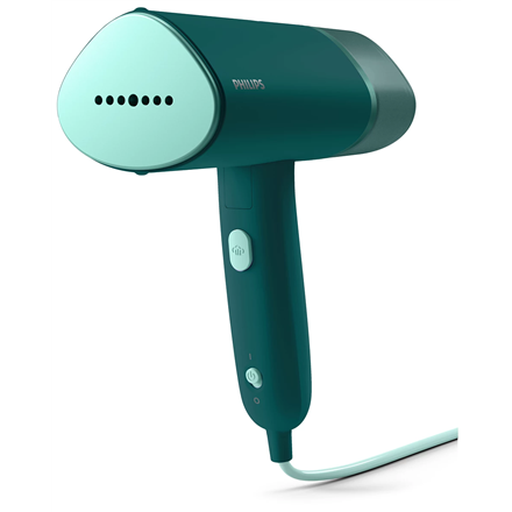 Image unavailable
A handheld steamer for hanging clothes and use without an ironing board. Philips says a garment steamer won’t give the same results as an iron.
1000 W; 30-second heat-up time; foldable design.
No. GINETEX advises setting the maximum ironing temperature according to the care label, not just the type of fibre. The symbol for a maximum of 110 °C means ironing without steam; follow the care label for the whole tie.
Wait until the iron is hot enough before using the steam function. The Consumers’ Association warns that an iron that’s still too cold can leak. Always follow the tie’s care label too.
To exercise your statutory rights, contact the retailer. The Dutch government says there’s no fixed statutory guarantee period in the Netherlands; what you can expect from a product depends, among other things, on the product and how it’s used.
For online purchases in the Netherlands, a 14-day cooling-off period applies in many cases, although there are exceptions. The Dutch government explains how this period works; it’s separate from your rights if a product is faulty.
Electrical equipment within the scope of the Low Voltage Directive 2014/35/EU must meet its requirements, which are incorporated into Dutch law. The NVWA explains the obligations that apply to manufacturers and importers, among others. This doesn’t in itself confirm that an individual model meets all the requirements.