
Patch maker with limited space
You mainly apply small fabric patches and share a work surface with others. Look for a suitable ironing tip, a heat-resistant surface and a safe place to let the iron cool.


Choose a mini iron if you mainly apply small patches and have limited work or storage space. A standard iron is more practical if you also want to use it on your laundry. Follow the patch manufacturer's instructions and check that the required heat is suitable for the fabric. In a shared space, make sure you also have a safe place to set down the hot iron and let it cool.
You mainly apply small fabric patches and share a work surface with others. Look for a suitable ironing tip, a heat-resistant surface and a safe place to let the iron cool.
You want to use one appliance for patches and everyday ironing. Check whether you can adjust the temperature and control the steam for each task.
You need to check whether the fabric can withstand the heat required for the patch. If it can't, sewing may be an alternative.
Best for: working on small patches, edges or hard-to-reach areas when you have limited space.
Trade-off: the small soleplate is designed for detailed work and is less practical for large items of laundry.
Best for: using the same appliance for everyday ironing, provided you can switch off the steam for patchwork.
Trade-off: check the specific model to see whether the temperature is adjustable and whether you can iron without steam.
Best for: a shared space that you also use for lots of everyday ironing or stubborn creases.
Trade-off: the Dutch Consumers’ Association describes steam generators as larger, more expensive and harder to store. Extra steam power is not in itself an advantage for patchwork, where the steam needs to be off.
Best for: fabrics that can't withstand the required heat, or when a longer-lasting attachment is important.
Trade-off: sewing takes extra work by hand. iBadge says sewing on patches is more durable for the patches covered by its own instructions.
For the patches covered in its own instructions, MrPatch recommends switching off the steam and using the highest temperature the garment fabric can safely withstand. Always follow the instructions for your patch and the garment's care label.
| What to consider | What to look for | Who should pay particular attention? |
|---|---|---|
| Heat for the patch and fabric | Read the patch instructions and the garment's care label. Check the temperature controls and whether you can switch off the steam. | If I'm applying patches to fabrics with different heat requirements, I want to avoid damage and follow the instructions. Around 31% of consumers put heat compatibility first. |
| Work-surface space | Compare the ironing surface and leave room for a heat-resistant mat and a place for the iron to cool. | When I share a work surface, I want to be able to set down and store the iron safely after patching. Around 25% of consumers say the space an iron takes up is their main concern. |
| Setting the iron down and letting it cool safely | Plan a stable, heat-resistant spot and consider the cord, switching off and cooling down. | If other people use the same space, I want to make sure they don't come across a hot iron or its cord. Around 25% of consumers put safe shared use first. |
| Patches and everyday laundry | Check the temperature and steam controls on the specific model, and compare the soleplate and storage space with your ironing needs. | If I want one appliance for both patchwork and laundry, I look for settings that can be adjusted for each task. Around 19% of consumers give combined use their highest priority. |
Steam specifications don't tell you whether your patch's adhesive will bond properly. Some patch instructions specifically call for dry heat.
Set the temperature, contact area and steam use according to the patch instructions. Assess steam power separately if you also want to use the iron on laundry.
The heat required by the patch may be higher than the fabric can safely withstand.
Read both the patch instructions and the garment's care label first. Don't use a temperature the fabric can't tolerate; consider sewing if heat isn't suitable.
Even a small, hot iron needs a safe place to set it down and let it cool in a shared space.
Plan your work surface, cord and cooling spot. An included rest doesn't replace switching the iron off or keeping an eye on it.
The Mini Iron II 8003EU is designed for small craft projects and precise pressing.
The Mini Steam Iron Set 611961 is designed for sewing and small ironing jobs.
The Easygliss Plus FV5736 is a standard steam iron for anyone who irons laundry as well as patches.
The TexStyle 3 SI 3041 GR is a standard steam iron with a manual temperature dial.
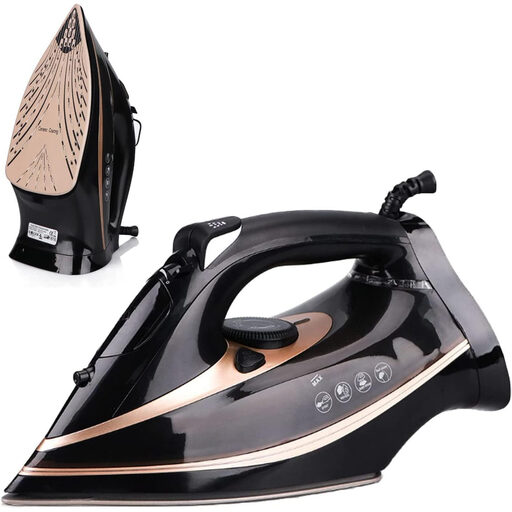
These Joybuy product picks are standard steam irons for anyone considering an appliance for everyday ironing as well as patchwork. Before using one for patches, check whether you can switch off the steam and set a suitable temperature for that model.
 No image available
An option to compare if you're also looking for a steam iron for laundry. Check whether you can switch off the steam for patchwork and set a suitable temperature.
The product name lists a continuous steam output of 70 g/min, a 120 g steam boost and a 300 ml water tank.
The product name also lists a self-cleaning function.
 No image available
The product description mentions dry ironing and five adjustable temperature settings. Check that they match the instructions for your patch and fabric.
The product name lists a non-stick soleplate, an automatic cleaning function and an anti-drip system.
The description lists a 1.95 m cord and says it can be used at home or on the go.
 No image available
The description mentions dry ironing and manual temperature and steam controls. Check that the settings are suitable for your patch instructions.
The product description lists a weight of 0.77 kg and dimensions of 25 × 7.5 × 13.5 cm.
Don't leave the appliance unattended while it's plugged in. Use a stable, heat-resistant surface while using it and letting it cool.
 No image available
The product description mentions dry ironing, a temperature dial and a slim soleplate tip for precision work. Check the temperature needed for the patch and fabric.
The product name lists a power output of 2000 W.
 No image available
The product description mentions a precision tip for hard-to-reach areas. Check that the temperature and steam settings are suitable for your patchwork.
The description lists automatic shut-off after 8 minutes upright or 30 seconds horizontally.
Don't leave the hot iron unattended. Stand it on its heel and unplug it after use.
Follow the instructions for your patch. For the patches covered in their own instructions, MrPatch and iBadge call for dry heat or switching off the steam. This isn't a general rule for all patches.
Don't assume every fabric is suitable. Check the garment's care label and the patch instructions before applying heat. A Dutch how-to guide advises against ironing the applications it describes onto fabrics including nylon, PVC, acetate and rayon. If the fabric can't withstand the required heat, you could consider sewing the patch on.
Use a flat, heat-resistant surface and leave room to set down the appliance safely and let it cool. Don't leave a hot iron plugged in and unattended, and follow the safety instructions for your chosen model.