
Pressing a waistcoat precisely
You mainly want to smooth seams, edges and areas around buttons with control. The shape of the soleplate and the instructions on the garment’s care label are important considerations.


For a cotton waistcoat, a steam iron with suitable temperature and steam settings and a pointed tip for working around seams and buttons is a good choice, provided the care label allows it. If you regularly tackle large loads of family laundry, a steam generator with a separate tank may be more practical. A garment steamer is better suited to freshening clothes on a hanger than to pressing seams sharply. In the Netherlands, CE marking is mandatory for electrical products. Check the marking on the specific product, as it does not in itself prove that an individual item is safe, according to the Netherlands Food and Consumer Product Safety Authority.
You mainly want to smooth seams, edges and areas around buttons with control. The shape of the soleplate and the instructions on the garment’s care label are important considerations.
As well as waistcoats, you iron other clothes and need to balance ease of handling against the reservoir size and the space available for a separate steam generator.
You want to choose a treatment that’s suitable for the whole garment. So start with the care label, not just the cotton outer fabric.
Choose this if: you mainly want to press one waistcoat flat and work carefully around seams, pockets and buttons.
Bear in mind: an iron with a built-in reservoir may need refilling more often when you have a larger pile of laundry.
Choose this if: you regularly have large amounts of ironing and stubborn creases, and have room for a separate water tank.
Bear in mind: the separate tank needs space both while you’re using it and when you put it away.
Choose this if: you want to freshen up a waistcoat on a hanger or smooth out light creases without an ironing board; Philips describes this use for its garment steamers.
Bear in mind: steaming without an ironing board doesn’t necessarily give you the same crisp finish along seams and edges as working with a soleplate.
| What to consider | What should you check? | Who is this important to? |
|---|---|---|
| Smoothing out creases | Compare continuous steam with a steam boost, and check that the temperature and steam settings are suitable for the care label. | If I want to press a cotton waistcoat properly flat, I need to know whether the settings are suitable for the care label. Around 36% of consumers prioritise crease removal. |
| Precision around seams and buttons | Look at the tip and shape of the soleplate, and check whether you can use it to reach small areas. | I want to work precisely around seams and buttons. Around 29% of consumers give precision on these details top priority. |
| Protecting the outer fabric and lining | Read the care label for the whole garment and check that the temperature and steam settings are suitable. | If my waistcoat has a lining, I want to choose a treatment that’s right for the whole garment, not just the cotton. Around 21% of consumers say fabric protection is their main concern. |
| Ironing larger amounts of laundry too | Compare a built-in reservoir with a separate tank and consider how much space the setup will take up. | When I’m ironing family laundry as well as a waistcoat, I weigh up a larger ironing session against the space needed for a separate tank. Around 14% of consumers put the total amount of laundry first. |
The care label applies to the whole garment. Any lining may also affect which temperature and steam settings are suitable.
Read the label before choosing the temperature or steam setting, and follow the limits given for the entire waistcoat.
Tefal lists the FV8066’s continuous steam output as 50 g/min and its steam boost as 280 g/min. These are different functions, so the figures are not directly interchangeable.
When comparing different models, compare the same type of steam specification and also check whether you can work precisely around seams.
A steam generator has a separate water tank. The Consumers’ Association describes this type as particularly useful for large amounts of ironing and stubborn creases.
Choose a setup based on the total amount of ironing you do, not just the amount of steam it produces.
Also consider how much space the separate tank will take up during use and when stored away.
The Dutch government says that the Netherlands has no fixed statutory guarantee period. A retailer’s or manufacturer’s guarantee is not the same as your statutory rights.
Check exactly what the manufacturer’s guarantee and the retailer’s terms cover. If there’s a problem, also bear in mind your statutory rights with the retailer.
Philips offers steam irons and garment steamers, among other products. The 3000 Series is one option to consider for smaller ironing sessions.
Tefal offers steam irons and steam generators. The FV8066 is one model to look at when comparing stated steam specifications.
The TexStyle 7 Pro SI 7149 is one model to consider if you want to manoeuvre around buttons and pockets.
This selection includes steam generators and steam irons for precise ironing or larger sessions. In the Netherlands, CE marking is mandatory for electrical products, so check the marking on the specific product. The Netherlands Food and Consumer Product Safety Authority stresses that a mark alone does not prove that an individual item is safe.
 No image available
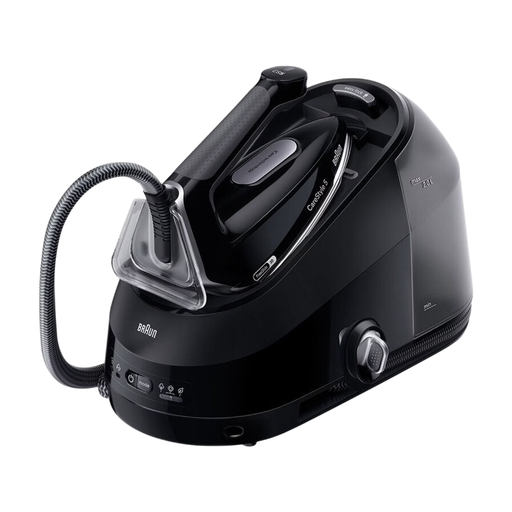
A steam generator to consider if you iron larger amounts of laundry as well as waistcoats; bear in mind that it has a separate tank.
The product name lists 2400 W and a 350 g steam boost. The product information states that it has a removable 1.4 L reservoir, continuous steam at 120 g/min and a ceramic soleplate.
 No image available
The 3D precision tip mentioned may be useful if you want to work around buttons and small areas of a waistcoat. As a steam generator, this model needs space for a separate tank.
The product information lists a 1,800 ml reservoir, continuous steam at 120 g/min and a steam boost of 380 g/min. It also mentions a Durilium AirGlide soleplate.
 No image available
The FreeGlide 3D soleplate mentioned may be useful if you want to manoeuvre around buttons and pockets while ironing; bear in mind that it has a separate tank.
The product information lists iCare temperature control, a removable 2 L reservoir, continuous steam of up to 150 g/min and a steam boost of 510 g/min.
 No image available
The manual temperature and steam controls may be useful if you want to match the settings to the care label.
The product name lists dual voltage. The product information states that it has a ceramic soleplate, a 0.15 L reservoir and weighs 0.77 kg.
 No image available
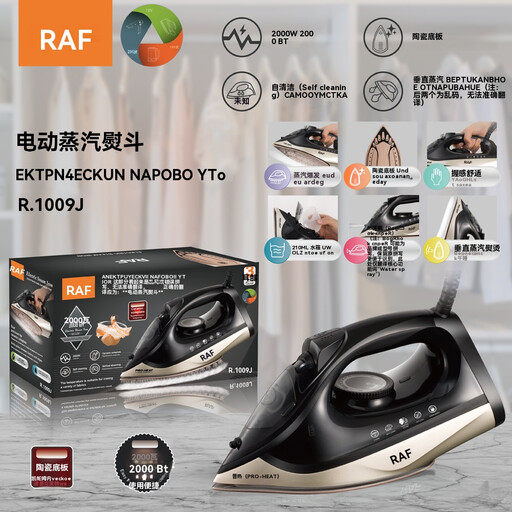
This steam iron is one to consider if you want to use a standard soleplate as well as vertical steam.
The product information lists a ceramic soleplate, a 210 ml reservoir, a steam boost and a self-cleaning function.
No. Follow the care label for the entire garment. The ironing symbols show the maximum soleplate temperatures; GINETEX states that the 110 °C symbol means you should iron without steam.
Follow the instructions for your exact model. Philips describes a descaling procedure for its steam irons; this procedure is not intended for steam generators and does not necessarily apply to other brands.
No. According to the Dutch government, the Netherlands has no fixed statutory guarantee period. What you can reasonably expect from a product depends on the circumstances. A manufacturer’s guarantee is in addition to your statutory rights, and the retailer is your point of contact if there’s a problem.
CE marking is mandatory for electrical products. The Netherlands Food and Consumer Product Safety Authority also lists safety requirements for electrical equipment. Check the marking on the specific product, as it does not in itself prove that an individual item is safe.