
If you look after a few ties
You want to press cotton ties neatly now and again without leaving them shiny, marked or misshapen. Check the care label first, and remember to take the lining into account too.


If you only have a few cotton ties to iron and limited storage space, an adjustable steam iron is usually the best choice. The Dutch Consumers’ Association says a steam iron is suitable if you do little ironing or have little space. For light creases that don’t need firm pressing, a hybrid appliance with vertical steam may be more convenient. A steam generator makes most sense if you also regularly iron large amounts of other cotton laundry. Always follow the care label for the entire tie, use a pressing cloth if ironing is permitted, and check the exact model variant and applicable product marking before you buy.
You want to press cotton ties neatly now and again without leaving them shiny, marked or misshapen. Check the care label first, and remember to take the lining into account too.
You have limited storage space and want to tackle small creases without having to set up a full ironing station each time.
Alongside ties, you regularly iron larger amounts of cotton laundry and need to balance capacity against size and maintenance.
A good choice if: you press a few ties at a time and also want to iron small items.
Bear in mind: it has a smaller water tank and can feel heavy in your hand. Use little pressure and a pressing cloth on a tie.
A good choice if: you mainly want to gently tackle light creases with vertical steam, but would also like a horizontal ironing option.
Bear in mind: vertical steaming doesn’t automatically provide the same pressing force as ironing on a flat surface.
A good choice if: your holiday home also regularly deals with larger loads of cotton linen with stubborn creases.
Bear in mind: the larger appliance needs more storage space and may be too heavy for your ironing board.
| What to consider | What to look for when buying | Who is this important for? |
|---|---|---|
| Protecting the fabric and shape | Check the care label for the entire tie and choose adjustable heat and steam. If ironing is permitted, use a pressing cloth and apply little pressure. | When I press a cotton tie, I want to avoid damaging the lining or shape. Around 33% of consumers prioritise protecting the fabric and shape. |
| Quick to use and put away | Check how much space the appliance takes up and whether you need a flat, heat-resistant surface. | For quick touch-ups, I don’t want to spend long setting up and tidying away. Around 27% of consumers prioritise quick use and compact storage. |
| Larger loads of cotton | Weigh the amount of other laundry you iron in each session against the appliance’s capacity and the space available for it and your ironing board. | If I also regularly iron linen as well as ties, capacity matters more. Around 20% of consumers prioritise larger loads of cotton laundry. |
| Safe use and maintenance | Check the manual, the model-specific automatic shut-off function and the applicable product marking for the exact model. | If the appliance is shared, I want to know how to use and maintain it safely. Around 20% of consumers prioritise safe use and maintenance. |
The percentages show how consumers with different primary buying concerns are distributed across these scenarios; they are not measured market shares. When it comes to ties, always follow the care label for the whole garment: the cotton outer fabric alone doesn’t tell you what temperature or amount of steam is suitable.
The lining and care label for the whole tie may call for different ironing conditions. Direct heat or pressure can also leave a shine or distort its shape.
Read the care label before you start. Only press the tie if the label allows it, place a pressing cloth between the soleplate and the fabric, and use little pressure.
The extra capacity is most useful for larger ironing sessions, while a generator takes up more storage space and may be too heavy for your ironing board.
Choose capacity based on all the laundry you actually iron, not just your ties.
The Easygliss Plus FV5736E0 is an example of a classic steam iron for smaller ironing jobs.
According to Philips, the OneTurn GC215/20 has horizontal ironing and vertical steaming modes; the DST3031/20 is a classic steam iron.
The TexStyle 7 SI7088GY is worth considering if a precision tip and automatic shut-off matter to you.
This selection includes classic steam irons, a 2-in-1 steamer and steam generators for different ironing needs in a holiday home.
 No image available
A classic steam iron is a straightforward option if you mainly press a few ties at a time. Check the full variant and water tank capacity before choosing based on capacity.
Only press the tie if its care label allows it; use a pressing cloth and apply little pressure.
 No image available
Worth considering if you’re looking at an appliance described as 2-in-1. Check that its features and method of use are suitable for pressing ties flat.
Follow the care label for the whole tie and, if ironing is permitted, use a pressing cloth and apply little pressure.
 No image available
A classic iron to consider for small pressing jobs. Check the manual for this variant for its temperature settings and whether it has automatic shut-off.
Only press the tie if its care label allows it; use a pressing cloth and apply little pressure.
 No image available
A good fit if you iron larger amounts of laundry as well as ties; bear in mind that a steam generator needs extra storage space.
The product name lists 2400 W, a 350 g steam boost and a 1,4 l water tank. Only press a tie if the care label for the whole garment allows it.
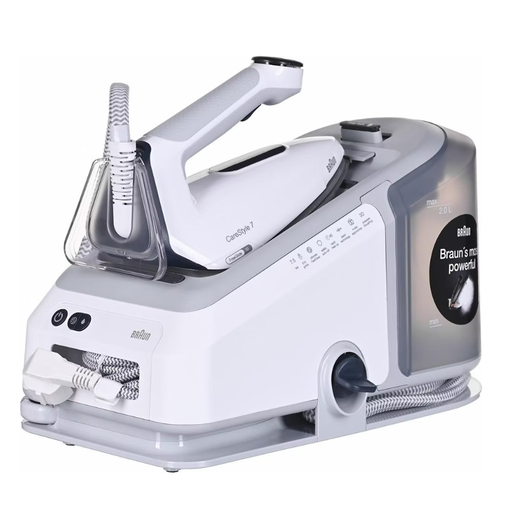 No image available
An ironing system to consider if you also regularly iron larger amounts of cotton. Allow for more storage space than you’d need for a classic iron.
Check the manual for model-specific settings and maintenance. Only press ties if the care label allows it, and use a pressing cloth with little pressure.
Don’t choose a setting based only on the outer fabric. Follow the care label for the whole tie and, if ironing is permitted, use a pressing cloth to limit direct contact with the soleplate. Start gently, especially if you don’t know what the lining is made from.
Follow the manual for your chosen model. The Dutch Consumers’ Association says steam irons are designed for tap water. Descale the appliance according to the instructions, and don’t use additives unless the manual allows them.
No. According to ACM ConsuWijzer, statutory guarantees apply alongside any manufacturer’s warranty. A product’s expected lifespan and the circumstances of the purchase also help determine what you can reasonably expect from it. Consumer protection may differ when a rental company makes the purchase rather than an individual consumer.
An appliance designed for Dutch mains voltage and covered by Directive 2014/35/EU must meet the requirements of that European Low Voltage Directive. The Dutch government explains that, after assessing the applicable requirements, the manufacturer must affix a CE marking if the appliance complies. Check the documentation for the specific model.