
Occasional ironing in a small home
You iron a few pillowcases at a time and want to be able to store the appliance easily. The Consumers' Association cites having little ironing to do and limited storage space as reasons to consider a steam iron.


For a few cotton pillowcases in a small home, a standard steam iron is often a practical choice, as it takes up less storage space than a steam generator. The Consumers' Association cites having little ironing to do and limited storage space as reasons to choose a steam iron. If you regularly iron large loads, a generator's larger tank may mean fewer refills, but the complete appliance needs more room. Also check the care label and make sure you have space to use and store the appliance.
You iron a few pillowcases at a time and want to be able to store the appliance easily. The Consumers' Association cites having little ironing to do and limited storage space as reasons to consider a steam iron.
You iron pillowcases along with plenty of other laundry and want to refill less often, provided you have room for a larger appliance. The Consumers' Association describes the larger tank as a factor to weigh up when choosing a steam generator.
You pay attention to the care label and steam settings, and want to avoid damp patches or limescale marks. The Consumers' Association advises following the care label and notes that cotton can be harder to smooth out than lightweight synthetic fabrics.
Best for: a few cotton pillowcases at a time and limited storage space.
Trade-off: the built-in tank will usually need refilling sooner than a steam generator's tank, as the Consumers' Association explains.
Best for: regularly ironing large loads, if you have room for the separate tank and ironing set-up.
Trade-off: the larger tank may mean fewer refills, but the complete appliance needs more storage space. Also check that your ironing board is suitable.
Best for: anyone who specifically wants to iron without built-in steam and follows the pillowcase care label.
Trade-off: cotton can be harder to smooth out without steam, so a dry iron is not necessarily the right choice for bedding.
Best for: a quick refresh when you'd rather not set up an ironing board.
Trade-off: for pillowcases you want to press flat, the Good Housekeeping Institute describes an iron as an easier-to-control option for small, flat fabric items.
| What to consider | What should you check? | Who should pay particular attention? |
|---|---|---|
| Storage and handling | Check the appliance and storage dimensions, its weight, cord storage and whether your ironing board is suitable for a generator, if applicable. | If I live in a small home and only iron a few pillowcases, I want to be able to store the appliance easily. Around 36% of consumers prioritise limited storage space and ease of handling. |
| Smoothing cotton | Check the care label and whether the steam can be adjusted; compare the steam boost separately from continuous steam. | I want to smooth out the cotton pillowcases without making them unnecessarily damp. Around 29% of consumers prioritise smoothing cotton above all else. |
| Refilling during an ironing session | Compare the exact model's tank capacity with the amount of laundry you usually iron in one go. | When I have a large load, I don't want to keep stopping to refill the water tank. Around 21% of consumers prioritise long ironing sessions and fewer refills. |
| Maintenance and fabric care | Read the model-specific maintenance instructions and check which type of water is recommended; follow the pillowcase care label. | I want to treat the fabric carefully and know what maintenance the appliance needs. Around 14% of consumers prioritise fabric care and maintenance. |
A steam boost and continuous steam are different specifications. If the fabric or ironing board gets wet, extra steam may actually be inconvenient.
Compare the features separately, choose adjustable steam if you need it, and iron the fabric without steam after steaming it.
The separate tank is part of the overall set-up and needs space too. A generator may also require a suitable ironing board.
Measure the space available for the complete appliance and check that your board is suitable before choosing a generator.
The Consumers' Association notes that anti-scale features slow the build-up of limescale but do not eliminate the need for maintenance. Some systems use replaceable cartridges, which can mean ongoing costs.
Before buying, read the descaling instructions for the specific model and check whether it needs any consumable parts.
Philips offers examples here of both a standard steam iron and a steam generator. Philips lists a ceramic soleplate and a 300 ml tank for the DST3031/20.
For the Easygliss Plus FV5736, Tefal lists continuous steam of 45 g/min and a steam boost of 220 g/min. Tefal also documents the Easy Dry 20 FS4020E0 dry iron.
For the TexStyle 7 Pro SI 7160, Braun lists features including a manually adjustable thermostat, anti-drip system, self-cleaning and automatic shut-off. Braun states that this version delivers up to 50 g/min of continuous steam in Turbo mode and has a 300 ml tank.
This Joybuy selection consists of steam irons, with a range of models for short ironing sessions and limited storage space.
 Image unavailable
The product name describes this model as compact and lightweight, which may suit anyone with limited storage space; its stated 0,15 l reservoir may mean more frequent refills during longer sessions.
The product name states that it has dual voltage.
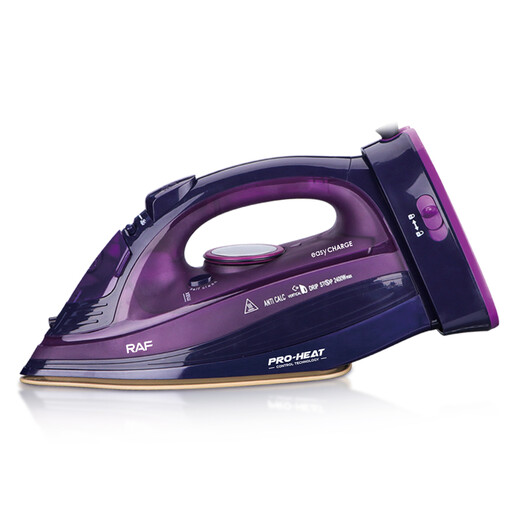 Image unavailable
This is a cordless steam iron. Check whether the stated tank capacity suits the number of pillowcases you iron at a time.
The product name lists 2400 W, a 320 ml tank, a steam output of 15–25 g/min, a ceramic soleplate and self-cleaning.
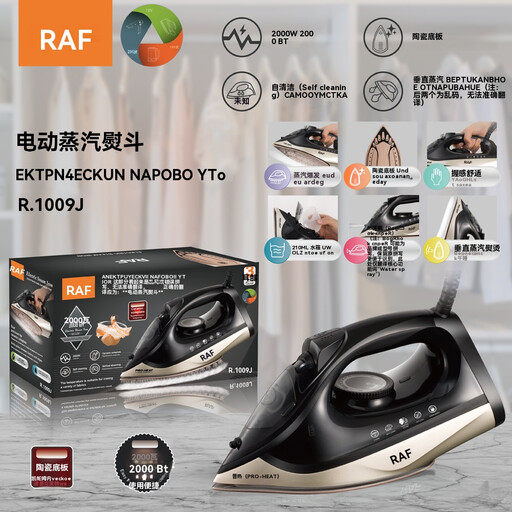 Image unavailable
A steam iron is an option if you want to press pillowcases flat; follow the care label and adjust the steam accordingly.
The product name lists a steam boost function, self-cleaning, vertical steaming and a 210 ml water tank.
 Image unavailable
This is a steam iron for pressing fabrics flat. Before buying, check the tank capacity and steam settings to make sure they suit your needs.
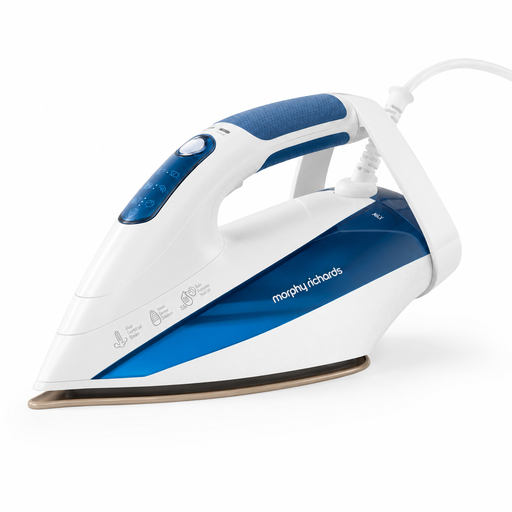 Image unavailable
The product name lists variable steam and a 350 ml tank; compare the capacity with the length of your usual ironing session.
The product name lists 2400–2800 W, 50 g/min steam, an anti-drip system and self-cleaning.
First, check the care label and only use settings that are suitable. The Consumers' Association notes that cotton can be harder to smooth out; after steaming, iron without steam and let the pillowcases cool and dry before putting them away.
Follow the instructions for the exact model when it comes to water and descaling. The Consumers' Association points out that anti-scale features slow the build-up of limescale but do not make maintenance unnecessary.
When you buy from a business at a distance, you usually have 14 days to change your mind, according to the Dutch government. You are also entitled to a product that is fit for purpose, and the Netherlands does not have a fixed statutory two-year guarantee period for every product. If something is faulty, contact the seller.
CE marking is required for electrical equipment covered by the Dutch Commodities Act Decree on Electrical Equipment. The Netherlands Food and Consumer Product Safety Authority (NVWA) describes low-voltage rules for equipment with a rated AC voltage of 50–1000 V or a DC voltage of 75–1500 V; check whether those rules apply to the specific appliance. CE marking is not a comparative assessment of how well the iron handles cotton.