
Ironing with limited storage space
You iron a few cotton handkerchiefs at a time and want to be able to put the appliance away easily after use.


For ironing a few handkerchiefs at a time, a standard dry or steam iron is generally more practical than a steam generator, provided you have a stable, heat-resistant place to iron. Choose steam if you need to tackle stubborn creases, but always follow the care label for the temperature. Only iron dry if the label and the model allow it. Also check the dimensions, safety features and CE marking of the exact model; the NVWA states that CE marking is compulsory for electrical products.
You iron a few cotton handkerchiefs at a time and want to be able to put the appliance away easily after use.
You want to smooth out creases properly and are weighing up steam against temperature control and dry ironing.
You have little space for a hot appliance and are looking for a stable surface, automatic shut-off and safe cooling.
Start by considering the space you have for ironing and the amount of laundry you need to tackle. Then decide how much steam you need and how much maintenance you’re willing to do.
| What to consider | What should you look for? | Who is this important for? |
|---|---|---|
| Storage and ironing space | Check the dimensions and make sure you have a stable, heat-resistant surface. | In a small rented flat, I want to be able to put the appliance away once it has cooled without making my ironing area unsafe. Around 36% of consumers give storage space and a usable place to iron top priority. |
| A smooth crease | Check the care label, the temperature control and whether the steam can be switched off. | If I want to press cotton handkerchiefs neatly, I need to be able to set the temperature according to the care label and know when I can iron dry. Around 29% of consumers put the result first. |
| Safe use | Check whether the exact model has automatic shut-off and whether the cord reaches your ironing area. | With little worktop space, I want to be able to set down the hot iron securely and let it cool safely. Around 21% of consumers give a safe set-up top priority. |
| Maintenance and repairs | Check the model’s descaling instructions and find out what repair options are available. | If I want to keep maintenance to a minimum and be able to get the appliance repaired, I want to know in advance what the model requires. Around 14% of consumers make maintenance and repairability their main consideration. |
For the Severin BA 3210, the manufacturer specifies variable steam of up to 30 g/min and a steam shot of up to 70 g/min. These figures refer to different functions.
Only compare continuous steam with continuous steam, and a steam shot with a steam shot.
Philips describes the STH3010/30R1 handheld steamer as an appliance for refreshing clothes without an ironing board. This doesn’t show that it can press a sharp crease into a cotton handkerchief.
For this task, choose an iron with a soleplate and a suitable ironing surface if a sharp crease is your priority.
The Consumentenbond associates steam generators with larger amounts of laundry and highlights their size and storage requirements.
Weigh up how much laundry you usually iron against the space you have for the appliance and its separate water tank.
ACM ConsuWijzer distinguishes between the statutory guarantee and any additional warranty. An extra warranty certificate does not replace your statutory rights.
Check what extra cover is being offered and who the seller is if something goes wrong.
The Severin models mentioned show how a dry iron, a travel iron and a standard steam iron differ in use and storage.
The Easygliss Plus FV5736E0 is an example of a standard steam iron for anyone considering steam control and automatic shut-off.
According to Braun, the TexStyle 3 SI 3054 GY is a standard steam iron with manual temperature control and automatic shut-off.
The Philips 3000 Series includes standard steam irons and a handheld steamer designed for a different task.
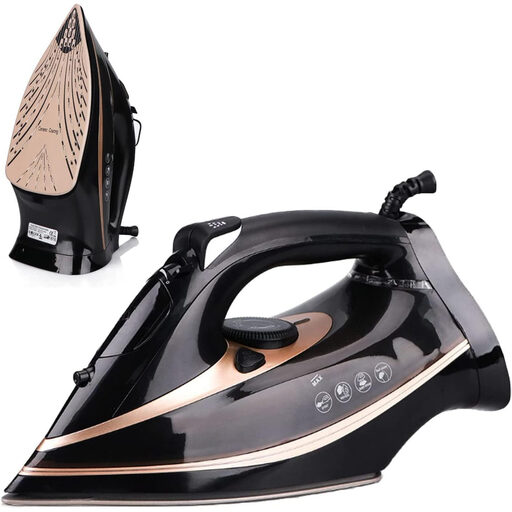
This product selection consists of steam irons with a soleplate for ironing small amounts of laundry. Set the temperature according to the handkerchief’s care label and check the details of the specific version.
 No image available
An iron with a soleplate may be suitable if you want to press handkerchiefs on an ironing surface; follow the care label for the temperature.
The product name lists a power rating of 2600 W, a ceramic soleplate, a 120 g steam shot, a 300 ml water tank and a self-cleaning function.
 No image available
A soleplate is useful if you want to press handkerchiefs on an ironing surface; check which temperature is suitable for the care label.
The product name lists 2400 W, a non-stick soleplate, an automatic cleaning function and an anti-drip system.
 No image available
A standard steam iron with a soleplate is an option if you want to press handkerchiefs and use steam. Check the features of the exact version before choosing.
 No image available
The product name describes this model as compact and suitable for dual voltage. Check that the stated features and temperature settings suit your ironing space and how you plan to use it.
Model designation: BHR9034EU.
 No image available
A standard steam iron with a soleplate suits anyone who wants to press handkerchiefs on an ironing surface; do not exceed the maximum temperature on the care label.
The product name lists a power rating of 2000 W.
Follow the care label on the specific handkerchief; the fibre name alone does not determine the temperature. GINETEX lists maximum soleplate temperatures of 110 °C without steam, 150 °C and 200 °C for ironing symbols. Do not set the iron higher than the label allows.
For a small number of handkerchiefs, a standard iron is the more practical choice, as long as you have a stable, heat-resistant place to iron. The Consumentenbond mainly associates steam generators with large amounts of laundry and highlights their size and storage requirements.
Follow the descaling instructions for the exact model. Philips refers owners of its steam irons to the manual for the relevant model; these instructions do not automatically apply to other brands.
Yes. The NVWA states that CE marking is compulsory for electrical products covered by this requirement. Check the marking on the specific model; the general requirement alone does not prove that a particular item carries the marking.
If the product is faulty, contact the seller; your statutory guarantee applies alongside any manufacturer’s warranty. ACM ConsuWijzer also advises checking who the seller is when you buy through a platform.