
Student with limited wardrobe space
You iron a cotton dress now and then and want to be able to put your iron away easily. The Consumers' Association considers a standard steam iron suitable if you iron infrequently or have limited storage space.


If you only iron a dress now and then and have limited storage space, start with a standard steam iron. The Consumers' Association considers this type suitable for people who iron infrequently or have little room. If you iron regularly for longer sessions, a steam generator with a larger tank could be a better fit, but it takes up more space. Always follow the care label on each dress.
You iron a cotton dress now and then and want to be able to put your iron away easily. The Consumers' Association considers a standard steam iron suitable if you iron infrequently or have limited storage space.
You often iron several dresses or garments one after another and are weighing up a larger tank against the space a steam generator takes up. Tefal lists a removable 1.8-litre water tank for the Express Airglide SV8026E0.
You want clear temperature settings and a stable place to iron when sharing an ironing area. Automatic shut-off can be a useful extra feature, but it doesn't replace paying attention; check that the specific model has it.
First, choose between a standard steam iron, a steam generator and a dry iron. The Consumers' Association outlines differences in size and use; the care label tells you what temperature and steam your dress can withstand.
Choose this if: you iron a few dresses at a time or have limited storage space.
Consider: the smaller tank may need refilling more often during longer sessions.
Choose this if: you often iron several garments in a row and have room for the appliance and ironing board.
Consider: the larger set-up takes up more space and may take longer to heat up.
Choose this if: you prefer to iron without built-in steam and the care label allows it.
Consider: there’s no built-in steam to help tackle creases.
| What to consider | What to check | Who it's important for |
|---|---|---|
| Storage and short sessions | Compare the appliance and tank dimensions with the storage space you have available. | If I only iron a few dresses, I want to be able to put the appliance away easily after use. Around 33% of consumers make limited storage space and short ironing sessions their top priority. |
| Creases and precision | Check the care label first, then compare the temperature control, continuous steam and the shape of the soleplate tip. | If I want to remove creases from cotton dresses and work around seams or pleats, I look at temperature and steam. Around 27% of consumers make smoothing out creases their top priority. |
| Safe shared use | Check whether the specific model has automatic shut-off; use a stable surface and avoid overloading sockets or connecting extension leads together. | If my housemates use the same iron, I want to make sure the ironing area is safe. Around 20% of consumers make safe shared use their top priority. |
| Use and maintenance | Check which descaling and cleaning method is recommended for the specific model. | If I want to spend as little time as possible on maintenance, I want to know in advance what the appliance requires. Around 20% of consumers make ease of use and maintenance their top priority. |
A steam boost and continuous steam output are two different features. A high steam boost figure alone doesn't tell you how much steam is available throughout an ironing session.
Compare the continuous steam and steam boost figures separately. For longer sessions, also consider the tank capacity.
A generator takes up room in addition to the iron itself. The Consumers' Association points out that the whole set-up may be too large or heavy for a standard ironing board.
Measure the space available and check the dimensions and weight capacity of your ironing board before choosing.
Remember to allow for the extra storage space needed for both the appliance and the ironing board.
An abbreviated model name can refer to several different versions, so you could mistakenly assume that your appliance has features found on another variant.
Check the full model code and the features of the version you intend to buy.
The TexStyle 3 range includes standard steam irons; the SI3030PU is one example, with a manual thermostat and precision tip.
Easygliss Plus is a range of standard steam irons; the Express Airglide SV8026E0 is a steam generator.
The 3000 Series is one example of the features you can compare when looking for a standard steam iron.
A standard steam iron with an adjustable thermostat is worth considering if you want to set the temperature yourself.
The Autosteam DW4020D1 is one example of a model that adjusts its steam output automatically.
This selection includes steam irons for anyone who wants to use steam when ironing cotton dresses. Compare each version with your available space and ironing routine. The NVWA says that electric irons sold in the Netherlands must carry the CE marking. Check the marking on the specific product, as it is not proof that the product has undergone a mandatory independent inspection.
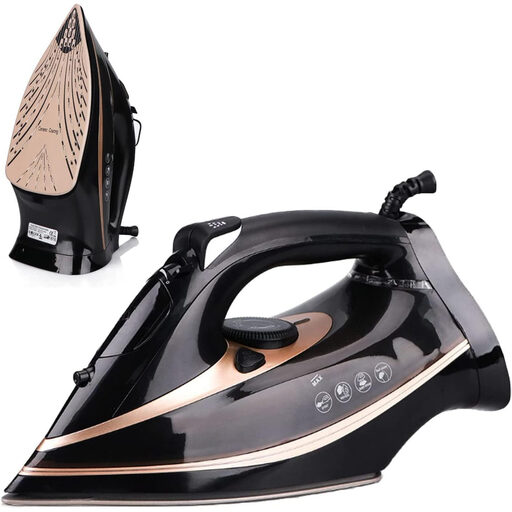 No image available
A standard steam iron for anyone who wants to use steam on cotton dresses. This type may suit short ironing sessions and limited storage space.
The product name lists 70 g/min steam, a 120 g steam boost, a 300 ml tank and self-cleaning.
 No image available
A handheld steam iron for anyone looking for a standard model for ironing at home.
The product name lists a non-stick soleplate, an automatic cleaning function and an anti-drip function.
 No image available
A standard steam iron for anyone considering this Tefal version. Check the full model code and the features of the specific product on offer.
 No image available
The product name describes a compact, lightweight model. Check that this version suits your ironing routine and available storage space.
The product name lists dual voltage. Check which voltage you need for your intended use.
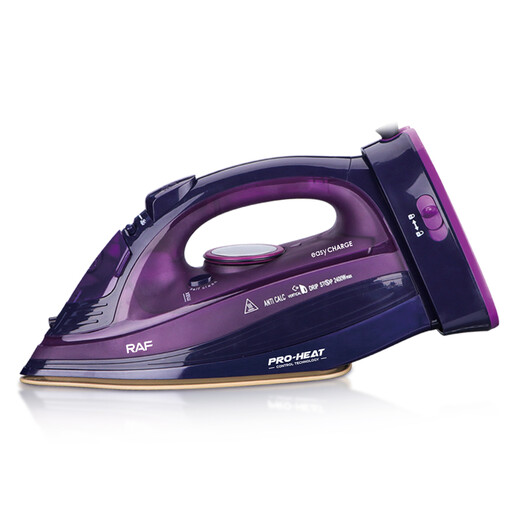 No image available
A cordless model for anyone specifically looking for an iron without a cord. Check how the appliance is powered while you iron.
The product name lists 2400 W, a 320 ml tank, a steam output of 15–25 g/min, a ceramic soleplate and self-cleaning.
No. Follow the care label on the specific dress, even if it’s made from cotton or a cotton blend. The GINETEX symbol chart shows maximum soleplate temperatures of 200 °C, 150 °C and 110 °C. The 110 °C symbol means you should iron without steam.
Place the iron on a stable surface and don’t connect extension leads to each other. The Fire Service also advises student accommodation residents not to plug too many appliances into one extension socket. Automatic shut-off doesn’t replace supervision.
Look up the exact model number and follow the instructions for that model. Philips and Tefal provide model-specific maintenance guidance. Tefal advises against using vinegar or descaling products to rinse out the steam tank.
Report the fault to the seller. According to the Dutch government, there is no fixed statutory warranty period in the Netherlands. What you can expect from a product depends, among other things, on the product itself and normal use. A manufacturer's warranty is additional.
Yes. According to the NVWA, electric irons sold in the Netherlands must carry the CE marking. The marking is not proof that the product has undergone a mandatory independent inspection, so check for it on the specific product.