
Housemate with limited storage space
You occasionally iron a cotton dress and want to put the appliance away easily afterwards. The Consumers’ Association suggests a standard steam iron if you do little ironing or have limited space.


If you only have a few dresses to iron and little storage space, a standard steam iron is a sensible place to start. If you often iron several items in a row and have room for the appliance and a suitable ironing board, a steam generator may be worth considering. The Consumers’ Association explains the difference between short, small ironing sessions and larger ones. Choose the temperature according to the dress’s care label, rather than simply because the fabric contains cotton, as GINETEX advises. Tank capacity, maintenance and automatic shut-off vary by model.
You occasionally iron a cotton dress and want to put the appliance away easily afterwards. The Consumers’ Association suggests a standard steam iron if you do little ironing or have limited space.
You want to smooth seams and larger areas of cotton, while paying attention to the care label, steam settings and how easy the soleplate is to handle. GINETEX advises setting the maximum temperature according to the garment’s care label.
You iron several items in a row and, if you have enough room to use and store it, could benefit from refilling less often. The Consumers’ Association describes a steam generator as a larger option for people who do a lot of ironing.
Start with the garment’s care label and the space where you iron and store the appliance. Then consider whether you iron in short sessions or often tackle several items in a row.
| What to consider | What to look for | Who is it important for? |
|---|---|---|
| Storage and short sessions | Compare the dimensions of the appliance and any base with the storage space available. Also check the tank capacity and how often you’ll need to refill it during short sessions. | If I need to put the appliance away after ironing one or a few dresses, I want to know whether it will fit in our shared cupboard. Around 36% of consumers put compact storage first. |
| Ironing performance and care label | Follow the ironing symbol and compare the temperature and steam settings. Check that the soleplate shape is suitable for seams and details. | If I want to iron areas of cotton and seams, I’ll choose a setting that matches the dress’s care label. Around 29% of consumers prioritise ironing performance. |
| Shared use and maintenance | Check the shut-off function and descaling method for the exact model. Also check which product safety rules apply; the NVWA states that products covered by the Commodities Act Decree on Electrical Equipment must carry CE marking. | If several housemates use the same appliance, I want to know how it switches off and how to maintain it according to the instructions. Around 21% of consumers prioritise safe, easy-to-maintain shared use. |
| Several items in a row | Compare the tank capacity with the length of your ironing sessions, and measure whether the appliance and any base will fit in your ironing and storage spaces. | If I often iron several items in a row, I want to refill less often without taking up too much of our shared space. Around 14% of consumers prioritise longer ironing sessions. |
A steam boost alone doesn’t tell you how well an iron will handle an entire dress. For cotton, the steam settings and care label matter too.
Compare steam functions on a like-for-like basis, and follow the dress’s care label for the temperature.
The Consumers’ Association describes steam generators as larger and harder to store than standard steam irons. A standard ironing board may also be unsuitable.
Measure the space available for ironing and storage beforehand, and check that the ironing board is suitable for the appliance.
The feature and shut-off time vary by model, and the soleplate may still be hot after the iron switches off.
Check the instructions for the exact model, and agree who will keep an eye on it, unplug it and leave it to cool.
The TexStyle 3 range includes steam irons, while CareStyle 3 includes steam generators. The right choice depends on the exact model.
The Freemove Power FV6670 is an example of a cordless steam iron with a base.
The PerfectCare PSG7200/20 is an example of a steam generator for longer sessions.
The Autosteam DW4020D1 is an example of a model with automatically regulated steam.
This selection features standard or compact steam irons for anyone who irons cotton dresses in short sessions. Check which product safety rules apply to each exact model; the NVWA states that products covered by the Commodities Act Decree on Electrical Equipment must carry CE marking.
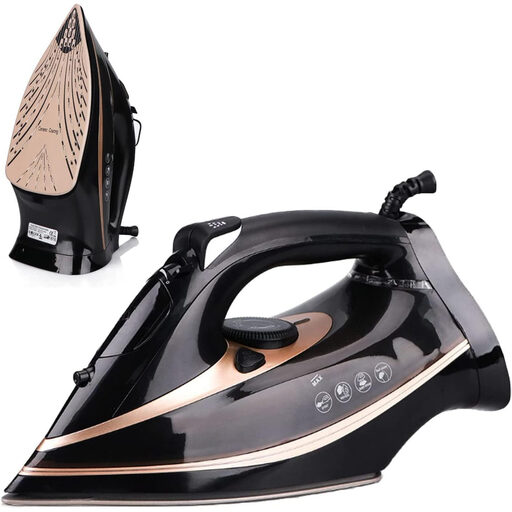 Image unavailable
A standard steam iron to consider for short ironing sessions in a shared home.
2600 W; continuous steam output of 70 g/min; 120 g steam boost; 300 ml tank; self-cleaning function.
 Image unavailable
The listed soleplate and precision tip are worth considering if you need to reach seams and details.
2400 W; 350 ml tank; steam boost; vertical steam; automatic cleaning function and anti-drip function.
 Image unavailable
The manual settings may be useful if you want to adjust the temperature and steam for each dress.
Removable 0.15 l tank; manual temperature and steam control; dry and steam ironing.
 Image unavailable
A standard steam iron to consider if you’re looking for a model for short ironing sessions.
2000 W; continuous steam output of 20 g/min; 90 g/min steam boost; non-stick soleplate.
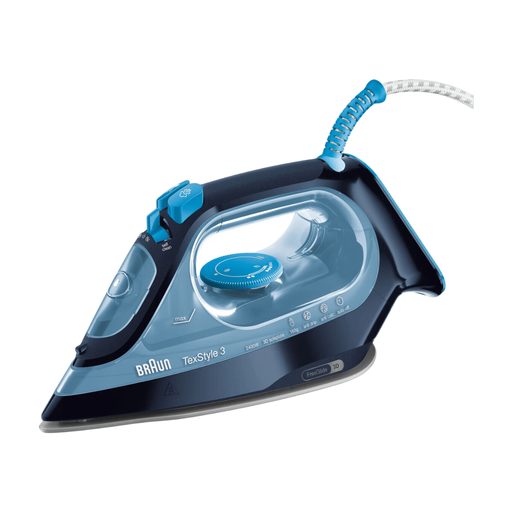 Image unavailable
The listed automatic shut-off and anti-scale system may be useful when the iron is shared; follow the instructions for this model.
Precision tip; anti-scale system; automatic shut-off; steam boost up to 170 g.
Not necessarily: follow the ironing symbol on the individual dress. GINETEX advises setting the maximum temperature according to the garment’s care label, as other materials or finishes may also affect the suitable temperature.
Use the descaling method in the instructions for the exact model. Tefal says the process varies by type; only use vinegar or descaling products for a particular task if the instructions allow it.
You don’t need to pay extra to have your statutory consumer rights. According to the Dutch government, the seller must provide a product that meets expectations; the Netherlands has no fixed statutory warranty period. Check exactly what an additional warranty covers.
The NVWA states that products covered by the Commodities Act Decree on Electrical Equipment must carry CE marking. For the applicable low-voltage rules, the NVWA refers to electrical equipment with a rated AC voltage of 50 V to 1000 V. Check which requirements apply to the specific appliance and review the relevant conformity information; CE is not an independent quality mark for ironing performance.