
Vandaag of morgen in huis

Kwaliteit gegarandeerd

Welkomstaanbiedingen ontgrendelen: GRATIS bezorging | Tot 80% korting | Gratis 30 dagen JoyPlus-proefperiode
Download de app
Good outdoor lighting makes a garden, balcony, facade or driveway more usable once it gets dark. However, it’s unwise to choose purely on looks or a high lumen count. A light can look great in the product photos but be unsuitable for an exposed driveway, provide too little light along a path, or prove fiddly to install.
The main pitfalls usually come down to three things:
With the right checks upfront, you can choose more confidently between solar garden lighting, an outdoor wall light, path lighting, an LED outdoor light or an in‑ground spotlight.
The IP rating indicates how well a product is protected against solid particles and water. For everyday use, location is at least as important as the number on the box.
For a hard‑wired outdoor light, also check that the cable, plug and connection point are suitable for outdoor use. An IP44 wall light, for example, shouldn’t be fitted in a fully exposed spot where it will face constant direct rain and strong jets of water.
Lumens indicate the amount of light. For atmospheric path lighting, a lower output can be enough. According to the product specs, the UME solar path lights deliver 10 lumens per light with a colour temperature of 3000K warm white. Ideal for marking a garden path or border, but not for brightly lighting a large driveway.
For functional lighting, a higher light output makes more sense. The Philips Zyren solar wall light, for instance, is specified at 4000 lumens, with an integrated LED and motion detection. The light colour varies by version: 3000K or 5000K.
Also consider the direction:
A solar outdoor light works without a fixed mains connection, but it does need sufficient direct sunlight. The UME 2‑pack states 6 to 8 hours of sunlight for a quoted lighting duration of 8 to 12 hours. Don’t place these lights beneath dense foliage or on the north side of a building if little sun reaches the panel. Clean the panel regularly with a soft, damp cloth.
An E27 outdoor light or GU10 outdoor light gives you flexibility: you choose the bulb and, if you wish, the colour temperature. Always check whether a bulb is included. The Aigostar A‑02 and various Philips wall lights are supplied without a light source. A fixed wall light on 230 volts should, according to the product information, be connected by a qualified electrician.
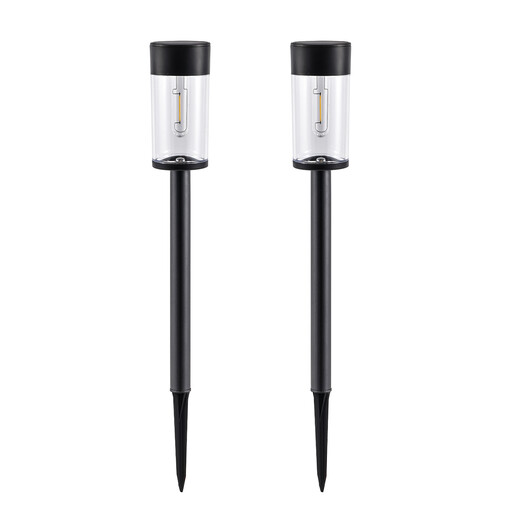
Why this suits the profile: This set is designed for anyone who wants to mark out a garden path, border or driveway edge without wiring. The ground spikes make placement easy.
The specifications state 10 lumens per light, so you can weigh the modest brightness against the decorative purpose. The IP65 rating is clearly listed; submersion is not intended.
2 lights per set, 3000K warm white, automatic on/off and solar power.
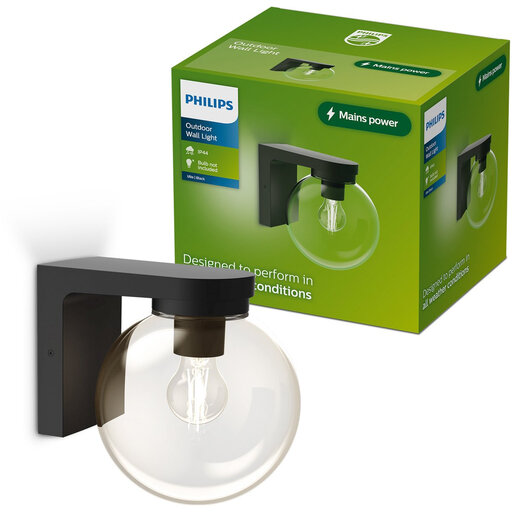
Why this suits the profile: The black aluminium-and-glass wall light suits an entrance, patio or facade where a fixed, understated lighting solution is desired.
The IP44 rating makes the limits of use clear: choose a sheltered location and install the light correctly to maintain its protection.
E27 cap, replaceable bulb and diffuse light distribution. You select the bulb separately.
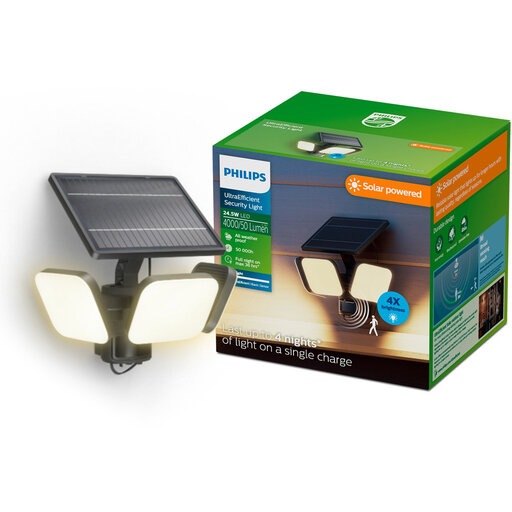
Why this suits the profile: The combination of solar power, a motion sensor and an adjustable head suits a driveway, garage, side path or entrance where targeted light is needed.
The product information lists IP65, 4000 lumens and a detection range of 8 metres when approached head‑on and 16 metres side‑on. That lets you compare concrete figures rather than just “powerful light”.
Solar installation with no fixed wiring, two light modes and 5000K white light on this version.
For a fixed outdoor light on the mains, correct connection is vital. Switch off the power and have a qualified electrician carry out the installation when the manual requires it. With a GU10 or E27 outdoor light, respect the maximum wattage for the fitting.
For solar garden lighting, the key maintenance points are simpler:
If you want smart control, opt for smart garden lighting with app control. Check beforehand whether Wi‑Fi, Bluetooth, an account or a specific app is required. With the Brilliant Kamara set, Tuya Smart, dimming, RGB and adjustable colour temperature are all listed; a cable is still required.
We’ve put together a complete, up-to-date list of products that fully meet these strict selection criteria and current European safety regulations.
Low solar path lights or in‑ground spots are suitable for a garden path. Pay attention to brightness, the spacing between lights and how secure the installation is. Low lumen values are often enough to mark the route; for visibility along a longer driveway you’ll need more focused, stronger light.
That depends on the location. IP44 outdoor lighting is generally suitable for sheltered areas such as under a canopy, on a balcony or on a facade beneath the eaves. For a fully exposed spot, a higher protection level like IP65 can be more practical. No IP rating automatically means a fitting can be placed under water.
A solar outdoor light doesn’t use mains electricity in normal operation, but performance depends on sunlight and battery capacity. For a mains‑powered LED outdoor light, look at the wattage and the hours of use. A 5‑watt light that runs for five hours a day uses about 25 watt‑hours per day. A sensor or timer can reduce the run time.
