
Vandaag of morgen in huis

Kwaliteit gegarandeerd

Welkomstaanbiedingen ontgrendelen: GRATIS bezorging | Tot 80% korting | Gratis 30 dagen JoyPlus-proefperiode
Download de app
An ionic hairdryer can be useful if you want to dry your hair quickly and experience less static electricity while styling. However, a high wattage or impressive rotational speed does not tell you everything. Some hairdryers are heavy to hold, become too hot or come with attachments that are not suitable for your hair.
If you are buying a new hairdryer in the Netherlands, it therefore pays to look beyond terms such as “salon quality” or “millions of ions”. Below, you can find out which specifications can be verified, which marketing claims should be treated with some caution and which models suit different needs.
Wattage indicates how much electrical energy the appliance uses, but not exactly how much air it moves or how precisely that airflow is directed. A fast hairdryer therefore needs more than just 1800 or 2400 watts. Also consider the motor type, airflow speed, weight and ability to direct the airflow.
A concentrator can focus the airflow for straight hair. For curls, a diffuser usually works better because it distributes the air over a larger area.
Brands often promote hairdryers with ionic technology as a way to combat frizz, static electricity or dull-looking hair. Do not present this as a guaranteed result. According to brands’ own research or product descriptions, negative ions may help reduce static charge and frizz, but the experience varies depending on hair type, moisture content and styling method.
Ionic technology also does not replace a suitable temperature setting or heat protection. Air that is too hot can still dry out or damage the hair.
A hairdryer with diffuser is not automatically suitable for every curl type. Check that the diffuser attaches securely, that the openings are large enough and that you can set the heat and speed to a low level. A narrow concentrator nozzle is particularly useful for blow-drying with a brush.
Also pay attention to the product packaging. Some models list two or three attachments, while others only include a concentrator. Check whether the cord is long enough for your bathroom or bedroom.
For regular use at home, a power rating of around 1600 to 1900 watts is often a sensible choice. Heavier models rated at 2300 or 2400 watts may produce a powerful airflow, but they can use more energy and sometimes weigh more.
A rotational speed such as 20,000 or 110,000 rpm sounds impressive, but only compare this when the airflow speed, motor type and noise level are also stated. Manufacturers use different measurement methods. A professional hairdryer with an AC motor, for example, may feel quite different from a lightweight dryer with a digital or brushless motor.
At least two speed settings and two heat settings already give you more control than a single fixed setting. For thick, long or curly hair, multiple speed settings and a separate cool-shot button are practical. A blast of cool air can help finish a style, but it does not automatically make the appliance safer for your hair.
A hairdryer with temperature control is particularly useful when several people use the appliance. Start on a low or medium setting and keep the hairdryer moving continuously. When using a diffuser, a low speed is often more comfortable and helps prevent curls from being blown out of shape.
A lightweight hairdryer helps prevent arm fatigue during longer blow-drying sessions. The models in this selection range from 330 grams to around 570 grams, while some traditional models weigh almost a kilogram. A folding handle makes a compact hairdryer or travel dryer easier to store.
Before using an appliance in the Netherlands, check that it is suitable for 220–240 volts. A dual-voltage model is more practical for travelling outside Europe, but you should still check whether you need a suitable plug adapter. Never use a hairdryer near a bath, shower or full washbasin, and keep the air intake clear.
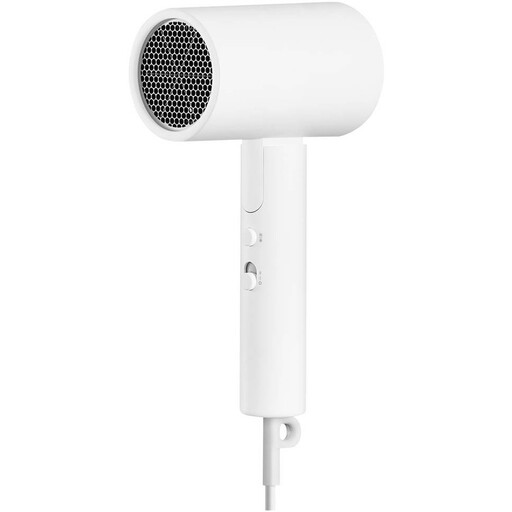
Why it suits this profile: The folding design, weight of around 433 grams and 1600-watt power rating make it suitable for daily use, a student room or short trips.
The specifications state specific settings: two speeds and two temperature modes. This means you do not have to rely solely on marketing language about power.
1600 watts, 20,000 rpm, folding design, concentrator nozzle and ionic technology according to the product description.
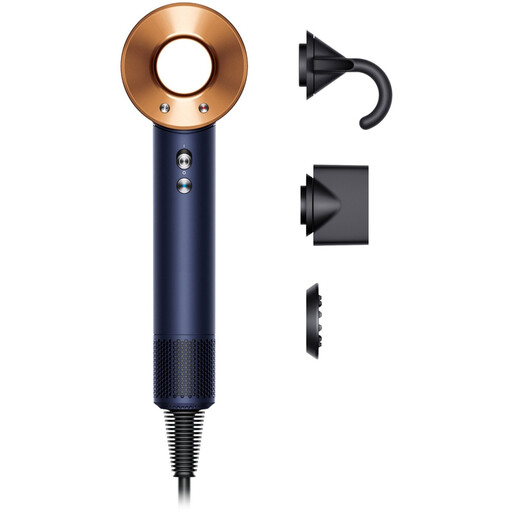
Why it suits this profile: Suitable for users who value multiple temperature and speed settings, as well as precise styling.
The product information lists three speeds, four temperature settings, a cool-air setting and a concentrator. These details are easier to verify than a general salon-quality claim.
V9 motor according to Dyson, three speeds, four temperature settings, intelligent temperature control according to the product description and a two-year manufacturer’s warranty.
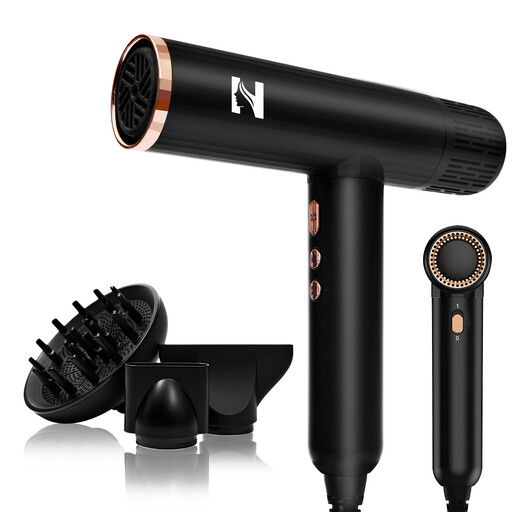
Why it suits this profile: The combination of a diffuser, three speeds and four temperature settings is practical for long, thick or curly hair and regular styling.
In addition to the stated motor speed, the product description lists an airflow of 23 m/s, three attachments and a noise level below 65 dB. This allows you to make a more informed comparison.
1900 watts, 0.57 kg, three speeds, four temperature settings, two concentrators and a diffuser. The ionic function is a claim from Nicebay’s product description.
We have compiled a complete, up-to-date list of products that fully meet these strict selection criteria and the applicable European safety regulations.
Yes, it can be, but prioritise a model with a diffuser, low speed and multiple temperature settings. According to brands’ own product information, ions may help reduce static electricity and frizz. The final result also depends on your curl pattern, styling product and drying technique.
For home use, you will often find models rated between 1600 and 2400 watts. More watts do not automatically mean a shorter drying time. Also compare the airflow, weight, settings and attachments. For fine hair, a lower power rating with good temperature control may feel more comfortable than a heavy model with maximum blowing power.
Usage mainly depends on the power rating and how long the appliance is used. An 1800-watt hairdryer running for ten minutes theoretically uses around 0.3 kWh. In practice, the selected setting and actual running time also matter. A faster airflow may shorten the time you need to use the appliance, but check the specific product details rather than relying solely on an ionic or rotational-speed claim.
