
Vandaag of morgen in huis

Kwaliteit gegarandeerd

Welkomstaanbiedingen ontgrendelen: GRATIS bezorging | Tot 80% korting | Gratis 30 dagen JoyPlus-proefperiode
Download de app
An ionic hair dryer can sound appealing if you struggle with static or frizzy hair. However, the word “ionic” alone says little about the day-to-day user experience. A model may advertise a high number of negative ions, yet still be awkward to use because of a heavy handle, limited heat control or a filter that is difficult to clean.
As a Joybuy Product Recommendation Officer, I filter product information down to verifiable specifications. This helps you see which features are genuinely relevant for home use, curly hair, long hair or travel.
A powerful hair dryer does not automatically have better airflow. Wattage mainly indicates electrical power consumption. A high-speed motor can operate efficiently, but the design of the air intake, nozzle and temperature control also affects the result.
A fast-drying hair dryer is therefore particularly useful when its power is combined with well-adjustable airflow. Weight is worth considering too: a 900-gram appliance feels very different after a few minutes compared with a lightweight hair dryer weighing around 360 to 480 grams.
Brands often associate ionic technology with less frizz, more shine or better moisture retention. According to the brand’s own research or product information, these may be intended benefits, but they are not guaranteed for every user. Treat a hair dryer with ionic technology as just one part of your decision.
Heat control, distance and movement remain important. Do not hold the hair dryer too close to your hair, and keep the airflow moving. A hair dryer with cool air is also useful for finishing a style without adding extra heat.
A narrow hair dryer with concentrator nozzle directs the airflow at a section of hair and is suitable for blow-drying with a brush. A hair dryer with diffuser distributes the airflow more evenly over curls and can help minimise disruption to the hair’s shape while drying.
Also check whether the filter can be removed. Hair and dust can block the air intake, causing the dryer to become hotter and work less comfortably. A removable filter makes regular cleaning easier.
For thick or long hair, higher wattage and multiple speed settings are practical. For example, the Babyliss 5513TE lists 2300 W, while compact models such as the Xiaomi H300 are specified at 1600 W. High-speed models may also list motor speeds such as 20,000 or 110,000 rpm.
Do not compare these figures directly with one another. Wattage, rpm and air speed measure different aspects. Pay particular attention to:
A good hair dryer with cool air has a separate cool-shot or cool-air button. This function is useful when finishing a blow-dried style. Some models also use NTC temperature control. According to the product descriptions of Xiaomi and various high-speed models, this technology continuously measures or regulates the temperature.
Treat this as a technical feature, not a promise that hair cannot be damaged. Keep to the recommended distance, do not block the air intake and choose a lower heat setting for curly or fragile hair.
For everyday use, weight and balance are at least as important as power. A lightweight hair dryer is useful if you style your hair for a long time or often take the appliance with you. If you live in a flat or get up early, you may also want to look for a quiet hair dryer. However, noise levels can only be compared reliably when they have been measured under the same conditions.
Finally, check the following:
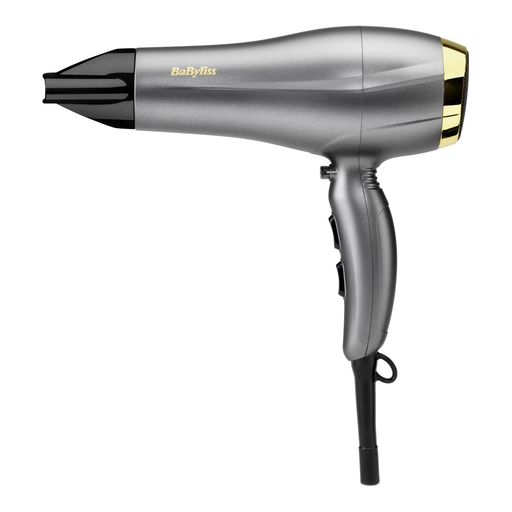
Why it suits this profile: With 2300W of power, this hair dryer offers a straightforward combination of ionic functionality, a diffuser and a concentrator for home use.
The product information lists specific accessories and a removable filter, so you do not have to base your decision on the word “ionic” alone.
2300 W, diffuser, concentrator, cool-air function and EU plug according to the product details.
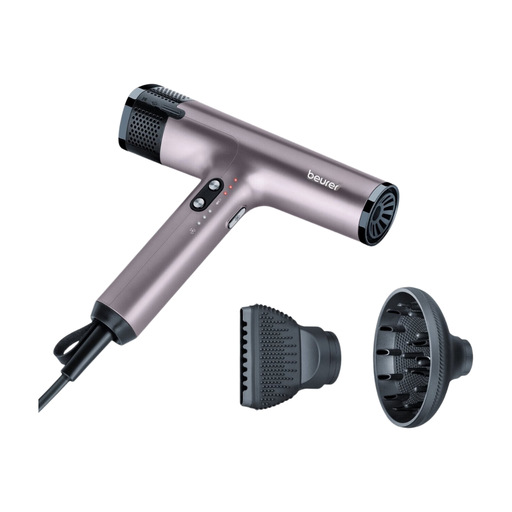
Why it suits this profile: This model is designed for controlled styling at home or in a salon-style setting, with a brushless motor, memory function and long cable.
The choice is not based on power alone: there are four temperature and airflow combinations, plus a filter-cleaning indicator.
360 grams excluding the cable, 2,80-metre cable, diffuser, slim magnetic concentrator nozzle and cool-shot function.

Why it suits this profile: For long, thick or curly hair, the three attachments, three speeds and four heat settings are practical.
The product description mentions not only a high-speed motor, but also adjustable speed and temperature settings, as well as a diffuser for curls.
1900 W, 110,000 rpm, stated airflow of 23 m/s, weight of 0.57 kg and a 2-metre cable.
A travel hair dryer should not just be small. Check whether the handle folds, how many attachments are included and whether the appliance is suitable for the mains voltage at your destination. According to the product description, the BABONIR FZ201 combines a folding design with a weight of 330 grams, 1800 W, a diffuser and a concentrator.
For curly hair, a diffuser is often more important than extremely powerful airflow. Choose a low speed, work in sections and do not use maximum heat with the diffuser unless the instructions allow it. A model such as the Ochama High-Speed Hair Dryer lists a diffuser, two speeds and four heat settings.
We have put together a complete, up-to-date list of products that fully meet these strict selection criteria and the applicable European safety regulations.
Brands often associate ionic technology with reduced static electricity and a smoother appearance. According to the brand’s own research or the product description, this is the intended use, but the effect varies depending on your hair type. Combine the function with a suitable concentrator nozzle, a low heat setting and consistent movement.
Its lifespan depends on how often it is used, as well as the motor, cable and maintenance. Clean the filter regularly, keep the air intake clear and only put the appliance away once it has cooled completely. According to product information, a brushless motor may be designed with durability in mind, but it does not guarantee a fixed service life.
Energy consumption depends on the wattage and how long the appliance is used. A 2300 W model uses more power over the same period than a 1600 W model. A fast-drying hair dryer may partly offset the difference if your hair dries sooner, but actual consumption depends on your settings and drying time.
