
A volunteer recording someone’s life story
Your main aim is to capture the interviewee’s voice clearly, and you want a setup that’s easy to test beforehand. Oral History offers practical advice on microphone placement.


Choose your setup based on how many voices you want to capture clearly and what you’ll be recording on. A wired lavalier microphone can work well for a seated interview with one main speaker; a set with two transmitters is another option if you want to record two voices separately. A recorder worn by the speaker provides standalone recording, but you’ll need to manage the files afterwards. Always check the connection and microphone placement, and make a test recording before the interview begins.
Your main aim is to capture the interviewee’s voice clearly, and you want a setup that’s easy to test beforehand. Oral History offers practical advice on microphone placement.
You want to capture questions and answers clearly, so check how many microphones and transmitters are included and how the voices are recorded. RØDE, DJI and Hollyland describe sets with multiple transmitters.
You prioritise checking the recording and using standalone or internal recording, followed by careful file management. Oral History also emphasises recording interview metadata.
First decide which voices you need to capture and how you’ll record them. Then check the microphone placement, connection and final file.
Best for: an interview where the main priority is to hear the interviewee clearly and the speakers will mostly remain seated.
Keep in mind: a microphone on the interviewee won’t automatically capture the questions as clearly; the cable and connection need to suit your setup.
Best for: interviews where both the interviewer and interviewee wear their own microphone.
Keep in mind: there are more components and files to manage. Internal transmitter recording is useful only if the feature is available and enabled.
Best for: standalone recording of one speaker when you don’t need to transfer the audio directly to a phone or camera.
Keep in mind: you’ll need to transfer the files afterwards; recording two separate speakers requires two recording setups.
| What to consider | What to look for | Who is this important for? |
|---|---|---|
| A clear voice without clothing noise | Check the clip and position the capsule around 15 cm below the mouth. Listen back to a test recording made while wearing the interview clothes. | If I’m recording someone’s life story, I want to capture the interviewee’s voice clearly without distracting clothing noise. Around 36% of consumers put intelligibility first. |
| Recording both people in the conversation | Check that the model actually includes two microphones or transmitters and that the recording device can save the voices separately. | If I want to capture both questions and answers clearly, there needs to be a suitable recording source for each speaker. Around 29% of consumers prioritise recording two separate voices. |
| Keeping a usable recording file | Check the recording indicator, battery and available storage, then play back a short test file beforehand. | If it would be difficult to repeat a conversation, I want to be able to check that the recording has actually been saved. Around 21% of consumers give recording reliability top priority. |
| Connection and setup | Compare the device’s exact input with TRS, TRRS or a digital connection, and check whether you need an adapter. | If I want to connect my equipment easily, the right combination of microphone, input and any necessary adapter is essential. Around 14% of consumers see a suitable connection and a straightforward setup as their main priority. |
Having two transmitters and internal recording doesn’t, by itself, tell you how the files will be saved on the connected recording device.
Check the recording and channel settings for the exact set, then play back a test file with both voices before the interview.
TRS and TRRS have different connection requirements. A microphone won’t automatically work with every phone or recorder that has a 3.5 mm input.
Check the plug, device input and any adapter against the exact models you’ll be using.
A recording feature can’t prevent a recording from failing to start or a lack of power or storage.
Check the indicator and file before and after the interview. After transferring the recording, keep the original and useful details about who is speaking, where and when the conversation took place, and what it was about.
According to BOYA, the BY-M1 is a wired lavalier that can be used with phones, cameras and recorders, among other devices. It may suit an interview with one main speaker.
The Shure MVL is a wired lavalier for recording with a compatible mobile device.
RØDE makes both wired lavaliers and wireless sets; connections and included components vary by model.
The DJI Mic 2 is a wireless system that can cater for both people in a conversation when supplied with two transmitters.
The Zoom F2 combines a portable recorder with a lavalier for standalone recording of one speaker.
This selection includes a wired lavalier and wireless microphones for interviews. Check the number of transmitters, connection and any internal recording features for each model.
 Image unavailable
The two listed transmitters make this a good fit for an interview where both people wear a microphone.
The product description lists internal 32-bit float recording.
 Image unavailable
This clip-on microphone may suit a setup focused on one speaker. Check that its connection is compatible with your recording device.
The product title lists a 3.5 mm connection, a 6 m cable and an omnidirectional microphone.
 Image unavailable
The listed version has one transmitter, so it isn’t suitable on its own for a setup where the interviewer and interviewee each need their own transmitter.
The product description lists internal 32-bit float recording. Check the connection for your exact recording device.
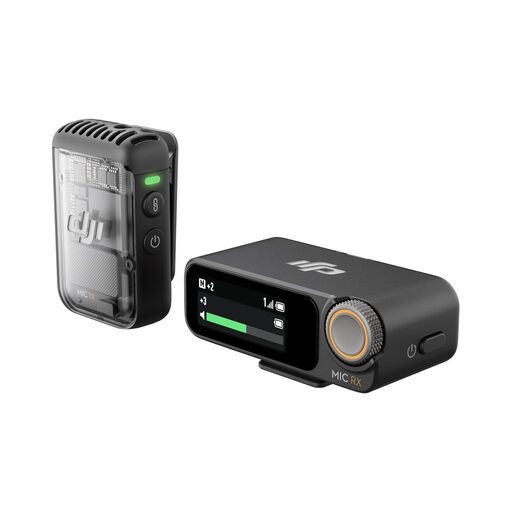 Image unavailable
This version lists one transmitter. You’ll need two recording setups if both the interviewer and interviewee are to have their own transmitter.
The product information lists internal 32-bit float recording and separate recording on the transmitter. Check the connection for your exact device.
 Image unavailable
The product title lists interviews and recording as possible uses. Check that the Type-C connection works with your recording device.
The title lists a Type-C interface. The product description gives a battery life of 3–6 hours.
Oral History recommends clipping the microphone around 15 cm below the mouth and making sure clothing doesn’t touch the capsule. Make a test recording in the clothes you’ll be wearing for the interview and listen back to it. This is recording advice, not a legal distance requirement.
No, the plug and input need to be compatible. For suitable phone use with the TRS plug on the Lavalier GO, RØDE specifies a TRS-to-TRRS adapter; a phone without a 3.5 mm port may also need an additional adapter. The Shure MVL has a TRRS plug and also needs a compatible input or adapter. Check your exact device and test the recording app.
Keep the original recording file and note who is speaking, where and when the conversation took place, and what it was about. Oral History highlights the importance of this metadata for finding and managing interviews. Also check that every expected file has actually been saved.
For each setup, check whether you’ll need batteries, adapters and storage media. BOYA lists an LR44 battery for the BY-M1; Zoom specifies two AAA batteries and microSD storage for the F2. For a consumer purchase in the Netherlands, the seller is responsible for the statutory guarantee if a product is faulty, as explained by the Netherlands Authority for Consumers and Markets.
An identifiable audio recording may be personal data. If the GDPR applies to your project, you need an appropriate legal basis for processing; consent is one option, but it isn’t automatically the only one. Publication also requires an assessment of the purpose and legal basis. The Dutch Data Protection Authority describes a limited exception for purely personal or household use. Which rules apply will depend in part on who is carrying out the project and whether the recording will be made public.