
Vandaag of morgen in huis

Kwaliteit gegarandeerd

Welkomstaanbiedingen ontgrendelen: GRATIS bezorging | Tot 80% korting | Gratis 30 dagen JoyPlus-proefperiode
Download de app
A bored dog will often find something to do for itself. That might be a cushion, chair or door frame. Interactive dog toys help combine exercise, chewing and time spent with you. However, not every toy is suitable for every dog.
The product name does not tell the whole story. A ball may be too large for a small dog, a rope can quickly start to fray and a squeaker may make a noise without the material being able to withstand vigorous chewing. Carrying out a few checks beforehand can help you avoid a disappointing purchase.
Terms such as durable dog toy, bite-resistant and chew-resistant refer to the material construction described in the product details. They do not guarantee that a dog toy will withstand every chewing session. A dog with strong jaws can still damage soft latex, fabric or seams.
So check:
Squeaky dog toys often attract attention quickly. In a flat, however, a constantly squeaking toy may be less convenient. Your dog may also try to bite the squeaker out. As soon as the inside becomes visible, you should replace the product.
A squeaky toy is particularly suitable when you can supervise your dog. For independent chewing, simple toys without small electronic or squeaking components may sometimes be more practical.
Fetching, tugging, chewing and mental stimulation require different features. A tug toy for a puppy may not be suitable for a medium-sized dog that chews powerfully. An interactive treat ball works differently from a dog fetching toy.
Start by choosing the purpose:
The size should suit your dog’s mouth and carrying ability. A 15 cm ball may be suitable for small and medium-sized dogs, but that does not automatically make it right for every dog in those categories. A toy that is too small could be swallowed, while one that is too large may be difficult to pick up.
Also look at the stated weight and shape. A ball with a handle is held differently from a smooth ball. For puppy toys, a soft shape that is easy to grip is often more practical, but supervision is still essential.
Common materials include latex, TPR, nylon, natural rubber, cotton, fleece and polyester. Each material has different properties:
Do not focus only on the material name. Also check the seams, fastenings, inner balls and loose accessories.
Washable dog toys are useful when playing outdoors, in water or during chewing sessions. Check in advance whether the product can be rinsed, needs to be cleaned with a damp cloth or must not be submerged.
Allow toys to dry completely and store them somewhere dry, out of direct sunlight and away from your dog when not in use. Inspect the toy before and after play. Replace it immediately if you notice cracks, deep grooves, loose parts, an exposed squeaker or a detached rope.
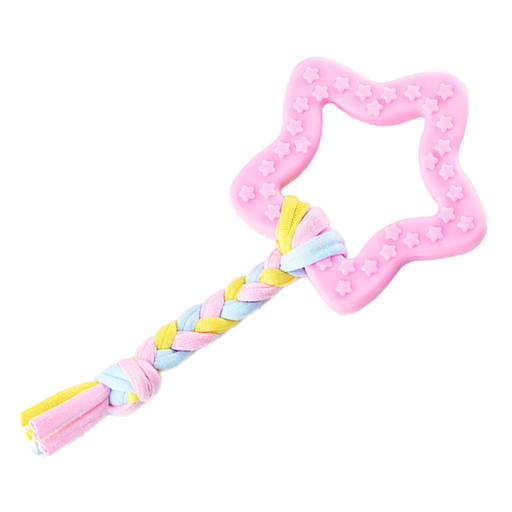
Why it suits this profile: This toy combines tugging, chewing and fetching in a compact 16.5 × 8 cm design. According to the product description, it is intended for puppies and small dogs.
The recommended target group and dimensions are clearly stated. The product is not intended for aggressive chewers or medium to large breeds.
TPR and fabric; suitable for tugging and chewing; can be cleaned by hand.

Why it suits this profile: The shape is designed to roll and bounce unpredictably. According to the product description, you can add snacks or xylitol-free peanut butter to provide extra entertainment.
The activity does not rely solely on sound or a battery. The shape and filling option provide variety, while the toy still needs to be checked regularly for damage.
Natural rubber; suitable for small and medium-sized dogs up to approximately 15 kg according to the product information; clean with warm soapy water and a soft brush.
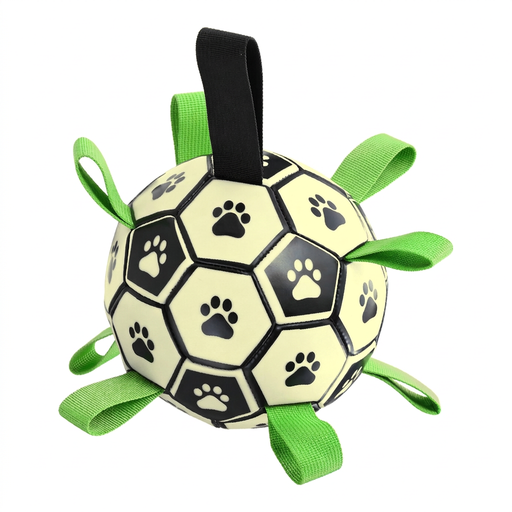
Why it suits this profile: For owners who want to play outdoors, this model features a nylon handle for throwing and tugging, a diameter of approximately 15 cm and a design for land and shallow-water play.
The intended use and size are clearly described. However, check the ball and nylon strap after every use; water resistance does not make the product indestructible.
Glow-in-the-dark effect according to the product description; nylon handle; suitable for throwing, tugging and fetching.
We have put together a complete, up-to-date list of products that fully meet these strict selection criteria and the applicable European safety regulations.
Choose a size that your puppy can hold securely and avoid small loose parts. Soft TPR or latex models may be suitable for gentle chewing, while a squeaky dog toy should always be used under supervision. Check the toy regularly, as puppies quickly learn how to reach seams and squeakers.
Lifespan depends on the material, frequency of use and chewing strength. A toy used for daily tugging and chewing will generally wear out faster than one used occasionally. There is no fixed usage period. Replace toys as soon as they tear, fray, crack or show loose parts.
Mechanical toys generally have no charging costs. Electronic balls need to be charged and require extra checks of the battery, cable and casing. A treat dispenser may also need regular refilling and cleaning. So do not compare only the purchase price; also consider maintenance, power requirements and how your dog uses the toy.
