
Vandaag of morgen in huis

Kwaliteit gegarandeerd

Welkomstaanbiedingen ontgrendelen: GRATIS bezorging | Tot 80% korting | Gratis 30 dagen JoyPlus-proefperiode
Download de app
A dog can greet a new toy with great enthusiasm, only to abandon it a few days later. That isn’t always the dog’s fault. Many poor purchases happen because of the wrong size, a material that doesn’t suit your dog’s chewing habits, or an interactive mechanism that adds little in practice.
With interactive dog toys, it’s not just about colour and shape. Instead, focus on how your dog plays, how often you’ll use the toy, and whether you can easily check and maintain it.
A product description might use terms like “chew-resistant” or “chew-proof”. According to the brand’s own product information, that doesn’t mean the toy is suitable for every dog. A strong chewer can damage even tough nylon, rubber, rope or plastic.
So, check the following:
A dog toy that is too small can be difficult to pick up and poses a risk if swallowed. A toy that is too large can be hard for a small dog to carry or move. Pay attention to the exact dimensions, not just the label “for dogs”.
Puppies also need extra supervision. Their play behaviour can change quickly as they grow. Toys that are suitable as puppy toys should therefore be reassessed regularly.
An interactive treat ball for dogs, a snuffle mat for dogs, or an electronic toy requires supervision and guidance. Some dogs understand a treat opening straight away, while others mainly try to bite the product open. A toy with sound or movement can also overstimulate some dogs.
Always use new products with your dog first. That way, you can see if they use the toy as intended.
For chew toys, the material is an important first consideration. Nylon, natural rubber, woven fabric and rope each have a different use profile.
Any claims about dental care should be taken with a pinch of salt. According to the product information from certain brands, chewing can help mechanically remove food debris or plaque. It does not replace regular dental care or advice from a vet.
Measure the toy and compare it with your dog’s mouth and body size. The zeze Bamboo Chew Toy, for example, is 12 × 5.5 × 2.5 cm without leaves and 22 × 5.5 × 2.5 cm with leaves. That makes the size relevant for small and medium-sized dogs.
For fetch dog toys, shape and grip are also important. A ball with a rope is usually easier to pick up than a smooth ball, while a compact toy is more practical for use in a flat or small garden.
With dog toys that hold treats, check whether the openings are suitable for the kibble or snacks you use. For snuffle products, choose dry snacks where possible and remove any leftovers after use. Wet food can get trapped in fabric or seams.
Electronic toys need extra attention for:
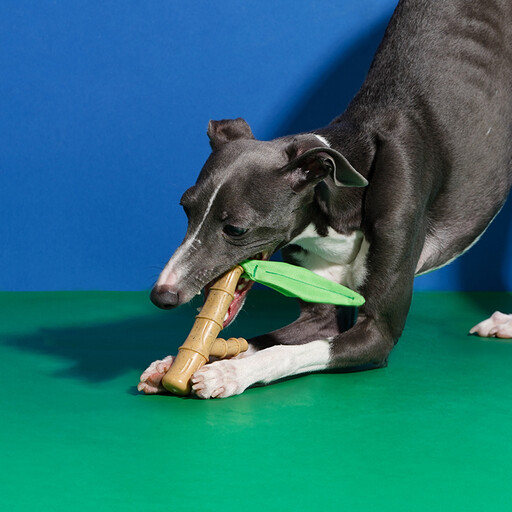
Why it fits this profile: A simple chew toy with no battery or complicated settings, and a shape that also works for fetch.
The product description mentions nylon and wood fibres with a high-pressure construction that is splinter-free according to the manufacturer. Still, check the surface regularly.
Dimensions of 12 or 22 cm, suitable for chewing and throwing, with a weight of approximately 0.06 kg.

Why it fits this profile: For those who want to combine chewing with rolling, bouncing and hiding treats.
The shape is designed for unpredictable rolling and bouncing, but the product information focuses on small and medium-sized dogs up to around 15 kg.
Natural rubber, suitable for kibble or xylitol-free peanut butter, and can be cleaned with warm water or on the top rack of the dishwasher.
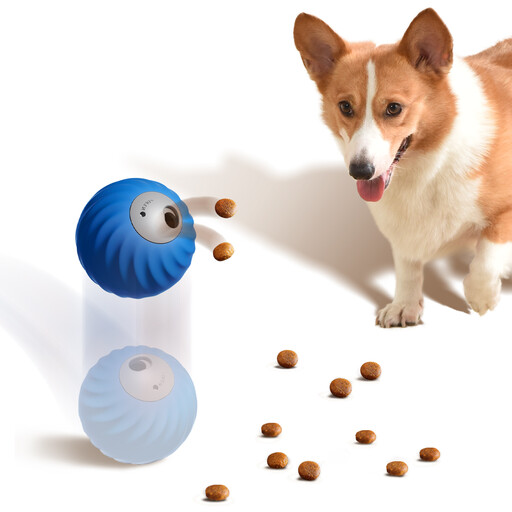
Why it fits this profile: For dog owners who want to combine exercise, treat rewards and independent play.
The ball has a designated compartment for snacks and two play modes. Supervise your dog, as the manufacturer warns against biting or dismantling parts.
Moving features, a replaceable plush cover and a USB-C rechargeable battery according to the product description.

Why it fits this profile: A compact alternative for cats that respond to a catnip toy or silvervine cat toy.
The outer layer is easy to inspect, and the product information advises replacement when the fabric or filling becomes damaged.
Size of 90 × 100 mm, with fleece, polyester fibre, catnip and silvervine according to the product description.
Alternate active play sessions with calmer activities. A rope toy for dogs is suitable for fetch or a controlled game of tug, while a snuffle mat takes more time for sniffing and searching. Don’t give every toy out all at once; by rotating them, you can better judge your dog’s interest.
Inspect toys before and after use. Look out for:
Stop using the toy if it’s damaged. If an animal swallows a large part, contact a vet immediately.
We’ve put together a full, up-to-date list of products that fully meet these strict selection criteria and comply with current European safety regulations.
Choose a size that the puppy can carry easily and avoid small loose parts. Start with short, supervised play and check the toy often. A soft toy or one with a clearly marked chewing section can be more practical than an electronic toy.
The lifespan depends on the material, play style and how often the toy is used. With a dog that chews heavily, a toy can wear out faster than with a dog that mainly fetches. There is no fixed usage period: replacing the toy as soon as it’s damaged is more important than a calendar date.
The main recurring costs are electricity, any replaceable covers and treats. Check before buying whether spare parts are available and whether the battery is rechargeable. With a USB-C model, you usually don’t need to buy separate batteries, but you do need to keep the charging port dry and clean.
