
Families with busy school mornings
A quick, predictable preparation method can be important before the school day begins. Individual portions save you measuring; extra-fine flakes offer another quick option, provided you have the equipment you need.


Choose individual sachets if quick preparation and no measuring are your priorities; choose fine oats from a pack if you want to decide the portion size yourself. In either case, compare fibre per 100 g and per portion used. If you have an allergy or coeliac disease, always check the latest label: according to the Netherlands Nutrition Centre, ordinary oats are not automatically suitable for someone with coeliac disease.
A quick, predictable preparation method can be important before the school day begins. Individual portions save you measuring; extra-fine flakes offer another quick option, provided you have the equipment you need.
The nutritional value per 100 g doesn’t automatically tell you how much fibre is in the portion you use. As a general guide, the Netherlands Nutrition Centre lists 4.4 g of fibre in 40 g of oats; the values for a particular product may differ.
For a specific allergy, the ingredients and allergens on the current packaging are what matter. If you have coeliac disease, oats require extra checking for the official Crossed Grain symbol; also check your school’s own policies if you’re sending food in with your child.
First decide whether a fixed portion or measuring it yourself better suits your morning routine. Then use the nutritional information and allergen label to compare products within that choice.
| What to consider | What to check when buying | Who it matters to |
|---|---|---|
| Quick preparation | Check the preparation method, time and equipment required. A stated preparation time of two minutes still assumes you can prepare the product as directed. | If there’s little time in the morning to measure and cook, I want a fixed portion that fits my routine. This convenience is the top priority for around 33% of consumers. |
| Fibre per portion | Compare fibre per 100 g with the amount you’ll actually use; check the ingredients too. | If fibre is your main concern, you’ll want to know what ends up in your bowl rather than relying only on a claim on the front of the pack. This is the top priority for around 27% of consumers. |
| Gluten and allergens | Read the current ingredients and allergen label. If you have coeliac disease, check for the official Crossed Grain symbol and separately take any school policies into account. | If someone in the family has a relevant allergy or coeliac disease, I need to know whether this particular product is suitable before using it or packing it. This check is the top priority for around 20% of consumers. |
| Choosing your own portion size | Check whether the pack contains individual sachets or whether you measure the oats out yourself, and how much you want to use for each breakfast. | If the amount you want varies from one morning to the next, I don’t want to be tied to a fixed sachet. This flexibility over portion size matters most to around 20% of consumers. |
Preparation time and portion size are two different things. Albert Heijn lists Quaker Oats Express Naturel sachets at 27 g each; this is not directly comparable with the general 40 g portion used in the Netherlands Nutrition Centre’s nutritional information.
Compare nutritional values per 100 g and per the amount you’ll actually eat, and check whether a sachet is the right size for your intended portion.
The Netherlands Nutrition Centre points out that oats can be contaminated with gluten during processing. The Quaker and Brinta products mentioned also list other cereals containing gluten as possible allergens.
If you have coeliac disease, check for the official Crossed Grain symbol and read the label on every new pack.
The ingredients can vary between oat products: Quaker Oats Express Protein lists soya protein, while Smaakt Haverzemelen lists several potential allergens.
As well as the nutritional information, read the full ingredients list and allergen information, especially if you’re sending the breakfast in with your child.
Oats Express Naturel is worth considering if you’re looking for individual portions to fit a quick morning routine.
Brinta Havermout is an option if you want to measure extra-fine flakes out of a pack yourself.
The range gives you options for comparing oats sold in packs with individually portioned products.
Golden Bridge fine wholegrain oats are worth considering if you prefer to measure portions out of a pack yourself.
Smaakt Haverzemelen is an addition to a breakfast you put together yourself, not a ready-to-eat instant porridge.
These products show two ways to plan a school breakfast with oats: Quaker Express for quick preparation, and Brinta Havermout if you want to measure portions out of a pack yourself. Compare the portion size, nutritional information and allergens for each product before choosing.
 No image available
For mornings when you don’t want to measure anything out yourself: the pack contains 12 individual sachets, and the description says they take two minutes to prepare.
Compare the fibre per 100 g with the amount per sachet shown in the current nutritional information. Check the allergen information too; if you have coeliac disease, you’ll need to check for the official Crossed Grain symbol.
 No image available
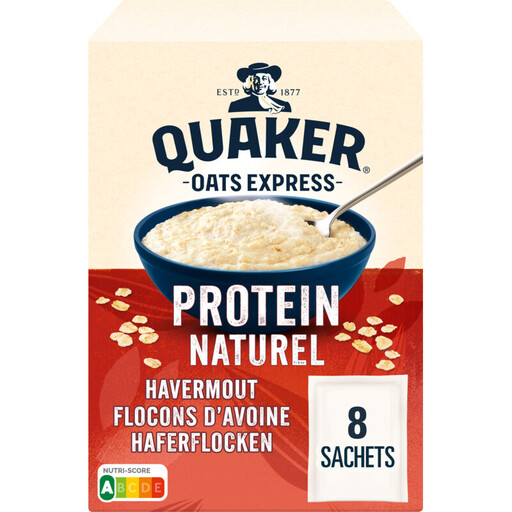
If you’re considering a quick-to-prepare oat product with added soya protein, the product description says it takes two minutes to prepare.
The ingredients list 85% wholegrain oats and 15% soya protein. Check the preparation instructions, fibre per portion used and current allergen information; wheat and barley may be present.
 No image available
If you want to measure out the amount for each breakfast yourself, this pack contains extra-fine oat flakes and lists 11 portions.
The ingredients list 100% oat flakes. Read the preparation instructions and fibre per portion used on the packaging; check the allergen information too, including the possible presence of wheat and rye.
Check the fibre per 100 g and work out how much that means for the portion you’ll actually eat. The Netherlands Nutrition Centre lists 4.4 g of fibre for a general 40 g portion of oats; for a branded product, always use its own nutritional information.
No. According to the Netherlands Nutrition Centre, oats can be contaminated with gluten during processing. If you have coeliac disease, check for the official Crossed Grain symbol on the packaging and read the current label.
Read the ingredients list and allergen information on the pack you’re using. The Netherlands Food and Consumer Product Safety Authority requires allergens to be clearly distinguished in the ingredients list; also look for statements about the possible presence of other allergens.
No: added protein alone doesn’t tell you whether the portion or ingredients are right for the breakfast you have planned. According to the product information, Quaker Oats Express Protein contains soya protein; compare its fibre per portion, ingredients and allergens with those of other options too.